8 Best CRM for Service Based Business in 2026
Compare the 8 best crm for service based business on price, free plans, booking and automation, with every price checked on November 12, 2026.
 Shamim Mia, Founder, SerpAstraLast verified November 12, 202614 min read
We compare pricing pages, documentation and public reviews. We never accept payment for rankings.

Key takeaways
- HubSpot Sales Hub is the best fit for most service businesses at $20/seat/month, with a free CRM for 2 users; Freshsales follows as the cheapest paid plan at $9/user/month billed annually, and Zoho CRM at $14/user/month billed annually.
- Field-service businesses should shortlist Jobber at $49/month and Housecall Pro at $59/month billed annually — general CRMs do not do quoting, dispatch or job scheduling.
- The single most important buying factor is what the price counts: per-seat CRMs scale with headcount, while Jobber, Housecall Pro and Keap charge per account, so a 5-person team pays very differently on each.
- Keap is the most expensive entry here at $249/month billed annually, plus a mandatory implementation fee — buy it only when email automation and payment chasing are the job.
On this page
Quick comparison
| Tool | Best for | Starting price | Free plan |
|---|---|---|---|
| HubSpot Sales Hub | Service businesses that want a free CRM now and one platform for sales, marketing and service as they grow | $20/seat/mo | Yes (free CRM) |
| Zoho CRM | Small service teams that want a real free plan and the cheapest paid CRM with automation built in | $14/user/mo (annual) | Yes (free plan) |
| Freshsales | Small sales teams that want phone, email and chat built into the CRM at the lowest paid price here | $9/user/mo (annual) | Yes (free plan) |
| Pipedrive | Solo reps and small teams that want the clearest visual sales pipeline and nothing else to learn | $14/user/mo (annual) | No (14-day trial) |
| Jobber | Solo home-service operators who need quoting, scheduling, invoicing and payments in one app | $49/mo | No (14-day trial) |
| Housecall Pro | Home-service crews that want scheduling, dispatch, reviews and marketing in one platform | $59/mo (annual) | No (14-day trial) |
| Keap | Established service businesses that want CRM, email automation, quotes, invoices and payments in one system | $249/mo (annual) | No (14-day trial) |
| Salesforce Sales Cloud | Service businesses that expect to scale past 10 staff and want the deepest customization and app ecosystem | $25/user/mo | Yes (Free Suite) |
Make one of these tools?
We re-check this list every quarter. Send a correction, request a review, or ask about a clearly labeled sponsored spot.
Request a listingThe best crm for service based business

HubSpot Sales Hub
Best for: Service businesses that want a free CRM now and one platform for sales, marketing and service as they grow
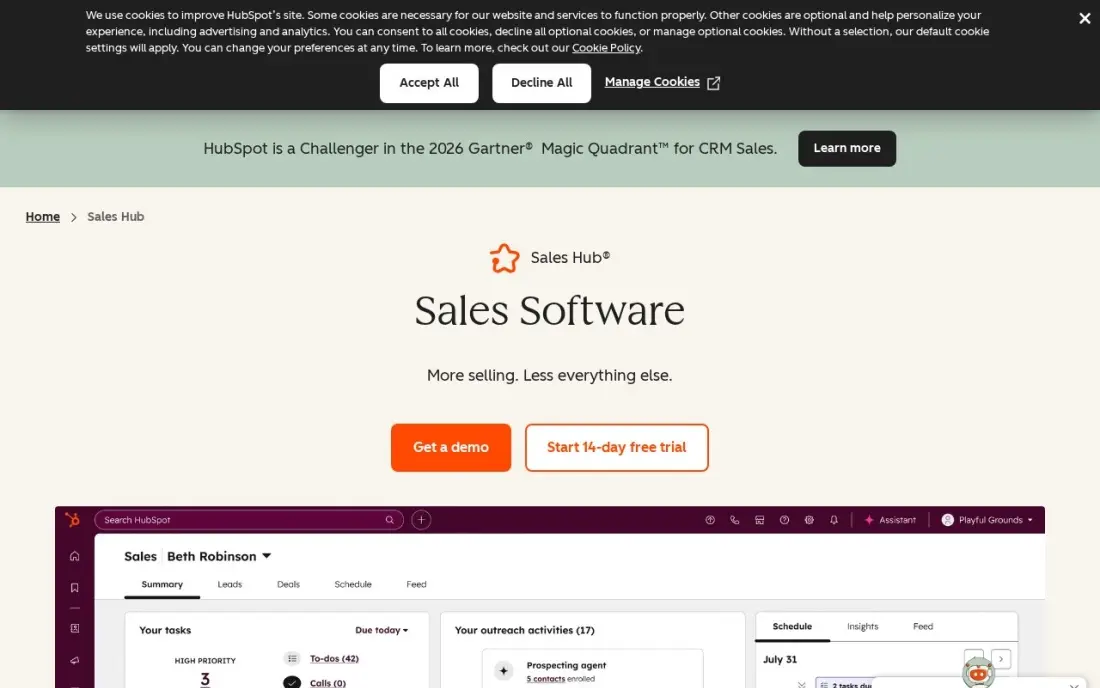
HubSpot Sales Hub is the safest default for a service business that sells by conversation: the free CRM covers up to 2 users and 1,000 contacts, and Starter costs $20 a seat a month, with a $7 a month new-customer rate for annual billing. Contacts, deals, email, tickets and marketing share one record, so a quote request, a follow-up call and a support ticket all sit on one customer page.
The catch is the jump to Professional. Sequences, forecasting and real automation start at $90 a seat a month, and there is no built-in quoting or job scheduling — a plumber or cleaner still needs a separate scheduling tool. Buy HubSpot when the business sells through calls, email and follow-up; buy Jobber or Housecall Pro when the job itself needs scheduling and dispatch.
What we like
- A genuinely free CRM for up to 2 users, so a solo operator can start at $0
- One shared record for contacts, deals, email, tickets and marketing, with no per-contact fees on Starter
- Starter seats cost $20 a month, with a $7 a month new-customer rate for annual billing
- More than 1,500 integrations, including QuickBooks, Stripe and Google Workspace
Watch out for
- The $7/seat new-customer Starter rate is a limited-time offer; the list price is $20/seat/month
- Real sales automation, sequences and forecasting wait for Professional at $90/seat/month
- No built-in quoting, scheduling or invoicing for field jobs — that work needs other tools or integrations

Zoho CRM
Best for: Small service teams that want a real free plan and the cheapest paid CRM with automation built in
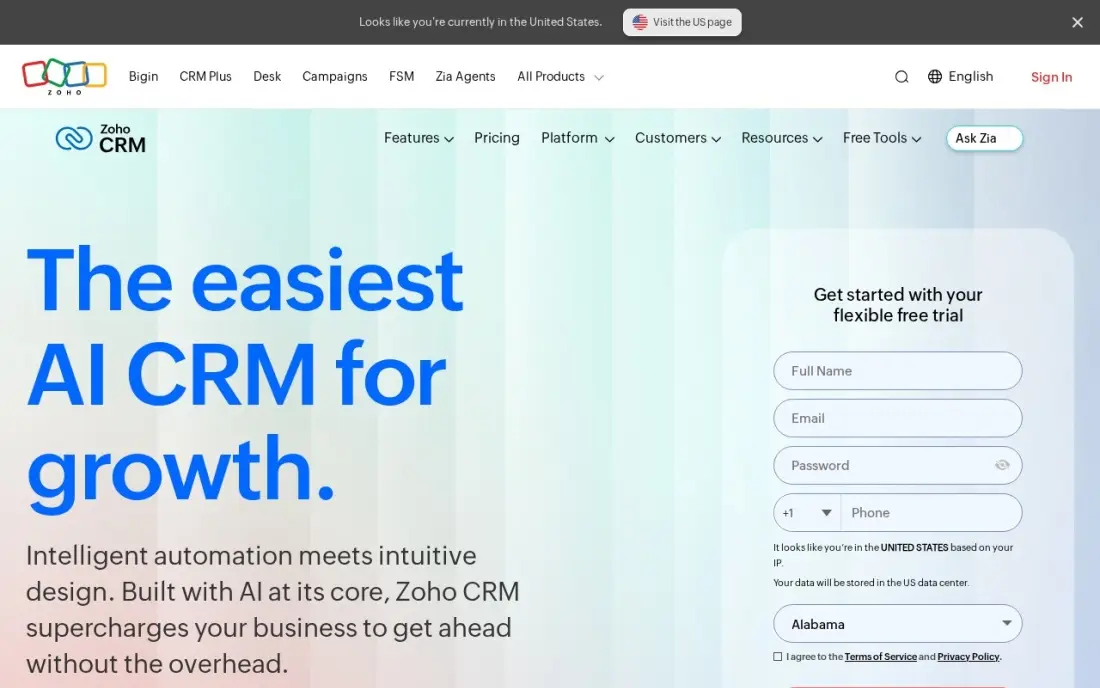
Zoho CRM is the value pick for a service team that wants automation without paying HubSpot prices. The free plan covers up to 3 users, and Standard costs $14 a user a month billed annually, or $20 billed monthly. That entry paid plan already includes workflow automation, email integration, mass email, built-in calling and sales forecasting — features other CRMs hold for a higher tier.
The limits are the free plan's ceilings and the AI gate. Three users and 5,000 records go fast once the business is busy, and Zia AI waits for Enterprise at $40 a user a month. Setup also takes longer than on Pipedrive or Freshsales, because the interface packs in more options. Choose Zoho when the budget is tight and the team will use the wider Zoho suite for invoicing and bookings.
What we like
- A real free plan for up to 3 users, with leads, contacts, deals and tasks included
- Standard at $14/user/month billed annually includes workflow automation, not just a contact list
- The wider Zoho suite adds invoicing, bookings and support without a second vendor
- Email integration, mass email and sales forecasting start on Standard, not a higher tier
Watch out for
- Zia AI, the built-in AI assistant, waits for Enterprise at $40/user/month
- The free plan covers only 3 users and 5,000 records, so a busy team outgrows it fast
- The interface packs in a lot of options, and setup takes longer than the simpler tools here

Freshsales
Best for: Small sales teams that want phone, email and chat built into the CRM at the lowest paid price here
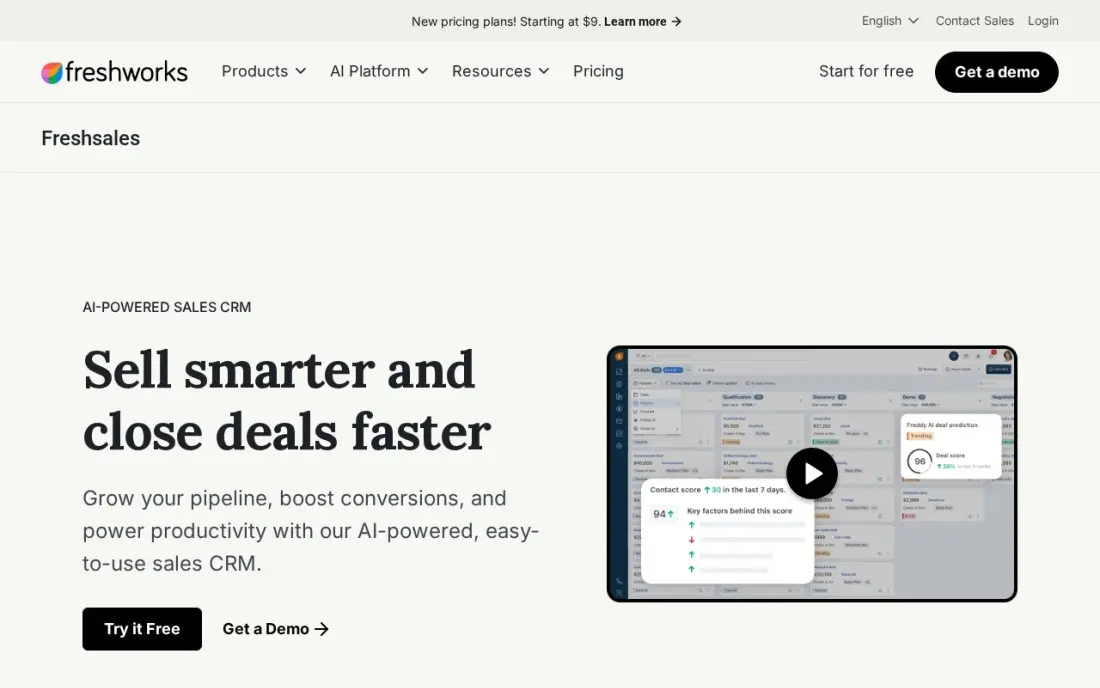
Freshsales is the cheapest paid CRM in this list, and it earns the spot by putting the phone in the product. Growth costs $9 a user a month billed annually, or $11 billed monthly, and includes a Kanban pipeline, lifecycle stages, built-in chat, email and phone, plus basic workflows. A service team can call a lead, log the call and send the follow-up email without leaving the CRM.
The step up is steep. Sales sequences, multiple pipelines and custom reports all wait for Pro at $39 a user a month — more than four times the Growth price — and branded documents cost another $19 a user a month on every plan. Pick Freshsales when the team sells by phone and email and wants the lowest paid entry; pick Zoho when sequences and reporting matter from day one.
What we like
- The cheapest paid plan here: Growth is $9/user/month billed annually
- Built-in phone, email and chat, so a service team makes calls without a second tool
- Basic workflows are included on Growth, not held for the top tier
- Free plan for up to 3 users covers the first months of a new service business
Watch out for
- Sales sequences, multiple pipelines and custom reports wait for Pro at $39/user/month
- Branded documents cost $19/user/month extra on every plan — more than double the Growth price
- The free plan is limited, and some reviewers report fewer native integrations than HubSpot or Salesforce

Pipedrive
Best for: Solo reps and small teams that want the clearest visual sales pipeline and nothing else to learn
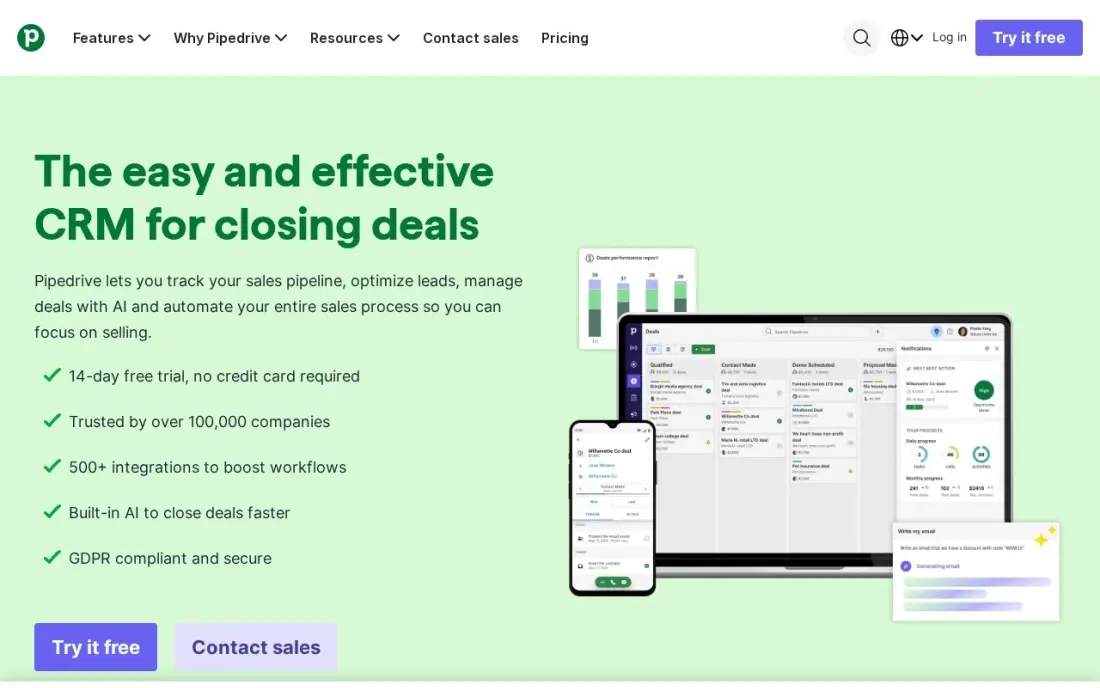
Pipedrive does one thing and does it well: a visual pipeline where every deal is a card you drag from one stage to the next. Lite costs $14 a user a month billed annually, or $24 billed monthly, and covers contacts, deals, activities, email integration and a mobile app. A service owner can see the week — who was quoted, who is waiting, who needs a nudge — at a glance.
Lite is thin: no workflow automation and no two-way email sync, so most teams move to Growth at $39 a user a month within a few months, and lead capture and document tools are paid add-ons. There is also no free plan, only a 14-day trial. Choose Pipedrive when the pipeline itself is the job; choose HubSpot when the team also needs marketing and service in the same record.
What we like
- The clearest visual pipeline in this list — deals move across stages by dragging a card
- Lite at $14/user/month billed annually is a low-cost start for a solo operator
- Email integration, activities and a mobile app are included from the entry plan
- More than 400 integrations cover invoicing, calendars and marketing tools
Watch out for
- No permanent free plan — only a 14-day trial
- Lite has no workflow automation and no two-way email sync; most teams need Growth at $39/user/month
- Lead capture, web visitors and document tools are paid add-ons, so the bill grows past the plan price

Jobber
Best for: Solo home-service operators who need quoting, scheduling, invoicing and payments in one app
Jobber is built for the way a home-service business actually works: a client books online, you send a quote, you schedule the job, you invoice and collect payment — all in one app. Core costs $49 a month billed monthly, or $29 billed annually, for one user, and includes online booking, scheduling, quotes, invoicing with online payments, a client hub and a basic website.
The one-user limit is the thing to plan around. A second person means moving to Connect, which is priced by team size, and the sales pipeline costs $49 a month extra on any plan. Card payments also add 2.9% plus 30 cents per transaction. Pick Jobber when you are a solo operator in cleaning, lawn care, plumbing or a similar trade; pick Housecall Pro when the crew is already five people.
What we like
- Built for field service: quoting, scheduling, invoicing, online booking and payments in one place
- Core at $49/month covers a solo operator with no per-job fees
- Clients get a self-serve hub for booking, quotes and payments
- More than 100 integrations, including QuickBooks and Google Calendar
Watch out for
- Core covers one user only — a second person means Connect, which starts higher
- The sales pipeline is a $49/month add-on, not included on Core
- Card payments cost 2.9% plus 30 cents per transaction on top of the plan price

Housecall Pro
Best for: Home-service crews that want scheduling, dispatch, reviews and marketing in one platform
Housecall Pro covers the whole home-service job: scheduling and dispatch, estimates, invoicing, online booking and payments, plus review management and marketing in the same platform. Basic costs $59 a month billed annually, or $79 billed monthly, for one user; Essentials covers up to 5 users and is the plan most small crews actually buy, at $149 a month billed annually or $189 billed monthly.
The awkward part is the pricing page itself, which leads with a questionnaire about trade, team size and goals and can show different prices after the answers. The figures here are the published no-quiz prices. There is no free plan, only a 14-day trial. Choose Housecall Pro when the crew is already several people and reviews and repeat bookings matter as much as the job board.
What we like
- Built for home service: scheduling, dispatch, estimates, invoicing and payments in one app
- Review management and marketing tools sit in the same platform as the job board
- Essentials covers up to 5 users, so a small crew shares one price
- Online booking and a customer portal cut down on phone tag with clients
Watch out for
- The pricing page leads with a questionnaire, so the published price is harder to find than on other tools here
- No free plan — only a 14-day trial — and Basic covers one user
- Card processing runs from 2.59% on top of the plan price, and the quiz can show higher prices for larger teams

Keap
Best for: Established service businesses that want CRM, email automation, quotes, invoices and payments in one system
Keap is the all-in-one pick for a service business that is done gluing tools together. There is one plan with every feature: CRM, email automation, appointments, quotes, invoicing and payments, for $249 a month billed annually or $299 billed monthly, with 2 users included. The visual automation builder handles the follow-up, reminders and payment chasing that eat a service owner's week.
The price is the honest barrier. At $249 a month it costs more than the other seven tools combined at their entry prices, and every new customer also pays a mandatory implementation package quoted by sales, starting at $500. Extra users cost $39 a month each. Buy Keap when the business already has steady revenue and automation is the bottleneck; do not buy it to run a first-year service business.
What we like
- One plan with every feature: CRM, email automation, appointments, quotes, invoicing and payments
- Visual automation builder handles follow-up, reminders and payment chasing without manual work
- Built for service businesses — the workflows match how a service firm actually sells and collects
- AI Plays automate lead follow-up and send-time decisions on the entry plan
Watch out for
- The entry price is $249/month billed annually — the highest here by a wide margin
- Every new customer pays a mandatory implementation package quoted by sales, starting at $500
- Leaving an annual plan early costs a $299 fee, and cancellation happens over the phone

Salesforce Sales Cloud
Best for: Service businesses that expect to scale past 10 staff and want the deepest customization and app ecosystem
Salesforce Sales Cloud is the enterprise default, and its Starter Suite is genuinely usable for a small service business: $25 a user a month, billed monthly or annually, covering leads, accounts, contacts, opportunities, built-in sales flows and email sync, with Slack included. A Free Suite covers up to 2 users, so a two-person firm can start without paying.
The real cost is everything past Starter. Pro Suite is $100 a user a month, Core is $195, and only Starter can be billed monthly — every higher edition is an annual commitment. Most serious rollouts also need a consulting partner, and that services bill can exceed the first year of licenses. Choose Salesforce when the business plans to scale past 10 staff and needs deep customization; choose HubSpot when a simpler platform will do.
What we like
- The deepest customization in this list, with the largest app marketplace behind it
- Starter Suite at $25/user/month covers leads, accounts, contacts, opportunities and email sync
- Free Suite covers up to 2 users for a business that is just starting
- Agentforce AI and Revenue Intelligence are available as add-ons when the team is ready
Watch out for
- Only Starter can be billed monthly; every higher edition is an annual commitment
- The step from Starter at $25 to Pro Suite at $100 per user is a fourfold jump
- Serious rollouts usually need a consulting partner, and that services bill can exceed the first year of licenses
The best crm for service based business is the one that matches how the work is actually sold and delivered: a consultancy sells by calls and proposals, a cleaning firm sells by bookings and repeat visits, and a plumber sells by quotes and dispatched jobs. We ranked the eight tools below by fit for the most common buyer — a US service business with a small team — starting with the general CRMs and ending with the field-service platforms, and every price was verified from the vendor's own pricing page on November 12, 2026.
How to choose the best crm for service based business
- Start with how the work is delivered. A business that sells by calls and proposals needs a general CRM such as HubSpot or Zoho CRM; a business that sends people to a site needs Jobber or Housecall Pro, which add scheduling, dispatch and job tracking.
- Count the seats, not the headline price. Per-seat CRMs charge for every user, while Jobber, Housecall Pro and Keap charge per account — a 5-person team pays $45–$125 a month on the general CRMs here and $149–$199 on the field-service ones.
- Check the free plan's real ceiling. HubSpot's free CRM covers 2 users, Zoho CRM's covers 3, and both stop being free the moment a fourth person needs access.
- Look for the feature that forces the upgrade. Sequences sit on HubSpot Professional and Freshsales Pro, automation sits above Pipedrive Lite, and the sales pipeline is a paid add-on on Jobber — the upgrade price is the real price.
- Confirm invoicing before you buy. Jobber, Housecall Pro and Keap invoice and collect payment in the app; the general CRMs need QuickBooks or Stripe, which adds cost and setup.
A CRM is only half the stack: the business also needs to be found. Our guide to CRM and invoicing software covers the billing side in more depth, and before you publish new service pages, run your titles through the free SERP snippet preview tool — it shows exactly how the title and description will look in Google.
Whatever you shortlist, try it with real jobs before you pay. The free plans and trials in this list are long enough to run one genuine week — your leads, your quotes, your bookings — and that week tells you more than any review can. Check two things in the trial: that a new enquiry becomes a scheduled job without retyping, and that the invoice goes out from the same record. Every tool here gives you a trial or a free plan, so there is no reason to buy before you have run real work through it.
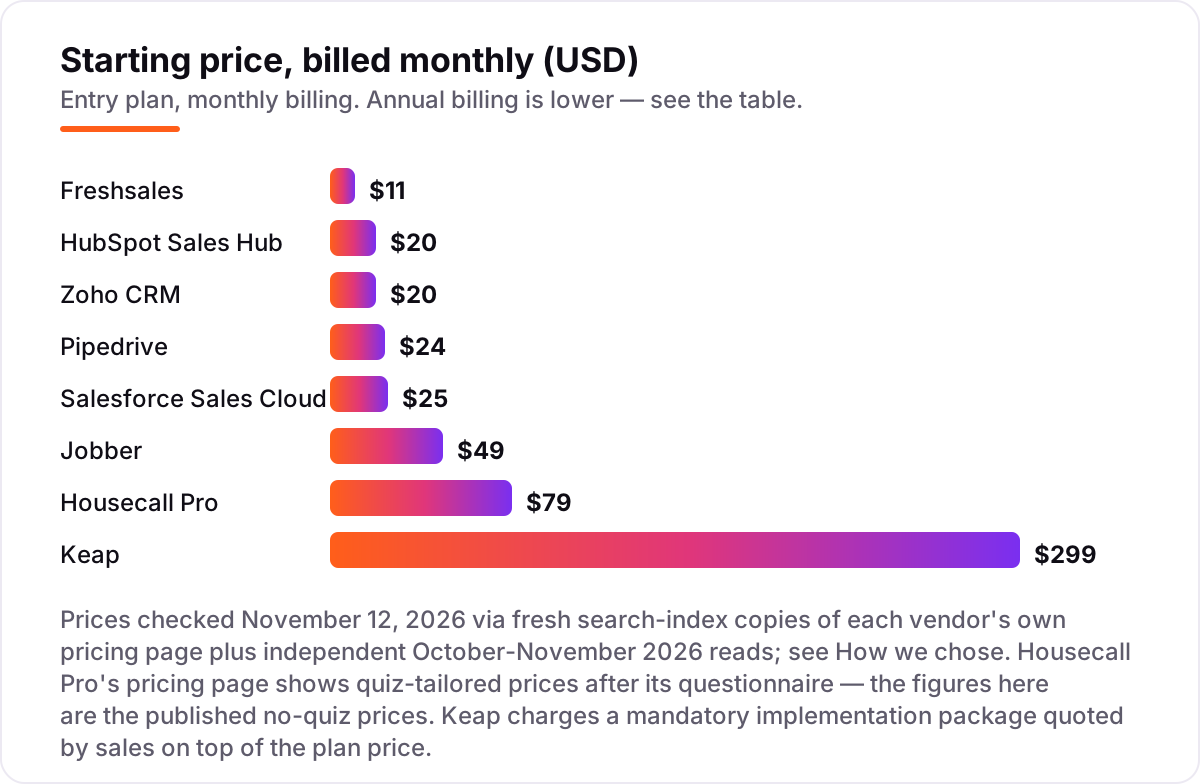
CRM for service based business pricing: what you will actually pay
Take a 5-person service team that sells by phone and email. On monthly billing, the licence costs $55 a month on Freshsales Growth, $100 on HubSpot Starter or Zoho CRM Standard, $120 on Pipedrive Lite and $125 on Salesforce Starter Suite. The same team on annual billing pays $45 a month on Freshsales, $70 on Zoho CRM or Pipedrive, and $100 on HubSpot — annual billing saves $10–$50 a month on the general CRMs, and it is worth taking once the team is settled.
A field-service crew pays differently, because the price is per account, not per seat. A 5-person crew costs $199 a month on Jobber Connect or $189 on Housecall Pro Essentials with monthly billing, and $99 or $149 a month respectively billed annually. Keap is the outlier: $299 a month billed monthly for 2 users, plus $39 a month for each of the 3 extra users, which comes to $416 a month — and the mandatory implementation package quoted by sales sits on top of that.
Over a year, the 5-person team pays $540 on Freshsales Growth billed annually, $840 on Zoho CRM Standard or Pipedrive Lite, $1,200 on HubSpot Starter, $1,500 on Salesforce Starter Suite, $1,188 on Jobber Connect billed annually, $1,788 on Housecall Pro Essentials billed annually, and $4,392 on Keap billed annually with 5 users. The same five people cost $540 a year at the cheap end and $4,392 at the dear end — a $3,852 gap that comes entirely from the pricing model and the automation included, not from headcount.
Three costs sit outside every number above. First, payment processing: Jobber charges 2.9% plus 30 cents per card payment, and Housecall Pro charges from 2.59%, so a business that takes $10,000 a month by card pays roughly $260–$290 in processing fees. Second, the add-ons: Jobber's sales pipeline is $49 a month, Freshsales branded documents are $19 a user a month, and Pipedrive's lead-capture tools are billed separately. Third, the setup: Keap's mandatory implementation package starts at $500, and Salesforce rollouts often need a consultant. If the business also needs to be found online, our monthly SEO service handles the visibility side — or compare providers in our guide to CRM and project management software.
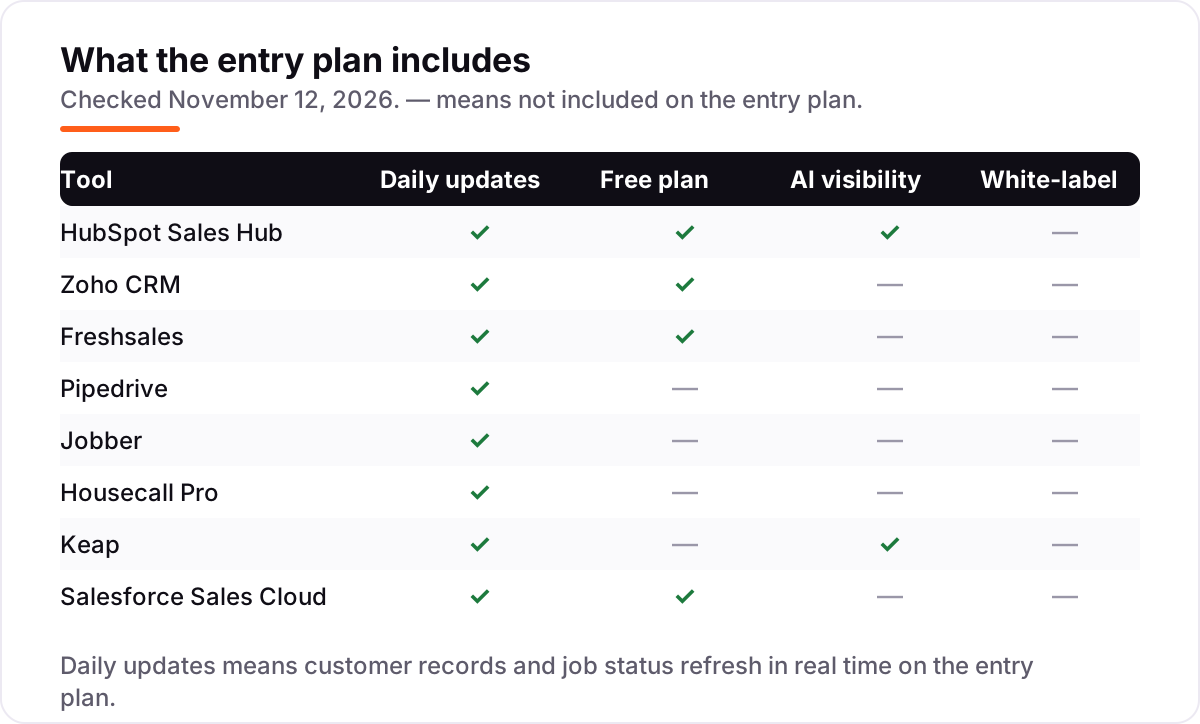
Know the difference: a CRM vs booking and dispatch software
The confusion in this category is between tracking a customer and running a job. A CRM tracks the relationship — the lead, the deal, the follow-up, the history — while booking and dispatch software manages the calendar, sends a technician to a site and tracks the job itself. A consultancy needs the first and can live without the second; a cleaning firm or plumber needs both, because the job is the product.
That is why this list splits in two. HubSpot, Zoho CRM, Freshsales, Pipedrive and Salesforce are general CRMs: they win at follow-up, pipelines and email, and they need a separate scheduling tool or integration to take bookings. Jobber and Housecall Pro are field-service platforms: they do quoting, scheduling, dispatch, invoicing and payments in one app, and their CRM features are simpler — a customer record and a job history, not a full sales pipeline.
Keap sits in the middle: it is a general CRM with strong email automation, quotes, invoicing and payments, but it has no dispatch board, so a crew that sends technicians to sites still needs scheduling elsewhere. The test is simple: if the business sends people to a customer's home or office, shortlist Jobber or Housecall Pro first and add a general CRM only if the sales process needs it; if the business sells from a desk, start with HubSpot, Zoho CRM or Freshsales.
Quick comparison: tool type by need
| Buyer | Best pick | Why |
|---|---|---|
| Most service businesses | HubSpot Sales Hub | Free CRM for 2 users, Starter is $20/seat/month, sales and service in one record |
| Tightest budget with automation | Zoho CRM | Free for 3 users, Standard is $14/user/month billed annually with workflows included |
| Cheapest paid plan | Freshsales | Growth is $9/user/month billed annually, with phone, email and chat built in |
| Simplest sales pipeline | Pipedrive | Visual drag-and-drop pipeline, Lite is $14/user/month billed annually |
| Solo home-service operator | Jobber | Quotes, scheduling and invoicing in one app, Core is $49/month for 1 user |
| Home-service crew of five | Housecall Pro | Dispatch, reviews and payments in one place, Essentials covers 5 users |
| Automation-first service firm | Keap | CRM, email, quotes and payments in one plan, $249/month billed annually |
| Scaling past 10 staff | Salesforce Sales Cloud | Deepest customization and app ecosystem, Starter Suite is $25/user/month |
Mistakes to avoid
- Budgeting on the promo price. HubSpot's $7 a seat Starter rate is a limited-time new-customer offer, and Jobber and Housecall Pro both run first-month discounts. The list price is what you pay once the offer ends, so compare tools on that number.
- Buying a general CRM for a field-service business. A pipeline does not dispatch a technician. If the team works on site, the scheduling, estimates and job tracking matter more than the deal stages — shortlist Jobber or Housecall Pro first.
- Ignoring the per-seat math. A $14 a user plan is cheap for one person and $70 a month for five; a $49 a month per-account plan is dear for one person and cheap for five. Price the whole team, not one seat.
- Forgetting payment processing. Card fees of 2.59–2.9% plus 30 cents per transaction sit on top of every plan here that takes payments, and on $10,000 of monthly card sales that is roughly $260–$290 a month.
- Paying for automation before the business needs it. Keap at $249 a month is a strong tool, but a business with ten clients a month does not need its automation builder — start on a free plan and upgrade when follow-up starts slipping.
How we chose
We verified each price from fresh search-index copies of the vendor's own pricing page, cross-checked against independent October and November 2026 reads, because the vendor pages could not be opened directly on November 12, 2026; where two independent reads agreed we used the figure, and where they conflicted we used the most recent direct read of the vendor page. Two prices changed on that basis: Freshsales Growth is $9/user/month billed annually, not the $15 figure still shown in older roundups, and Housecall Pro Basic is $59/month billed annually ($79 billed monthly), not the $49 figure in older listings. This list carries no review ratings because the G2 review pages were not opened on November 12, 2026, and we would rather show no rating than a stale or estimated one. No vendor paid for a place in this list, and none of the links here are affiliate links.
What to do next
Start with the free plan or trial of your top pick and run one real week of jobs through it. Check that a new enquiry becomes a quote and then a scheduled job without retyping, and that the invoice goes out from the same record. If the books are sorted but new customers are not finding you, our monthly SEO service handles the visibility side — or compare providers in our guide to construction CRM software. Once your tools are in place, find out what's holding your rankings back.
Frequently asked questions
What is the best CRM for a service based business?
HubSpot Sales Hub is the best fit for most service businesses: a free CRM for 2 users, then Starter at $20/seat/month with sales, marketing and service in one record. Field-service firms should shortlist Jobber or Housecall Pro instead, since general CRMs do not schedule or dispatch jobs.
How much does a CRM for a service business cost?
Entry prices run from $0 to $249 a month. HubSpot, Zoho CRM and Freshsales all have free plans, and the cheapest paid plans cost $9–$20 per user a month. A 5-person team typically pays $45–$125 a month for a general CRM, or $149–$199 a month for a field-service platform.
Is there a free CRM for service based businesses?
Yes, with limits. HubSpot's free CRM covers 2 users and 1,000 contacts, Zoho CRM's free plan covers 3 users, Freshsales is free for up to 3 users, and Salesforce offers a Free Suite for 2 users. None of the field-service tools here — Jobber, Housecall Pro or Keap — has a free plan.
Do I need a field-service CRM or a general CRM?
It depends on how the work is delivered. A general CRM such as HubSpot or Zoho fits businesses that sell by calls, email and quotes. A field-service platform such as Jobber or Housecall Pro fits businesses that send people to a site, since it adds scheduling, dispatch, estimates and job tracking.
What is the difference between a CRM and booking software?
A CRM tracks the customer relationship — leads, deals, follow-up and history — while booking software manages the calendar and takes appointments. Jobber and Housecall Pro do both, which is why they suit trades. A general CRM needs a separate scheduling tool or integration to take bookings.
Can I switch CRMs later?
Yes, but plan the move at a quiet point in the year. Export contacts, deals, notes and open quotes from the old tool, import them into the new one, and check that every active deal and scheduled job carried over before you cancel. Switching mid-season means running two systems while jobs are live.
Does a CRM include invoicing and payments?
Sometimes. Jobber, Housecall Pro and Keap include invoicing and payments, so a job can be quoted, done and paid in one app. HubSpot, Zoho CRM, Freshsales, Pipedrive and Salesforce need an integration such as QuickBooks or Stripe for invoicing, which adds cost and setup.
Sources we checked (8)
- HubSpot Sales Hub pricing — hubspot.com/pricing/sales (checked November 12, 2026)
- Zoho CRM pricing — zoho.com/crm/zohocrm-pricing.html (checked November 12, 2026)
- Freshsales pricing — freshworks.com/crm/pricing (checked November 12, 2026)
- Pipedrive pricing — pipedrive.com/pricing (checked November 12, 2026)
- Jobber pricing — getjobber.com/pricing (checked November 12, 2026)
- Housecall Pro pricing — housecallpro.com/pricing (checked November 12, 2026)
- Keap pricing — keap.com/pricing (checked November 12, 2026)
- Salesforce Sales Cloud pricing — salesforce.com/sales/pricing (checked November 12, 2026)
Make one of these tools?
We re-check this list every quarter. Send a correction, request a review, or ask about a clearly labeled sponsored spot.
Request a listingShamim
Founder of SerpAstra
A full-stack SEO and digital marketer who spends most days on Local SEO for dental practices, AI search visibility and lead generation.
Free SEO and AI visibility audit
Find out what is holding your rankings back
Send us your site. Within 2 business days you get a written audit, an AI visibility check and a short fix list ranked by impact. Free, with no contract attached.
Request my free audit→Related buying guides
 Accounting & Finance10 Best CRM and Invoicing Software in 2026, ComparedCompare the 10 best crm and invoicing software tools on price, free plans, native invoicing and CRM depth, with every price checked November 12, 2026.Read guide →
 Sales & CRM8 Best CRM and Project Management Software in 2026, ComparedCompare the 8 best crm and project management software tools on price, free plans and project features, with every price checked November 12, 2026.Read guide →
 Construction & Field Service12 Best Construction CRM Software in 2026, ComparedCompare the 12 best construction crm software options for builders and remodelers on price, free plans and fit, with every price checked November 12, 2026.Read guide →