8 Best Sales Analytics Tools in 2026, Compared
Compare the 8 best sales analytics tools, from CRM reporting to call intelligence and KPI dashboards, on forecasting, data sources and real per-user price.
 Shamim Mia, Founder, SerpAstraLast verified November 2, 20268 min read
We compare pricing pages, documentation and public reviews. We never accept payment for rankings.
Key takeaways
- Most sales analytics starts in the CRM: Zoho CRM includes sales forecasting from $14 a user a month billed annually, and HubSpot's free CRM covers two users.
- Salesforce Sales Cloud has the deepest ceiling from $25 a user a month billed annually, but its AI sits on higher tiers and most teams pay for setup help.
- Gong is the pick for analysing what happens on calls and linking it to pipeline health, but it is quote-only and an enterprise purchase.
- For a sales dashboard on the office TV, Databox has a free plan with 3 data sources and Klipfolio covers unlimited users for $120 a month billed annually.
On this page
Quick comparison
| Tool | Best for | Starting price | Free plan |
|---|---|---|---|
| Salesforce Sales Cloud | B2B sales teams with complex deals that want reporting that scales past 20 reps | $25/user/mo | No (30-day trial) |
| HubSpot Sales Hub | Growing teams that want sales reports inside the CRM with no data syncing | $20/seat/mo | Yes (free CRM) |
| Zoho CRM | Budget-conscious small teams that want forecasting on the first paid plan | $20/mo | Yes (3 users) |
| Pipedrive | Small sales teams that want a clear visual pipeline with basic reporting | $24/mo | No (14-day trial) |
| Gong | B2B revenue teams that want analytics built from what reps actually say on calls | Custom quote | No (demo only) |
| Databox | Sales and marketing teams that want live KPI dashboards from many tools | $89/mo | Yes (free plan) |
| Power BI | Microsoft-based companies that want to combine CRM, finance and sales data in one report | $14/user/mo (annual) | Yes (Desktop free) |
| Klipfolio | Small teams that want flat-priced sales dashboards shared with unlimited users | $140/mo | No (14-day trial) |
Make one of these tools?
We re-check this list every quarter. Send a correction, request a review, or ask about a clearly labeled sponsored spot.
Request a listingThe best sales analytics tools

Salesforce Sales Cloud
Best for: B2B sales teams with complex deals that want reporting that scales past 20 reps
Salesforce Sales Cloud is the reporting backbone for many large sales teams because everything — accounts, leads, opportunities and custom objects — sits in one model you can report across. Starter costs $25 a user a month billed annually, there is a 30-day free trial, and the AppExchange marketplace adds specialised analytics apps when the built-in reports run out.
The depth costs effort. There is no free plan and no monthly billing, Einstein AI and workflow automation sit on higher tiers than Starter, and most small teams need an admin or partner to set up the fields and stages that make reports trustworthy. Choose it when the sales process is complex and the team will keep growing.
What we like
- The deepest customization in this list, with the largest app marketplace (AppExchange) behind it
- Starter covers accounts, contacts, leads and opportunities for $25/user/month billed annually
- Scales from a 5-person team to thousands of users on one platform, with no migration later
Watch out for
- No free plan and no monthly billing — annual contracts only, so the first invoice is a full year
- Einstein AI and workflow automation sit on higher tiers, not on Starter
- Setup usually needs an admin or a partner, so small teams pay for implementation help on top of the licence
HubSpot Sales Hub
Best for: Growing teams that want sales reports inside the CRM with no data syncing
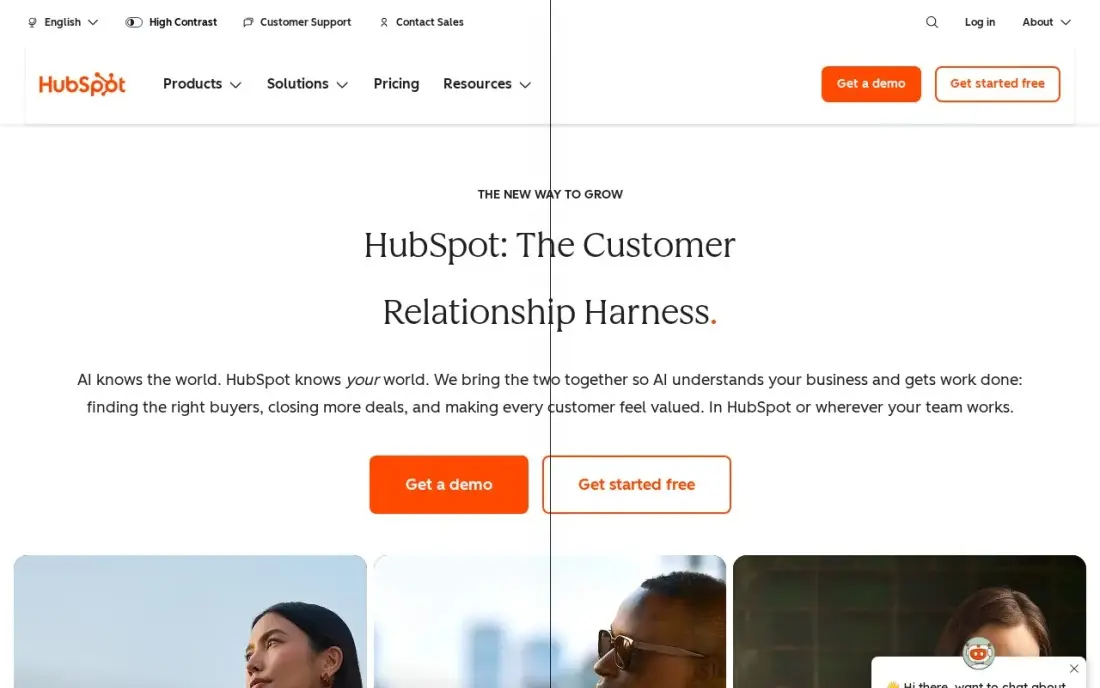
HubSpot Sales Hub keeps leads, deals, emails and reporting in one place, so a sales manager reads pipeline numbers without exporting anything. The free CRM covers two users, and Starter lists at $20 a seat a month with a second pipeline, 500 HubSpot Credits a month and the Prospecting Agent. Its 13,909 G2 reviews average 4.4 out of 5.
The analytics most managers want arrive on Professional, which costs $90 a seat a month plus a mandatory $1,500 onboarding fee, so a ten-person team faces a large step up. The $7 Starter price on the page is a new-customer promotion, not the standing rate. It suits a team already marketing in HubSpot.
What we like
- Free CRM for up to 2 users, and Starter removes HubSpot branding and adds a second pipeline
- Prospecting Agent and Breeze AI agents are included from Starter
- 500 HubSpot Credits a month and 50 workflows come with Starter
- Deepest native CRM in this list: deals, sequences and reporting in one place
Watch out for
- Starter is $20 a seat a month at list — the $7 figure is a new-customer promotion only
- Professional jumps to $90 a seat plus a mandatory $1,500 onboarding fee
- Per-seat pricing scales fast: ten seats on Starter cost $2,400 a year at list

Zoho CRM
Best for: Budget-conscious small teams that want forecasting on the first paid plan
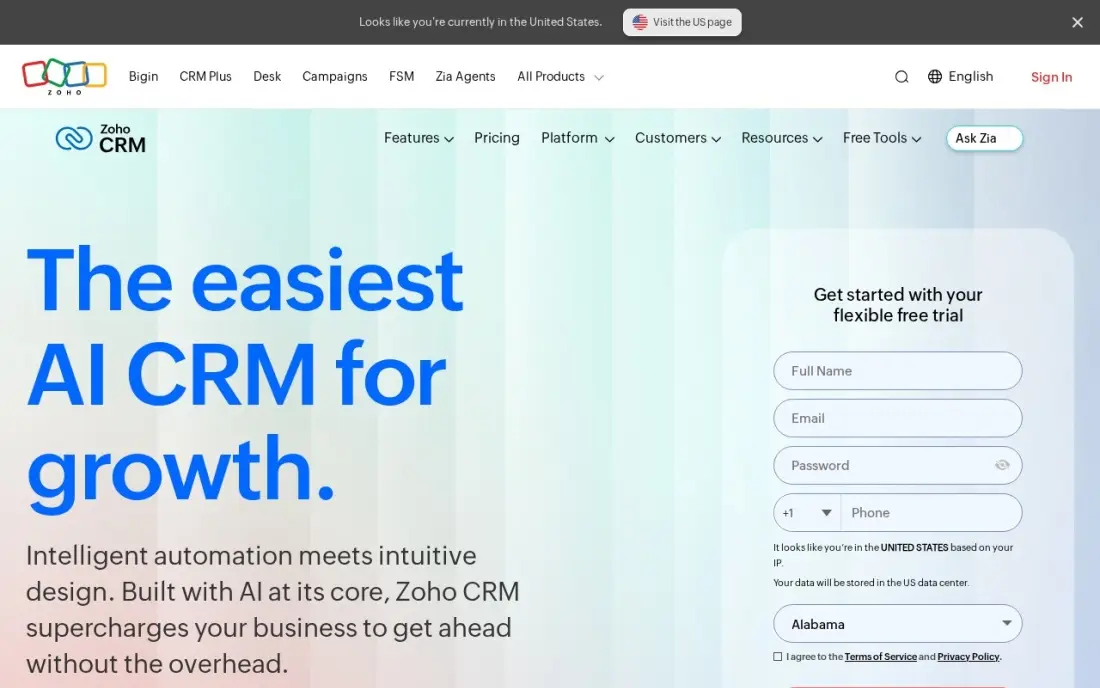
Zoho CRM gives small teams real sales analytics at the lowest price in this list. The free plan covers up to three users, and Standard at $14 a user a month billed annually, or $20 monthly, adds sales forecasting, five pipelines and built-in calling. Professional costs $23 and Enterprise $40, so the climb between tiers is gentle.
The predictive layer sits higher up: Zia, Zoho's AI assistant, predicts deal outcomes and flags anomalies only on Enterprise. G2 reviewers rate ease of setup lower than rivals, and support and storage add-ons sit outside the seat price. Pick it when you need forecasting this quarter and cannot justify Salesforce.
What we like
- Free plan covers up to 3 users with pipelines, leads and contacts — the only free tier here that fits a tiny team, not just a solo user
- Zia, Zoho's AI assistant, predicts deal outcomes, flags anomalies and suggests the best time to contact a lead on Enterprise and the top tier
- The cheapest full-featured ladder here: Standard $14, Professional $23 and Enterprise $40 a user a month billed annually
Watch out for
- Zia's predictions and AI features need Enterprise at $40 a user a month — Standard buyers get scoring rules, not the AI assistant
- G2 reviewers rate ease of setup 8.0, the lowest here, and support scores trail HubSpot and Pipedrive
- Add-ons for support tiers, storage and training sit outside the seat price, so the invoice can exceed the plan price

Pipedrive
Best for: Small sales teams that want a clear visual pipeline with basic reporting
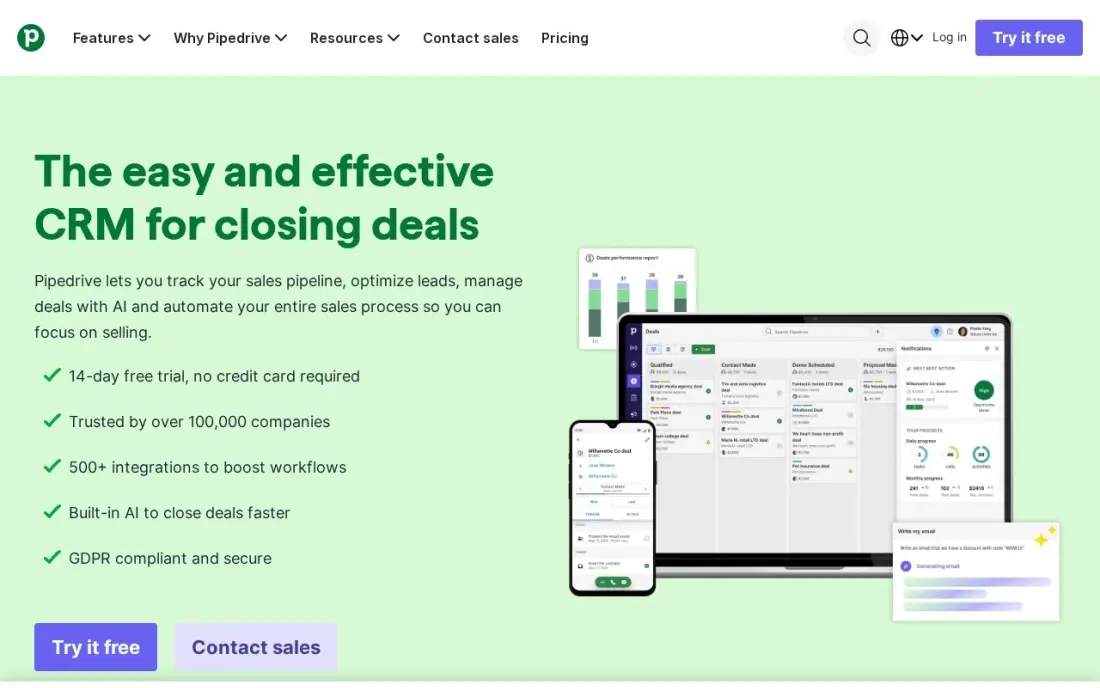
Pipedrive turns the pipeline itself into the main report: deals sit as cards in stages, so a manager sees stuck deals at a glance, and Lite at $14 a user a month billed annually, or $24 monthly, includes contacts and basic reporting. There are no onboarding fees or seat minimums, and a 14-day trial lets you load real deals.
Lite has no two-way email sync and no AI. Nova, the assistant that briefs reps and keeps deal records current, starts on Growth at $39 a user a month billed annually, and LeadBooster and Smart Docs are paid add-ons. It suits teams that want visibility without a reporting project.
What we like
- The clearest visual pipeline in this list: drag-and-drop deals, custom stages and a mobile app reps actually use
- AI assistant Nova briefs reps before calls and keeps deal records current from the Growth plan up
- No onboarding fees and no seat minimums, so a two-person team pays for two seats and nothing else
Watch out for
- Lite has no two-way email sync and no AI — Nova starts on Growth at $39 a user a month billed annually
- LeadBooster, Smart Docs and Projects are paid add-ons, so the real bill is higher than the plan price
- No free plan, only a 14-day trial, and monthly billing costs $24 against $14 on annual billing

Gong
Best for: B2B revenue teams that want analytics built from what reps actually say on calls
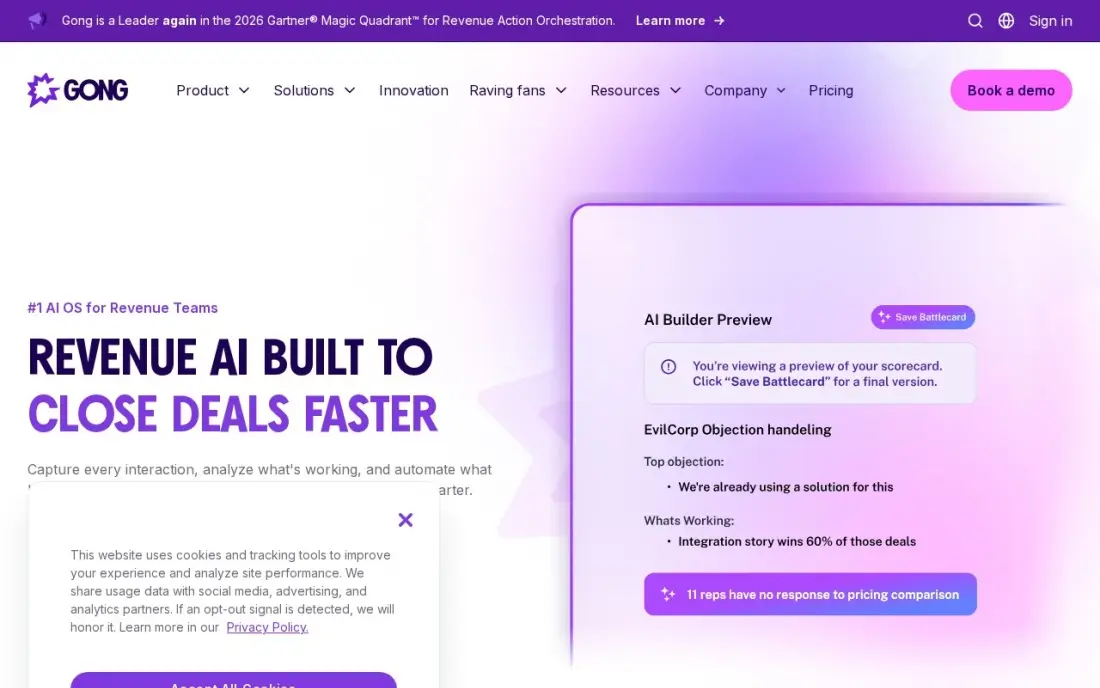
Gong measures the part of selling a CRM cannot see: the conversation. Every call is recorded and analysed, with AI summaries, trackers and deal boards that link talk to pipeline health and forecasts. It scores 4.7 on G2 from more than 6,600 reviews and integrates deeply with Salesforce and HubSpot, so its signals sit next to the deal record.
It is an enterprise purchase. Gong publishes no price; buyer reports put core licences around $1,300 to $1,600 a user a year plus a mandatory platform fee, and implementation usually takes four to eight weeks. There is no free trial. Buy it once CRM reporting is clean and the next question is why deals stall.
What we like
- Records and analyzes every sales call, with AI summaries, trackers and coaching cues tied to real conversations
- Deal boards and forecasting link what was said on calls to pipeline health
- The largest review base in this list — 6,679 G2 reviews — with deep Salesforce and HubSpot integrations
Watch out for
- No published pricing — buyer reports put core licences around $1,300-$1,600/user/year plus a mandatory platform fee
- Implementation typically takes 4-8 weeks and usually needs paid professional services
- Premium pricing puts it out of reach for small teams

Databox
Best for: Sales and marketing teams that want live KPI dashboards from many tools
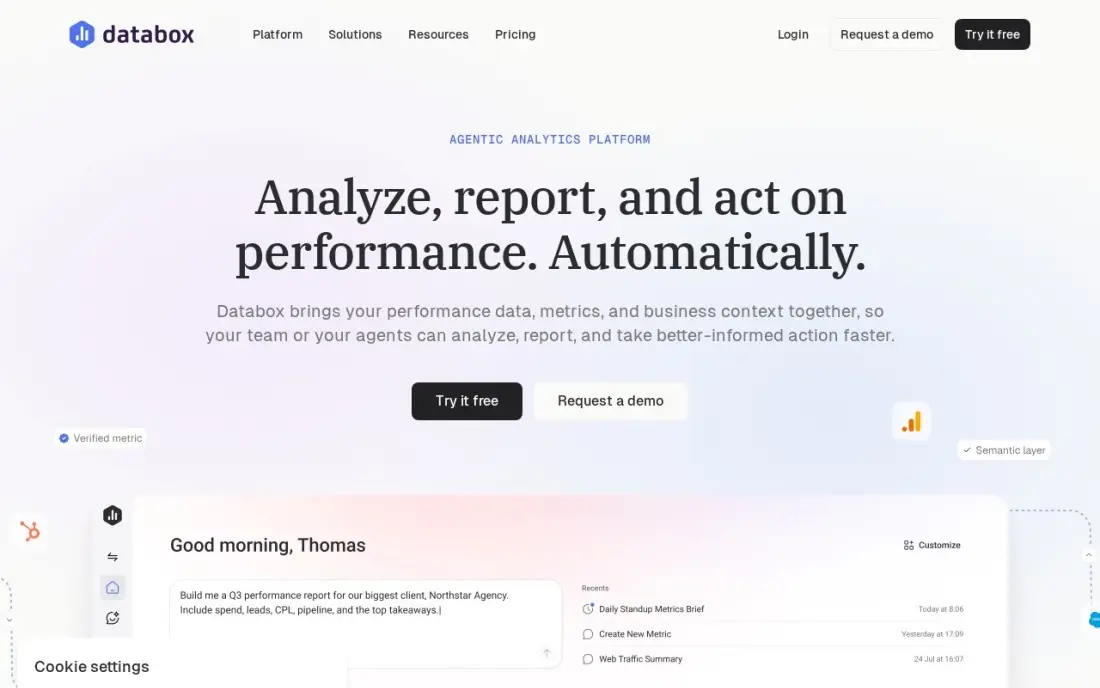
Databox pulls sales numbers from more than 130 connectors — CRMs, ad platforms and support tools — into KPI dashboards, scorecards and mobile alerts. The free plan covers one user and three data sources, and Genie AI Analyst, which explains what changed in your metrics, works even on the free plan. Analyst costs $71 a month billed annually, or $89 monthly.
Its plans count users and sources. Analyst covers one user and five sources, so a ten-person team needs Team Scale at $319 a month billed annually, and white-label dashboards cost $200 a month extra. It is built for tracking agreed KPIs, not deep ad-hoc analysis, which suits most sales floors.
What we like
- A free plan with 3 data sources and 50 AI credits a month
- Genie AI Analyst is available even on the free plan
- 130+ connectors built for marketing and sales KPIs
- Scorecards and mobile alerts keep metrics in front of the team
Watch out for
- Analyst covers 1 user and 5 sources, so a team of 10 needs the $319 Team Scale plan
- White-label client dashboards are a $200 a month add-on
- It is built for KPI tracking, not for deep ad-hoc analysis

Power BI
Best for: Microsoft-based companies that want to combine CRM, finance and sales data in one report
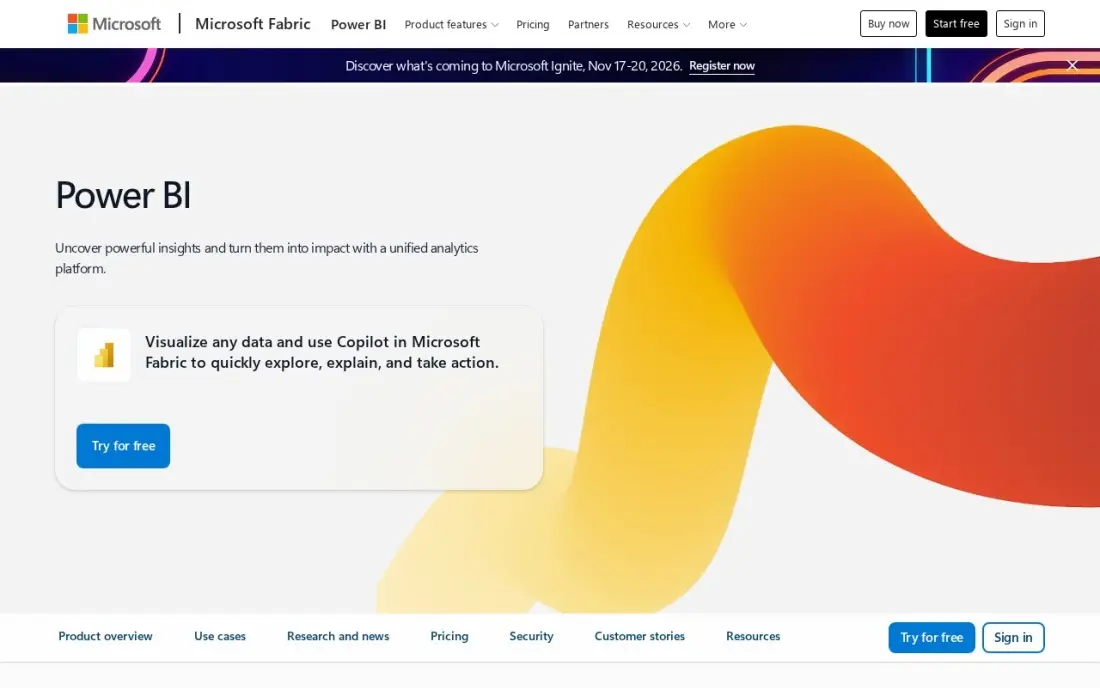
Power BI is the analytics tool to choose when sales data must be joined with finance, product or operations data. Pro costs $14 a user a month billed annually, the free Desktop app lets an analyst build reports before paying, and the Microsoft 365, Teams and Azure integration is deeper than any rival's.
Budget for the audience, not just the author: every viewer of a shared report needs a paid licence, and Copilot needs Premium Per User at $24 a user a month. It also needs someone who can model data. Pick it when your company runs on Microsoft and sales reporting has outgrown the CRM's own dashboards.
What we like
- The cheapest published entry here at $14/user/month, with a genuinely free Desktop app
- Copilot in Fabric answers questions and builds visuals inside the tool teams already use
- Deep integration with Microsoft 365, Teams and Azure — including OneLake and Fabric
Watch out for
- Pro rose to $14/user/month — the $10 figure in older roundups is stale
- Sharing and publishing need a paid license for every viewer, not just creators
- Copilot and advanced AI features need Premium Per User at $24/user/month
Klipfolio
Best for: Small teams that want flat-priced sales dashboards shared with unlimited users
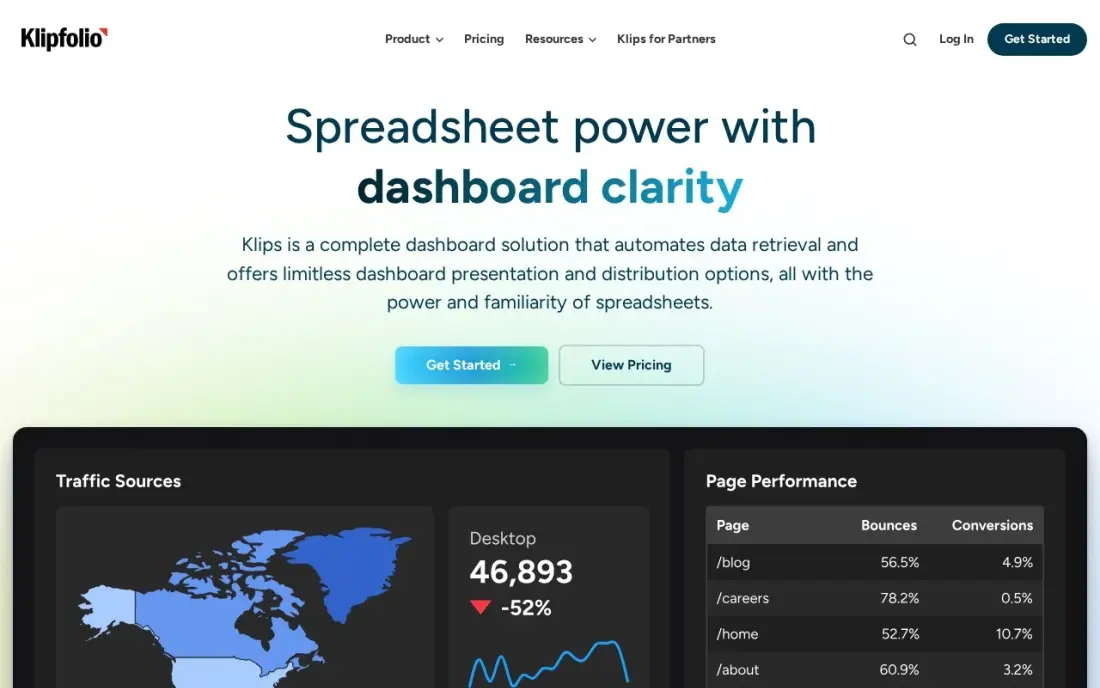
Klipfolio prices dashboards by the account, not the seat: Base costs $120 a month billed annually, or $140 monthly, for unlimited users, so every rep can see the leaderboard without adding licence cost. More than 130 connectors and a formula bar let you build custom metrics, and your logo is included on Base. G2 reviewers rate it 4.5.
Base allows only three dashboards and refreshes data every four hours, so it suits a daily sales screen rather than live call-floor numbers. Its AI analyst is listed as coming soon, and there is no free plan. Choose it when you want one shared sales dashboard for the whole company.
What we like
- Flat pricing: $120 a month billed annually for unlimited users
- Your own logo on dashboards is included on the Base plan
- 130+ connectors and a formula bar for custom metrics
- A simple builder that non-technical users can learn quickly
Watch out for
- Base allows only 3 dashboards
- The AI analyst is listed as coming soon, not shipped
- Data refreshes every 4 hours on Base, not on demand
The best sales analytics tools answer three questions a sales manager asks every week: what is in the pipeline, what will close and why some deals stall. We compared eight tools across the three ways teams get those answers — CRM reporting, conversation intelligence and dashboard software — on data sources, forecasting, AI and the real per-user bill. Every price below comes from the vendor's own pricing page as checked in November 2026.
How to choose the best sales analytics tools
- Fix the data before buying analytics. A dashboard on top of half-filled deal stages shows wrong numbers faster; clean fields and stage rules come first.
- Start in the CRM you already use. Most pipeline, win-rate and forecast reports live in the CRM, and a separate tool only adds value once those are trusted.
- Decide who needs to see the numbers. Per-viewer pricing in BI tools adds up when the whole sales floor needs access; flat-priced dashboards avoid that.
- Check the data sources. If you want revenue next to ad spend or support tickets, count the connectors and the source limit on each plan.
- Find out where forecasting and AI sit. Predictions and AI assistants often live on a higher tier than the entry price.
- Ask how fresh the data is. Some dashboards refresh every few hours, which is fine for a weekly review and wrong for a live call floor.
Sales analytics shows which channels bring revenue; if organic search is one of them, our monthly SEO service grows it, and the free UTM builder tags campaign links so leads arrive in the CRM with a clean source.
Sales analytics tools pricing: what you will actually pay
Take a ten-rep team. CRM reporting on Zoho CRM Standard costs $140 a month billed annually, or $1,680 a year; billed monthly at $20 it is $2,400 a year. Pipedrive Lite costs the same $14 a user billed annually but $24 monthly, and Salesforce Starter costs $250 a month, or $3,000 a year, with annual billing only. HubSpot Sales Hub Starter lists at $20 a seat, or $2,400 a year for ten.
Dashboards add a second line. Klipfolio Base covers all ten reps for $120 a month billed annually, or $1,440 a year. Databox needs Team Scale at $319 a month billed annually for a ten-person team, about $3,828 a year. Power BI Pro costs $14 a user billed annually, so ten viewers cost $1,680 a year, rising to $2,880 on Premium Per User at $24 if you want Copilot. Gong publishes no price; buyer reports put it around $1,300 to $1,600 a user a year plus a platform fee.
Know the difference: CRM reporting vs business intelligence
CRM reporting works on data the CRM already holds: deals, stages, activities and owners. It is quick to set up and every rep understands it, because the report is a view of the pipeline they update every day. Zoho CRM, Pipedrive, HubSpot and Salesforce all work this way, and for most teams under twenty reps it is all the analytics they need.
Business intelligence joins sales data with everything else — finance, product usage, marketing spend, support tickets — and models it into reports the CRM cannot build alone. Power BI, Databox and Klipfolio sit here, from simple KPI screens to full data models. The cost is set-up and ownership: someone has to keep the connections working and agree what each metric means.
Quick comparison: tool type by need
| Buyer | Best pick | Why |
|---|---|---|
| Complex B2B sales orgs | Salesforce Sales Cloud | Deepest reporting model, Starter $25/user/month billed annually |
| HubSpot teams | HubSpot Sales Hub | Reports inside the CRM, free for 2 users |
| Small teams on a budget | Zoho CRM | Forecasting on Standard at $14/user/month billed annually |
| Pipeline-first teams | Pipedrive | Visual pipeline and basic reports from $14/user/month annual |
| Call-level insight | Gong | Links call content to pipeline health, priced by quote |
| Multi-source KPI dashboards | Databox | 130+ connectors, free plan with 3 sources |
| Microsoft companies | Power BI | Joins sales with other data, Pro $14/user/month annual |
| One shared sales screen | Klipfolio | Unlimited users for $120/month billed annually |
Mistakes to avoid
- Building dashboards before defining stages. If reps disagree on what "qualified" means, every chart built on it is wrong.
- Paying per viewer without counting viewers. A BI tool that charges every reader can cost more than the CRM; price the whole audience.
- Tracking activity instead of outcomes. Calls made and emails sent are easy to count; win rate and cycle length tell you what is working.
- Ignoring lead source. Without a clean source on every deal, you cannot tell which marketing channel produces revenue.
- Buying call intelligence for a team that does not call. Gong pays off for phone- and video-led sales, not for self-serve or email-only funnels.
How we chose
We checked each vendor's pricing page in November 2026 and recorded starting prices exactly as shown, with annual and monthly figures where both are listed. We grouped the tools by where the analytics come from — the CRM, the call or a dashboard across sources — and ranked them for the most common buyer, a sales team of five to fifty reps. Gong publishes no price, so the figures we mention are labelled as buyer reports. Ratings come from G2 pages checked on the dates shown in the sources. No vendor paid for a place in this list, and none of the links here are affiliate links.
What to do next
Write down the five numbers your sales meeting needs every week, then check whether your current CRM can report them from clean data before buying anything new. If the numbers show organic search under-delivering, book a free SEO review.
Frequently asked questions
What are the best sales analytics tools?
For most teams, the CRM is the first sales analytics tool: Zoho CRM includes forecasting from $14 a user a month billed annually, and Salesforce Sales Cloud scales furthest from $25. Gong adds call-level analytics, and Databox, Klipfolio and Power BI build dashboards across several data sources.
Do I need a separate sales analytics tool if I have a CRM?
Not at first. CRM reports cover pipeline, win rate and forecasts for most small teams. Add a dashboard tool when you need sales data next to marketing or finance data, and add conversation intelligence such as Gong when you want to know why deals stall.
Is there a free sales analytics tool?
Yes. HubSpot's free CRM covers two users, Zoho CRM's free plan covers three, Databox has a free plan with one user and three data sources, and Power BI Desktop is free to build reports. Sharing Power BI reports needs a paid Pro licence for each viewer.
How much do sales analytics tools cost?
On published prices, Zoho CRM and Pipedrive start at $14 a user a month billed annually, Power BI Pro at $14, HubSpot Sales Hub Starter lists at $20 a seat, Salesforce Starter at $25, Databox Analyst at $71 a month billed annually and Klipfolio at $120 for unlimited users. Gong is quote-only.
What sales metrics should a sales analytics tool track?
Start with pipeline value by stage, win rate, average deal size, sales cycle length and activity per rep. Add forecast accuracy once you have a few quarters of data, and track lead source so you know which marketing channels produce revenue, not just leads.
Which sales analytics tool is best for small businesses?
Zoho CRM is the best value, with a free plan for three users and forecasting on Standard. Pipedrive suits teams that want a clear visual pipeline, and Databox's free plan is the cheapest way to put sales KPIs on a shared dashboard.
Sources we checked (15)
- Salesforce Sales Cloud — www.salesforce.com/sales/pricing (checked November 12, 2026)
- Salesforce Sales Cloud reviews on G2 (checked November 12, 2026)
- HubSpot Sales Hub — www.hubspot.com/pricing/sales (checked November 12, 2026)
- HubSpot Sales Hub reviews on G2 (checked November 12, 2026)
- Zoho CRM — www.zoho.com/crm/pricing (checked November 12, 2026)
- Zoho CRM reviews on G2 (checked November 12, 2026)
- Pipedrive — www.pipedrive.com/pricing (checked November 12, 2026)
- Pipedrive reviews on G2 (checked November 12, 2026)
- Gong — www.gong.io/pricing (checked November 2, 2026)
- Gong reviews on G2 (checked November 2, 2026)
- Databox — databox.com/pricing (checked November 12, 2026)
- Databox reviews on G2 (checked November 12, 2026)
- Power BI — www.microsoft.com/en-us/power-platform/products/power-bi/pricing (checked November 10, 2026)
- Klipfolio — www.klipfolio.com/pricing (checked November 12, 2026)
- Klipfolio reviews on G2 (checked November 12, 2026)
Make one of these tools?
We re-check this list every quarter. Send a correction, request a review, or ask about a clearly labeled sponsored spot.
Request a listingShamim
Founder of SerpAstra
A full-stack SEO and digital marketer who spends most days on Local SEO for dental practices, AI search visibility and lead generation.
Free SEO and AI visibility audit
Find out what is holding your rankings back
Send us your site. Within 2 business days you get a written audit, an AI visibility check and a short fix list ranked by impact. Free, with no contract attached.
Request my free audit→Related buying guides
 Sales & CRM11 Best CRM Platforms for Small Sales Team Reporting in 2026, ComparedCompare the 11 best crm platforms for small sales team reporting on price, dashboards and forecasting, with every price checked November 12, 2026.Read guide →
 Data, Analytics & AI12 Best Data Visualization Platforms for Analytics in 2026, ComparedCompare the 12 best data visualization platform for analytics options on price, free plans and AI features, with prices checked November 12, 2026.Read guide →
 Sales & CRM8 Best CRM Software for Sales Teams in 2026, ComparedCompare the 8 best CRM software for sales teams on pipelines, forecasting, automation and per-seat price, with every price checked on vendor pages.Read guide →