
7 Best Web Analytics Platforms for 2026 (Pros, Cons and Pricing)
Compare the 7 best web analytics platforms on price, free plans and features — from free GA4 to privacy-first Plausible, with prices checked November 12, 2026.
 Shamim Mia, Founder, SerpAstraLast verified November 12, 202612 min read
We compare pricing pages, documentation and public reviews. We never accept payment for rankings.

Key takeaways
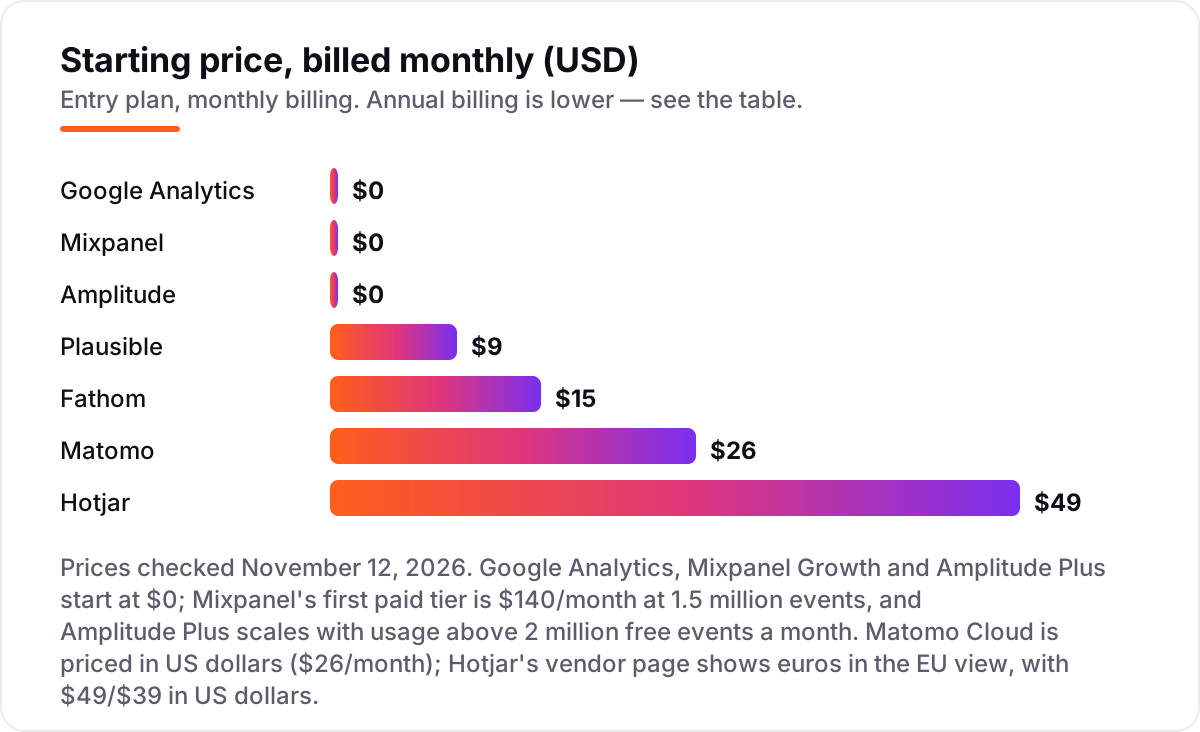
- Google Analytics leads for most teams at $0, with Plausible from $9 a month and Fathom from $15 a month as the privacy-first paid picks.
- The single most important buying factor is the pricing unit: pageviews, hits and events are three different bills for the same traffic.
- Three tools start free — GA4, Mixpanel (1 million events a month) and Amplitude (2 million events) — but only GA4 stays free at any volume.
- Every price below was checked on the vendor's own pricing page on November 12, 2026. Ratings are G2, with review counts shown.
On this page
Quick comparison
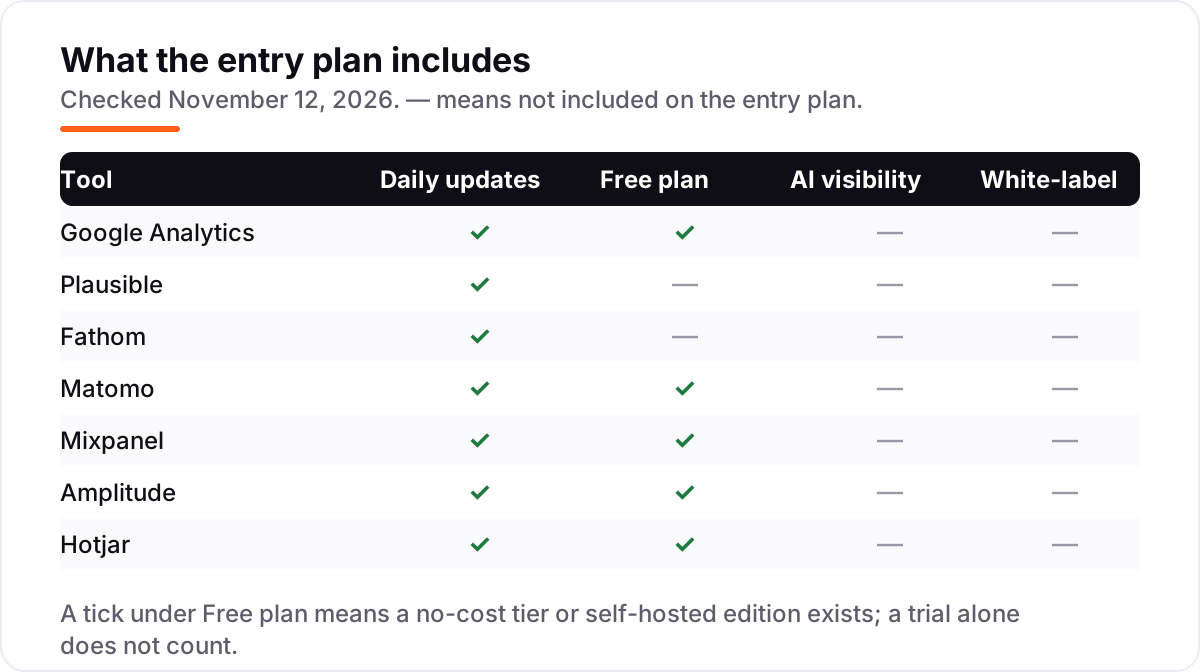
| Tool | Best for | Starting price | Free plan |
|---|---|---|---|
| Google Analytics | Small businesses and marketing teams that want the deepest free analytics and live in Google Ads and Search Console | $0 | Yes (free) |
| Plausible | Small businesses and bloggers who want a one-screen, cookie-free dashboard without a consent banner | $9/mo | No (30-day trial) |
| Fathom | Agencies and site owners running many small sites who want one price for all of them | $15/mo | No (7-day trial) |
| Matomo | Privacy-conscious teams that want a full GA replacement they own, with heatmaps and funnels included | $26/mo | Yes (self-hosted) |
| Mixpanel | Product and growth teams that need funnels, retention and cohorts for a web or mobile app | $0; $140/mo at 1.5M events | Yes (1M events) |
| Amplitude | Product teams that want the deepest behavioral analytics and can live with a learning curve | $0; usage-based | Yes (2M events) |
| Hotjar | Marketing teams that want to see why visitors leave, with heatmaps and session recordings | $49/mo | Yes (free plan) |
Make one of these tools?
We re-check this list every quarter. Send a correction, request a review, or ask about a clearly labeled sponsored spot.
Request a listingThe best web analytics platform

Google Analytics
Best for: Small businesses and marketing teams that want the deepest free analytics and live in Google Ads and Search Console

Google Analytics is the default analytics tool for a reason: the standard GA4 property costs nothing, covers web and app in one event-based model, and links directly into Google Ads and Search Console, so acquisition, engagement and conversions sit in one place. Real-time reports show what is happening right now, explorations answer deeper questions, and the free BigQuery export — up to 1 million events a day — means the data is never locked in.
The price is the learning curve and the privacy trade-off. GA4 uses cookies and Google infrastructure, so EU and UK visitors usually need a consent banner, and the interface buries simple answers behind custom reports. Free properties also sample explorations above 10 million events per query and keep event data for 2 or 14 months. Start here unless privacy law or simplicity pushes you elsewhere.
What we like
- Free with no pageview cap for standard properties, and the deepest Google Ads and Search Console integration in this list
- Real-time reports, explorations, audiences and attribution in one tool, with a free BigQuery export of up to 1 million events a day
- Event-based model tracks web and app in one property, with 30 key events and 50 event-scoped custom dimensions
Watch out for
- Uses cookies and Google infrastructure, so EU and UK visitors usually need a consent banner
- Steep learning curve — the interface buries simple answers behind explorations and custom reports
- Free properties sample explorations above 10 million events per query and keep event data for 2 or 14 months only

Plausible
Best for: Small businesses and bloggers who want a one-screen, cookie-free dashboard without a consent banner

Plausible is the cleanest privacy-first alternative to GA4: a sub-1KB script, no cookies, no personal data stored, and a dashboard that fits the whole story on one screen. Starter costs $9 a month for up to 10,000 pageviews on one site, with three years of data retention, goals, custom events and a Google Analytics import — enough for most small sites and blogs.
What you give up is depth. There are no session recordings or heatmaps, and funnels, user journeys and ecommerce revenue attribution wait for Business at $19 a month. The hosted service has no free plan, only a 30-day trial, though the open-source Community Edition is free to self-host. Pick Plausible when you want the numbers without the compliance stack.
What we like
- No cookies and no personal data collected, so most sites need no consent banner under GDPR
- A sub-1KB tracking script that loads fast and shows the whole story on one dashboard screen
- Transparent pageview pricing with no overage fees — one month over the tier needs no action
Watch out for
- No free plan for the hosted service — only a 30-day trial, and the self-hosted edition lacks funnels and revenue goals
- Funnels, user journeys and ecommerce revenue attribution need Business at $19 a month
- Deliberately narrow: no session recordings, heatmaps or product-level funnels

Fathom
Best for: Agencies and site owners running many small sites who want one price for all of them
Fathom's pitch is one clean dashboard without GDPR headaches, and the pricing is the most honest in this list: $15 a month covers 100,000 pageviews across 50 sites, and every plan carries the same features — event and revenue tracking, UTM campaigns, the API and unlimited email reports. Nothing is held back for a higher tier, so the only question is how much traffic you have.
The trade-off is scope. Fathom deliberately does less than GA4 or Matomo: no funnels, no visitor profiles, no attribution models, and no session recordings. It is also $15 a month for what GA4 does free, so you are buying privacy, simplicity and multi-site convenience, not features. Pick it when you run many small sites and want one bill for all of them.
What we like
- Every plan carries the same features — event and revenue tracking, UTM campaigns and the API are never held back
- 50 sites included on the entry plan, so one subscription covers a whole portfolio of small sites
- Cookieless tracking with EU data isolation available, and no cross-day visitor tracking
Watch out for
- No free plan and only a 7-day trial, which needs a card up front
- No funnels, visitor profiles or attribution models — deliberately minimal reporting
- Custom events and API requests count against the same pageview allowance

Matomo
Best for: Privacy-conscious teams that want a full GA replacement they own, with heatmaps and funnels included

Matomo is the only full suite in this list: Cloud Business at $26 a month includes funnels, heatmaps, session recordings, A/B testing, ecommerce tracking and a tag manager, with no data sampling and raw data kept for 24 months. It is also the only tool here you can truly own — the open-source Community Edition is free to self-host, and the hosted Cloud stores data in Frankfurt.
Watch the unit: Matomo prices by hits, not pageviews, and a hit is any tracked action — a pageview, an event, a download, an outlink, a site search or an ecommerce request. A busy site burns through 50,000 hits faster than it burns through 50,000 pageviews. Pick Matomo when data ownership matters and you want the suite, not just the dashboard.
What we like
- You own the data: self-host for free, or use the hosted Cloud with data stored in Frankfurt
- Funnels, heatmaps, session recordings, A/B testing, ecommerce tracking and a tag manager are all in the Cloud price
- No data sampling on any plan, with raw data kept for 24 months on Cloud Business
Watch out for
- Hits include every tracked action — pageviews, events, downloads and searches — so the allowance burns faster than pageviews alone
- The self-hosted edition is free in licence only: you supply the server, updates and maintenance
- Interface feels dated next to Plausible and Fathom, and setup takes longer

Mixpanel
Best for: Product and growth teams that need funnels, retention and cohorts for a web or mobile app
Mixpanel is the tool product teams reach for when they want to understand what users do inside the product, not just which pages they visit. The free plan covers 1 million events a month with session replay and feature flags included, and Growth adds unlimited saved reports, cohorts, custom properties and multi-touch attribution. Funnel and retention analysis is the deepest in this list.
The catch is the unit. Mixpanel prices by events, and a single page load can fire several events, so a busy site passes 1 million events sooner than it expects — and the first paid tier is $140 a month at 1.5 million events. Setup is also real work: the event taxonomy has to be planned before the reports make sense. Pick it for product analytics, not for counting pageviews.
What we like
- Free plan covers 1 million events a month with session replay and feature flags included
- Funnel, retention and cohort analysis with a polished interface, plus experimentation on Growth
- Usage-based pricing with a published calculator, so the bill at any volume is visible before you commit
Watch out for
- Priced by events, not pageviews, so a busy site can pass 1 million events far sooner than it expects
- The jump from free to paid is steep — $140 a month at 1.5 million events, with no cheaper paid tier
- Setup is complex: event taxonomy and tracking plans take real work before the reports make sense

Amplitude
Best for: Product teams that want the deepest behavioral analytics and can live with a learning curve
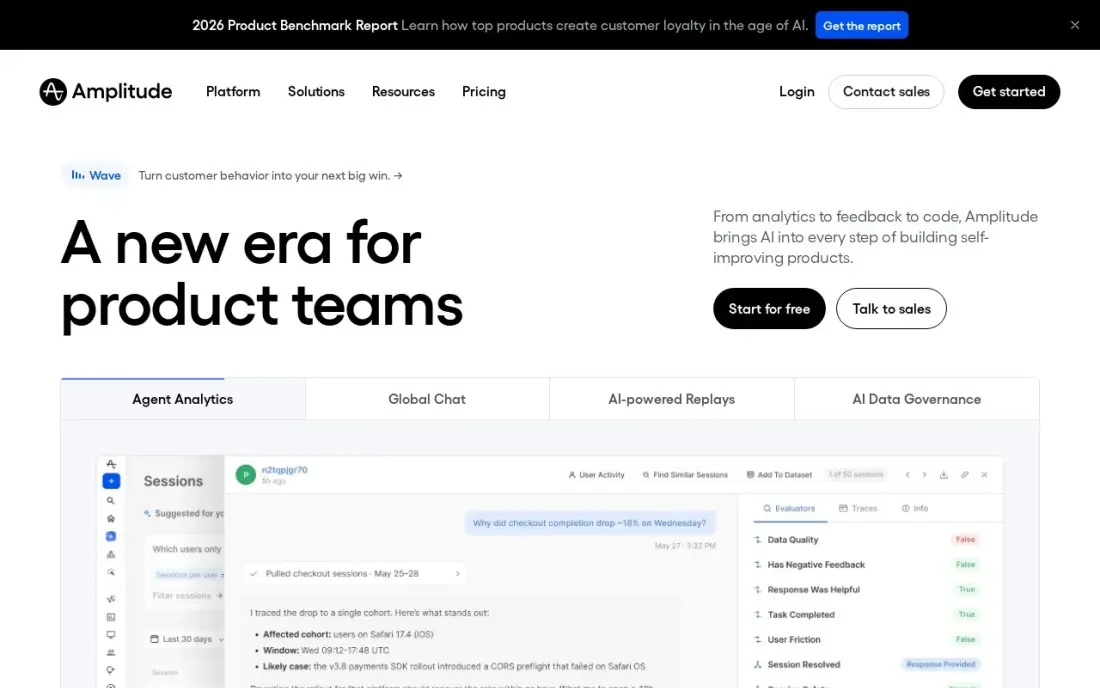
Amplitude is the deepest product analytics platform in this list, and its free plan is the most generous: 2 million events a month with no time limit, no credit card and unlimited seats, including session replay and AI features. Plus starts at $0 with the same 2 million events free, then scales with volume up to 70 million events a month — cohorts, heatmaps and custom analyses included.
The generosity ends at 2 million events. Plus needs a credit card to activate, and the calculator climbs to $75 a month at 3 million events billed annually, while Growth and Enterprise are custom-quoted and buyers report median contracts around $64,000 a year. There is also a real learning curve. Pick Amplitude when behavioral depth matters more than a simple dashboard.
What we like
- The largest free allowance in this list — 2 million events a month, with no time limit and no credit card
- Deep behavioral analysis: funnels, retention, cohorts, session replay and experimentation in one platform
- Unlimited seats on the free plan, so the whole team can explore the data
Watch out for
- Plus needs a credit card to activate, and paid usage climbs fast — $75 a month at 3 million events billed annually
- Growth and Enterprise are custom-quoted, and buyers report median contracts around $64,000 a year
- A real learning curve: teams budget two to four weeks to get comfortable with the advanced features

Hotjar
Best for: Marketing teams that want to see why visitors leave, with heatmaps and session recordings
Hotjar answers the question the numbers cannot: why visitors leave. Heatmaps show where people click and how far they scroll, session recordings show the exact moment a visitor hesitates, and surveys ask them why — all in one tool. The free plan covers up to 200,000 sessions a month, which is far more than most small sites need, and Growth at $49 a month adds 13 months of data access and AI summaries.
One change matters more than the price: Hotjar no longer sells standalone accounts. New sign-ups go through Contentsquare, surveys are now a separate product from $79 a month, and the pricing page shows euros to EU visitors. Pick Hotjar as a companion to GA4 or Plausible, not as a replacement — it shows behavior, not traffic.
What we like
- Heatmaps and session recordings show exactly where visitors click, scroll and drop off
- The free plan covers up to 200,000 sessions a month — far more than most small sites need
- Surveys and feedback widgets sit in the same tool, so the why sits next to the what
Watch out for
- Hotjar no longer sells standalone accounts — new sign-ups go through Contentsquare, and surveys are now a separate product from $79 a month
- The vendor's own pricing page shows euros in the EU view, so US buyers should confirm the dollar price at checkout
- Filtering and segmentation feel thin on large session volumes, and reviewing recordings takes real time
The best web analytics platform for your site depends on what you want the numbers to do: count visitors, respect their privacy, or explain what they do inside your product. The 7 tools below are ranked by fit for the most common buyer, a small business or marketing team that wants reliable traffic data without hiring a data team, and every price was checked on the vendor's own pricing page on November 12, 2026.
How to choose the best web analytics platform
- Name the job first. Counting visitors is a different job from understanding product behavior. GA4, Plausible, Fathom and Matomo count visitors; Mixpanel and Amplitude explain product use; Hotjar shows why visitors leave.
- Check the pricing unit before the price. Plausible and Fathom charge by pageviews, Matomo by hits, Mixpanel and Amplitude by events. One page load can be one pageview, several hits or several events — the same traffic gets three different bills.
- Decide how much privacy you need. GA4 uses cookies and usually needs a consent banner in the EU and UK. Plausible, Fathom and Matomo are cookieless, so most sites need no banner for the analytics alone.
- Check data retention and sampling. GA4 keeps event data for 2 or 14 months and samples explorations at scale; Plausible keeps 3 years on Starter and 5 on Business; Matomo Cloud keeps raw data for 24 months with no sampling.
- Count the sites, not just the traffic. Fathom covers 50 sites for $15 a month, Matomo Cloud covers 30, Plausible Starter covers 1. An agency with many small sites pays very different amounts on each.
- Try it with real traffic. Every tool here has a free plan or a trial, so run it alongside your current tool for a week and compare the numbers before you pay.
Analytics tells you what happened, but it does not fix the pages that underperform. If the data shows pages losing visitors, our SEO audit service finds what is holding them back. And before you judge a campaign, the free UTM builder makes clean tracking links so every visit is attributed to the right source.
Whatever you shortlist, install it alongside your current tool for a week before switching. The numbers will differ slightly between tools — different tools define a session or a visitor differently — so a side-by-side week tells you which difference is a definition and which is a real problem. Every tool in this list offers a free plan or a trial, so there is no reason to buy before you have run real traffic through it.
Web analytics platform pricing: what you will actually pay
Take a small business site with 100,000 pageviews a month, plus a SaaS app sending about 2 million events a month. For the website alone, the subscription costs $0 on GA4, $19 a month on Plausible Starter, $15 on Fathom, $42 on Matomo Cloud Business at the 100,000-hit tier, and $49 on Hotjar Growth at the 7,000-session tier — though Hotjar is a behavior tool, not a traffic counter, so it sits alongside one of the others rather than replacing it.
For the app's 2 million events, Mixpanel Growth costs $259 a month billed monthly, because the first 1 million events are free and the 2-million tier is priced at $259. Amplitude Plus costs $0 at exactly 2 million events, since the first 2 million are free, and $75 a month billed annually at 3 million events. Over a year on monthly billing, the website costs $0 on GA4, $180 on Fathom, $228 on Plausible Starter and $504 on Matomo Cloud at the 100,000-hit tier. Annual billing cuts most of these: Fathom drops to $150 a year, Plausible Starter to $90 and Matomo Cloud to $420 at the 100,000-hit tier.
Three costs sit outside every number above. First, the unit: a site with heavy event tracking can pass 1 million Mixpanel events while serving only 100,000 pageviews, so event-priced tools cost more for the same traffic. Second, implementation: GA4's free price assumes someone on the team can set up events and conversions, which is real work. Third, the consent banner: GA4 usually needs one in the EU and UK, and the banner itself costs some traffic.
Know the difference: pageviews, hits and events
The confusion in this category is the unit, not the feature list. A pageview is one page load. A hit is any tracked action — Matomo counts a pageview, an event, a download, an outlink, a site search and an ecommerce request as one hit each. An event is one user action, and a single page load can fire several: a pageview, a scroll, a click and a form interaction. The same site can cost $15 a month on a pageview plan, $42 on a hits plan and $259 on an events plan, all for the same traffic.
The unit matters most when the site changes. A content site with mostly reading pays least by pageviews, because one visit is a handful of pageviews. A SaaS app with buttons, modals and in-app actions pays least by pageviews too — but it cannot buy a pageview plan that measures what users do inside the app, which is why Mixpanel and Amplitude price by events. And a site that tracks downloads, searches and outbound clicks pays more by hits than its pageview count suggests. Count what the site actually fires in a month — not what it serves — and price all three units for that volume before buying.
There is a second, quieter confusion: a free plan is not a free business. GA4 is free at any volume, but it needs a consent banner in the EU and UK and someone to set up events. Mixpanel and Amplitude are free up to 1 and 2 million events, but the first paid tier is $140 and $75 a month respectively. Budget on the unit plus the setup, not on the $0 headline.
Quick comparison: tool type by need
| Buyer | Best pick | Why |
|---|---|---|
| Small business that wants to pay $0 | Google Analytics | Free at any volume, with the deepest Google Ads integration |
| Site owner who wants no consent banner | Plausible | Cookieless dashboard from $9/month, no personal data stored |
| Agency running many small sites | Fathom | 50 sites and 100,000 pageviews for $15/month |
| Team that wants to own its data | Matomo | Self-host free or Cloud from $26/month, heatmaps included |
| Product team that needs funnels | Mixpanel or Amplitude | Free to 1M and 2M events a month respectively |
| Marketer who wants to see why visitors leave | Hotjar | Heatmaps and recordings, free to 200,000 sessions a month |
Mistakes to avoid
- Comparing prices without checking the unit. Pageviews, hits and events are three different bills for the same traffic — a $9 pageview plan and a $140 event plan can cover the same site.
- Picking GA4 and skipping the consent banner. GA4 uses cookies, so EU and UK visitors usually need a banner; the banner itself costs some traffic, and skipping it is a compliance risk.
- Paying for product analytics to count pageviews. Mixpanel and Amplitude are built for in-app behavior; a content site pays event prices for answers a $9 pageview tool gives.
- Ignoring data retention. GA4 keeps event data for 2 or 14 months, so year-on-year comparisons need an export; Plausible keeps 3 to 5 years and Matomo Cloud keeps raw data for 24 months.
- Buying on the $0 headline. Free plans end at 1 or 2 million events, and the first paid tier is $75 to $140 a month. Price the traffic you will have next year, not the traffic you have today.
How we chose
We checked each vendor's own pricing page on November 12, 2026 and recorded the starting price exactly as shown, including the annual-billing figure where the page lists one, and we ranked the tools by fit for the most common buyer — a small business or marketing team that wants reliable traffic data without hiring a data team — not by brand size. Three prices needed extra care. Matomo Cloud now lists Business at $26 a month in US dollars for 50,000 hits, not the $29 figure still shown in some directories. Mixpanel's calculator shows $100 a month billed annually at 1.5 million events, not $120. Hotjar's own page shows euros to EU visitors, so the $49 monthly and $39 annual figures are the US-dollar prices. Ratings come from G2 pages checked November 12, 2026: Google Analytics 4.5 from 6,863 reviews, Matomo 4.2 from 97, Plausible 4.9 from 6, Fathom 4.7 from 22 and Amplitude 4.5 from 2,977. Mixpanel and Hotjar show no rating because no fresh G2 copy of their pages was available within three days. No vendor paid for a place in this list, and none of the links here are affiliate links.
What to do next
Start with the free plan or trial of your top pick and run it alongside your current tool for a week, so you can compare the numbers on real traffic before you switch. Check that the pricing unit matches what your site actually fires, that data is kept long enough for year-on-year comparisons, and that the dashboard answers questions without a data team. If the numbers point to pages losing visitors, our monthly SEO service handles the visibility side. Once your tools are in place, find out what's holding your rankings back.
Frequently asked questions
What is the best web analytics platform?
Google Analytics is the best fit for most teams at $0, with the deepest free reports and Google Ads integration. If privacy matters, Plausible at $9 a month or Fathom at $15 are the simple paid picks. Product teams that need funnels and retention should look at Mixpanel or Amplitude instead.
How much does a web analytics platform cost?
Entry prices run $0 to $49 a month. GA4, Mixpanel and Amplitude all start free, Plausible starts at $9, Fathom at $15, Matomo Cloud at $26 and Hotjar at $49. The real cost depends on the pricing unit — pageviews, hits or events — so price your actual traffic before comparing.
Is there a free web analytics platform?
Yes, with limits. GA4 is free with no pageview cap, Mixpanel covers 1 million events a month free, Amplitude covers 2 million, Hotjar has a free plan up to 200,000 sessions, and Matomo's Community Edition is free to self-host. Free plans work until traffic or event volume outgrows the allowance.
What is the difference between pageviews, hits and events?
A pageview is one page load. A hit is any tracked action — Matomo counts pageviews, events, downloads, searches and ecommerce requests as hits. An event is one user action, and a single page load can fire several. The same site can cost $15 on a pageview plan and $140 on an event plan.
Do I need consent banners with these tools?
With GA4, usually yes — it uses cookies and Google infrastructure, so EU and UK visitors need a consent banner. Plausible, Fathom and Matomo are cookieless and collect no personal data, so most sites need no banner for the analytics alone. Other tools on the page, like ad pixels, still need consent.
Can I switch web analytics platforms later?
Yes, and the safe way is to run both tools in parallel for a month. Install the new tool, let it collect data alongside the old one, and compare the numbers before you remove the old script. Historical data does not transfer, so the overlap month is the only way to keep a continuous record.
What should I check before paying for a web analytics platform?
Four things: what the price counts as one unit, how long data is kept, whether reports are sampled at your volume, and what happens when you exceed the allowance. Then run the free plan or trial with real traffic and check the numbers against a second tool before committing.
Sources we checked (13)
- Google Analytics pricing — marketingplatform.google.com/about/analytics (checked November 12, 2026)
- Google Analytics on G2 — 4.5/5, 6,863 reviews (checked November 12, 2026)
- Plausible pricing — plausible.io/#pricing (checked November 12, 2026)
- Plausible on G2 — 4.9/5, 6 reviews (checked November 12, 2026)
- Fathom pricing — usefathom.com/pricing (checked November 12, 2026)
- Fathom on G2 — 4.7/5, 22 reviews (checked November 12, 2026)
- Matomo pricing — matomo.org/pricing (checked November 12, 2026)
- Matomo on G2 — 4.2/5, 97 reviews (checked November 12, 2026)
- Mixpanel pricing — mixpanel.com/pricing (checked November 12, 2026)
- Amplitude pricing — amplitude.com/pricing (checked November 12, 2026)
- Amplitude on G2 — 4.5/5, 2,977 reviews (checked November 12, 2026)
- Hotjar pricing — hotjar.com/pricing (checked November 12, 2026)
- Amplitude contract data — vendr.com/marketplace/amplitude (checked November 12, 2026)
Make one of these tools?
We re-check this list every quarter. Send a correction, request a review, or ask about a clearly labeled sponsored spot.
Request a listingShamim
Founder of SerpAstra
A full-stack SEO and digital marketer who spends most days on Local SEO for dental practices, AI search visibility and lead generation.
Free SEO and AI visibility audit
Find out what is holding your rankings back
Send us your site. Within 2 business days you get a written audit, an AI visibility check and a short fix list ranked by impact. Free, with no contract attached.
Request my free audit→Related buying guides
 Marketing11 Best Marketing Analytics Platforms in 2026, ComparedCompare the 11 best marketing analytics platforms in 2026 on price, free plans and reporting, with every price checked November 4, 2026 for US teams.Read guide →
 Data, Analytics & AI12 Best Analytics Software in 2026: Pricing, Features and Pros & ConsThe 12 best analytics software tools for 2026, compared on price, free plans and what each one measures, with every price checked on the pricing page.Read guide →
 Project & Product Management10 Best Product Analytics Tools in 2026 (Free and Paid, Compared)10 best product analytics tools compared on price, free plans and fit, from Mixpanel and Amplitude to free GA4. Priced from vendor pages, November 2026.Read guide →