12 Best Platforms for Microlearning in 2026 (Pros, Cons and Pricing)
Compare the 12 best platforms for microlearning on price, free plans, features and AI authoring, with every price checked November 12, 2026.
 Shamim Mia, Founder, SerpAstraLast verified November 12, 202615 min read
We compare pricing pages, documentation and public reviews. We never accept payment for rankings.

Key takeaways
- TalentLMS leads for most teams at $119 a month billed annually for up to 40 learners, with Mitti free for up to 10 users and 7taps free to start.
- The single most important buying factor is the pricing unit: per-user, per-seat and per-enrollment pricing turn a cheap-looking plan into a dear one at 40 learners.
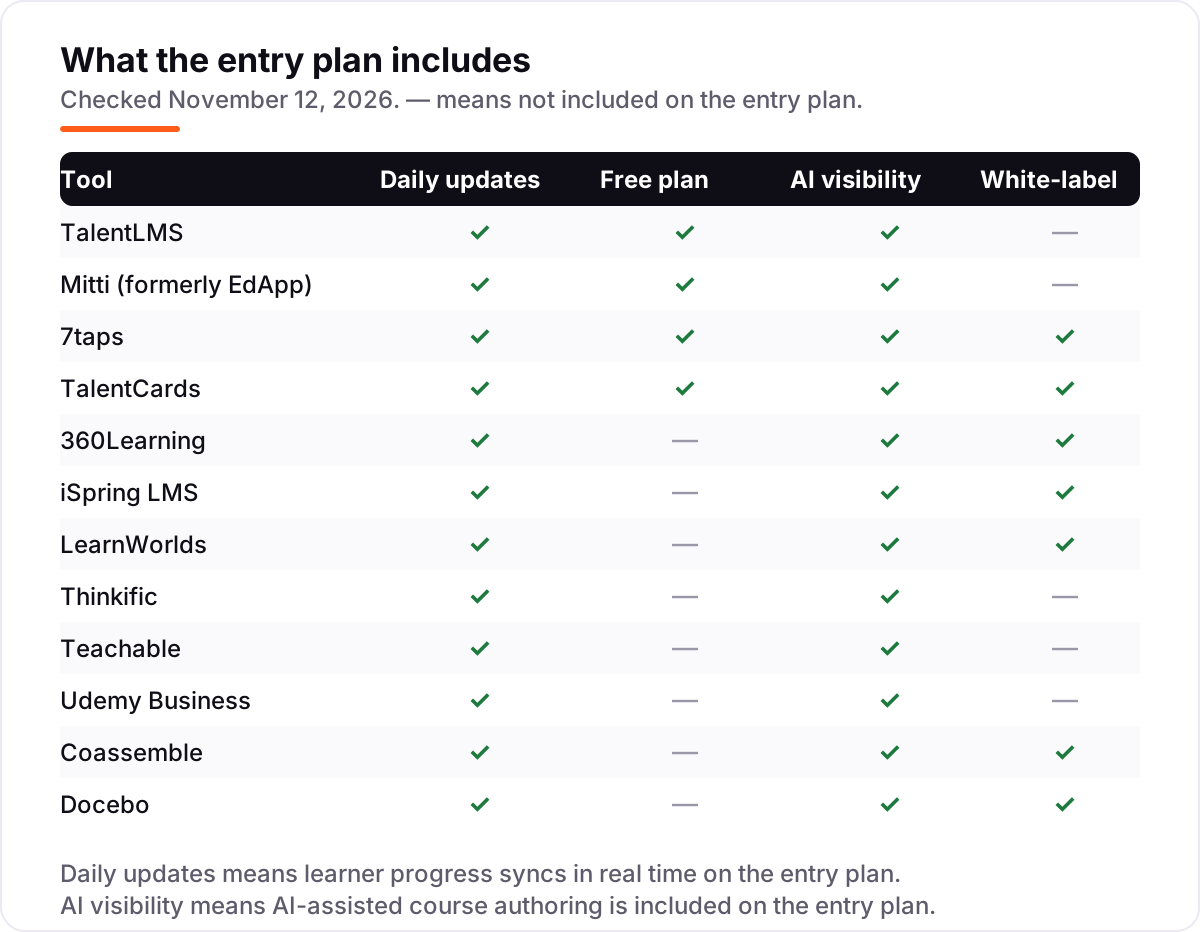
- Four of the 12 tools have a genuinely free plan — TalentLMS, Mitti, 7taps and TalentCards — plus Coassemble's free sandbox; Docebo is the only quote-only platform here.
- Every price below was checked on the vendor's own pricing page or a fresh crawl of it on November 12, 2026. Ratings are G2, with review counts shown.
On this page
Quick comparison
| Tool | Best for | Starting price | Free plan |
|---|---|---|---|
| TalentLMS | Small and mid-size teams that need training live fast | Free; Core $119/mo | Yes (free plan) |
| Mitti (formerly EdApp) | Frontline and deskless teams training on phones | Free; Premium $24/seat/mo | Yes (free plan) |
| 7taps | L&D teams that need short courses built and shared fast | Free; Pro $99/mo | Yes (free plan) |
| TalentCards | Field teams learning in short bursts on phones | Free; Standard $50/mo | Yes (free plan) |
| 360Learning | Companies where employees create courses together | $8/user/mo | No (30-day trial) |
| iSpring LMS | Companies turning PowerPoint decks into courses | $6.91/user/mo | No (30-day trial) |
| LearnWorlds | Course creators selling interactive video courses | $29/mo | No (30-day trial) |
| Thinkific | Creators selling structured courses with assessments | $109/mo | No (30-day trial) |
| Teachable | First-time course creators launching fast | $39/mo | No (7-day trial) |
| Udemy Business | Teams that want a ready course library instead of building courses | $30/user/mo | No (free trial) |
| Coassemble | Small teams turning internal knowledge into short courses | $250/mo | No (free sandbox) |
| Docebo | Enterprises training employees, customers and partners | Custom quote | No (demo only) |
Make one of these tools?
We re-check this list every quarter. Send a correction, request a review, or ask about a clearly labeled sponsored spot.
Request a listingThe best platforms for microlearning

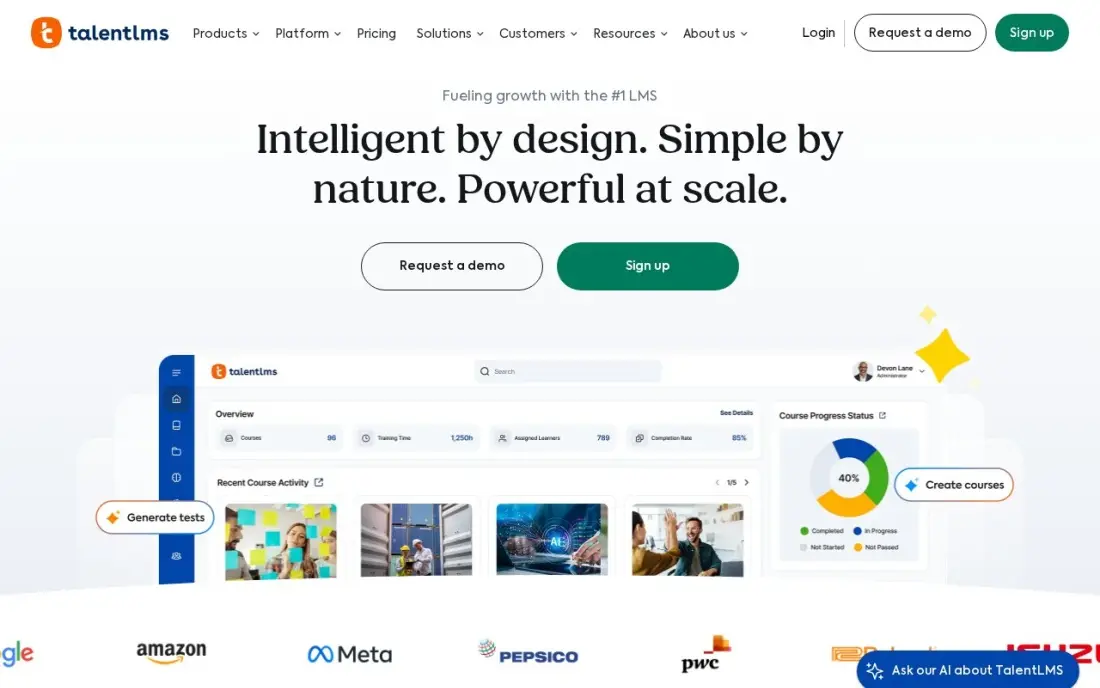
TalentLMS is the most complete starting point in this list, and the only full LMS here with a real free plan: 5 users and 10 courses at $0. Core at $119 a month billed annually covers up to 40 active users, and only people who log in during the month count, so seasonal learners cost nothing. Unlimited courses, learning paths, automations and AI course authoring come with Core, plus SSO and a custom domain.
The pricing unit is the reason it leads: flat per-bracket pricing, not per seat, so adding a 41st learner steps the plan to $159 a month. The trade is that removing TalentLMS branding needs Pro at $449 a month, and Core's 5,000 AI credits are a one-time allowance. Buy TalentLMS when the team needs a real LMS; buy Mitti when training is phone-first and nothing else.
What we like
- The only full LMS here with a genuinely free plan: 5 users and 10 courses at $0 with no time limit
- Flat pricing by user bracket, not per seat: Core covers up to 40 active users for $119 a month billed annually
- Only people who log in during the month count, so seasonal learners cost nothing
- AI course authoring, learning paths, automations and a custom domain are included on Core
Watch out for
- Core jumps from $119 to $159 a month once you pass 40 active users
- Removing TalentLMS branding and automations need Pro at $449 a month billed annually
- Core's 5,000 AI credits are a one-time allowance that does not renew

Mitti is the rebrand of EdApp, and it is built for microlearning from the start: bite-size mobile lessons, gamification and a library of more than 1,000 editable courses. AI turns a PDF, PowerPoint or Word file into a course, and learners can complete lessons offline and sync when they reconnect. The free plan covers up to 10 users with basic training and reporting included.
The price needs care: Premium is $24 a seat a month billed annually, but that buys the whole Mitti platform, so 40 seats cost $960 a month, the dearest here at that size. A team of 11 pays for every seat, since the free plan stops at 10. Buy Mitti when the audience works on phones in the field; buy TalentLMS when the team sits at desks and needs a full LMS.
What we like
- Built for microlearning from the start: bite-size mobile lessons, gamification and a 1,000-plus editable course library
- AI turns a PDF, PowerPoint or Word file into a course, so existing material becomes training fast
- Learners can complete lessons offline and sync when they reconnect
- Free for up to 10 users, with basic training, inspections and reporting included
Watch out for
- Premium is priced per seat for the whole Mitti platform, not for training alone, so 40 seats cost $960 a month billed annually
- The free plan stops at 10 users, so a team of 11 pays for every seat
- Advanced training features such as SSO sit on the Premium plan

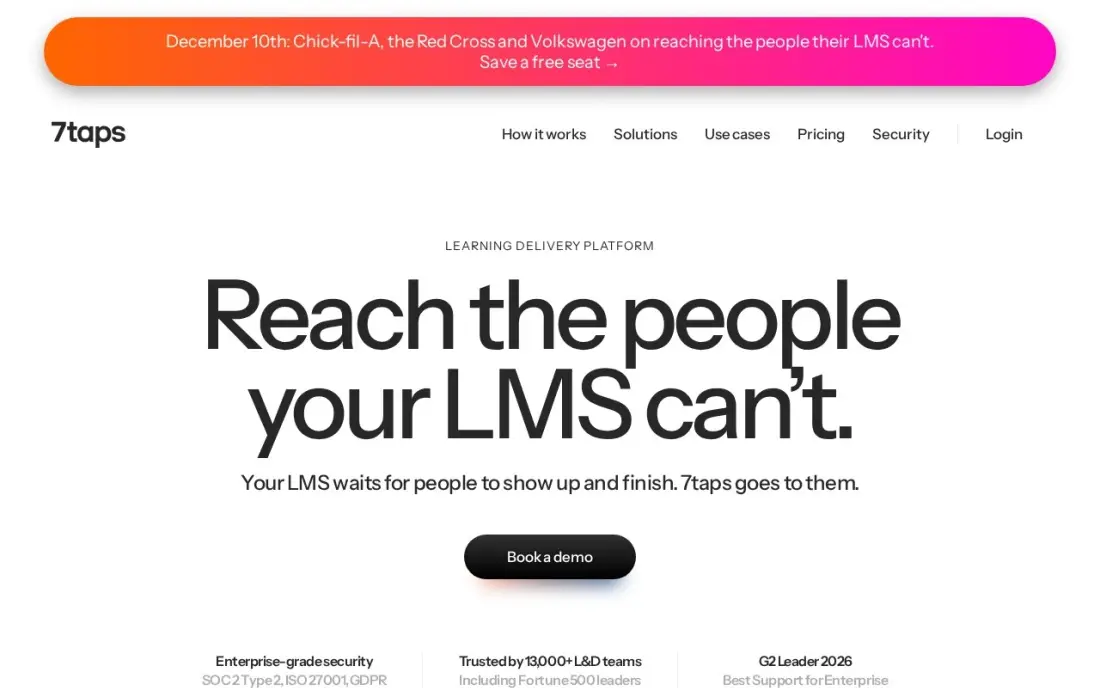
7taps is the fastest authoring tool in this list. AI drafts a course, and it ships by link, QR code or SMS — no app install for the learner. The free plan allows one shared course with unlimited learners, and Pro at $99 a month per editor removes the cap, adds unlimited video uploads and advanced analytics. Quizzes, polls and forms are built into the authoring flow.
Unlimited learners on every plan is the pricing story: the audience never raises the bill, only the number of editors does. The catch is that one editor costs $99 a month, so two authors cost $198, and SCORM and xAPI export, SSO and unlimited learning paths need Enterprise. With a 4.8 G2 score from 293 reviews, it is the best-liked tool here. Buy 7taps when speed matters more than a course library.
What we like
- The fastest authoring here: AI drafts a course, and it ships by link, QR code or SMS
- Unlimited learners on every plan, including Free, so the audience never raises the bill
- Quizzes, polls, forms and analytics are built into the authoring flow
- The highest G2 score in this list at 4.8 from 293 reviews
Watch out for
- The free plan allows only 1 shared course at a time, so a library needs Pro
- Pro is priced per editor at $99 a month, so two authors cost $198
- SCORM and xAPI export, SSO and unlimited learning paths need Enterprise

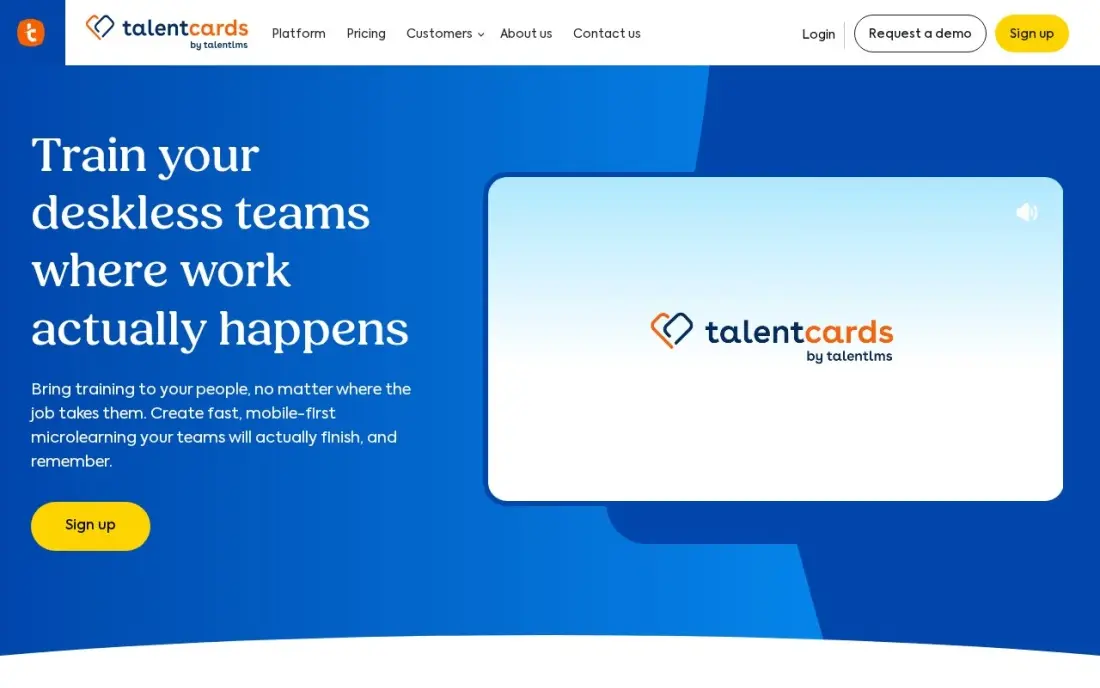
TalentCards turns training into card decks for phones: short, searchable lessons that work offline, with spaced repetition to help the material stick. AI course creation is included on the free plan, which covers up to 5 users, and custom in-app branding comes with it — a combination no other tool here offers at $0. Standard is $50 a month for 50 users, about $1 per learner, with $1 for each additional user.
The weak spot is reporting: reviewers call out missing route codes and thin analytics, and there is no built-in content library, so every card set has to be authored by the team. Premium at $75 a month keeps the same $1.50 per additional user. Buy TalentCards when the audience is a field team learning in short bursts; buy 360Learning when managers need richer reporting.
What we like
- Card-based lessons built for phones: short, searchable and available offline
- AI-powered course creation and spaced repetition are included on the free plan
- Custom in-app branding is included even at $0, which is rare in this list
- Standard is $50 a month for 50 users, about $1 per learner
Watch out for
- Standard covers 50 users, so a 51st learner costs $1 a month extra on top of the $50
- Reporting is the weakest part: reviewers call out missing route codes and thin analytics
- No built-in content library — every card set has to be authored by the team

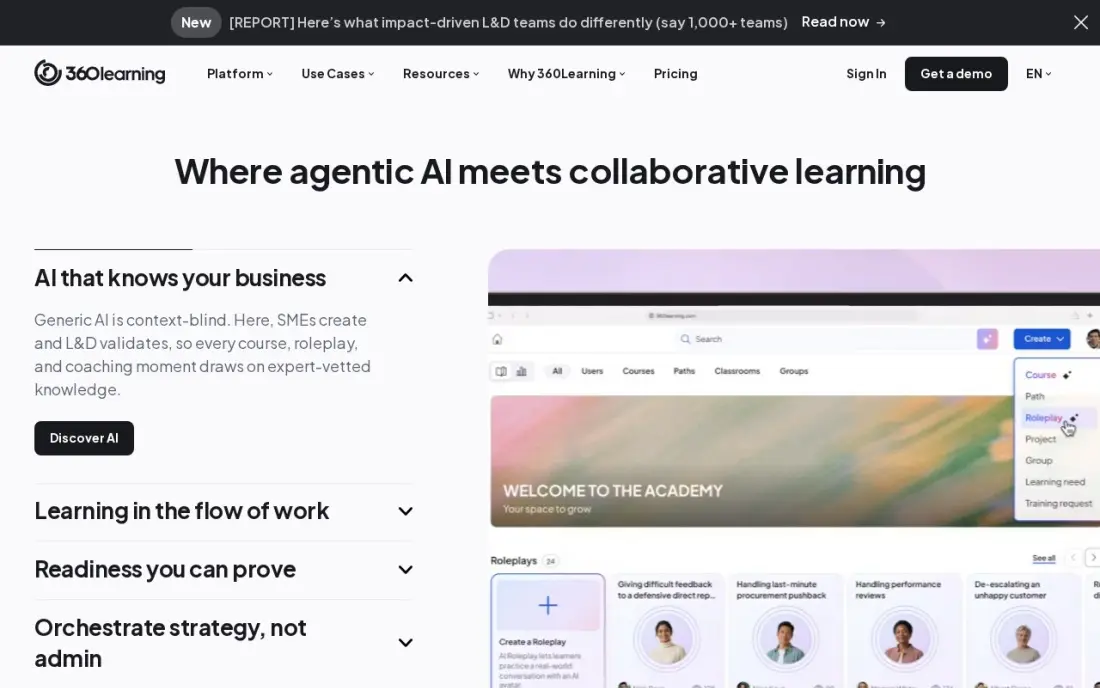
360Learning is the collaborative option: subject-matter experts author courses with peer review, so knowledge becomes training the whole company can use. Academies and skills mapping give structure without a central course factory, and mobile apps on iOS and Android cover learners on the move. Team is $8 a user a month billed monthly, up to 100 users, with a 30-day trial.
It is the only self-serve plan here with no annual commitment, so a team can leave after a month. The limit is the 100-user cap — a bigger workforce moves to a quoted Business plan — and there is no annual discount, so the $8 rate never drops. AI roleplay and deeper skills features sit on higher tiers. Buy 360Learning when employees should create the courses; buy iSpring when the content already exists as decks.
What we like
- The only self-serve plan here with no annual commitment: Team is $8 a user a month, billed monthly
- Subject-matter experts author courses with peer review, so knowledge leaves one person's head
- Academies and skills mapping give structure without a central course factory
- Mobile apps on iOS and Android for learners on the move
Watch out for
- Team stops at 100 users, so a bigger workforce moves to a quoted Business plan
- Billed monthly with no annual discount, so there is no way to cut the $8 rate
- AI roleplay and deeper skills features sit on higher tiers, not Team

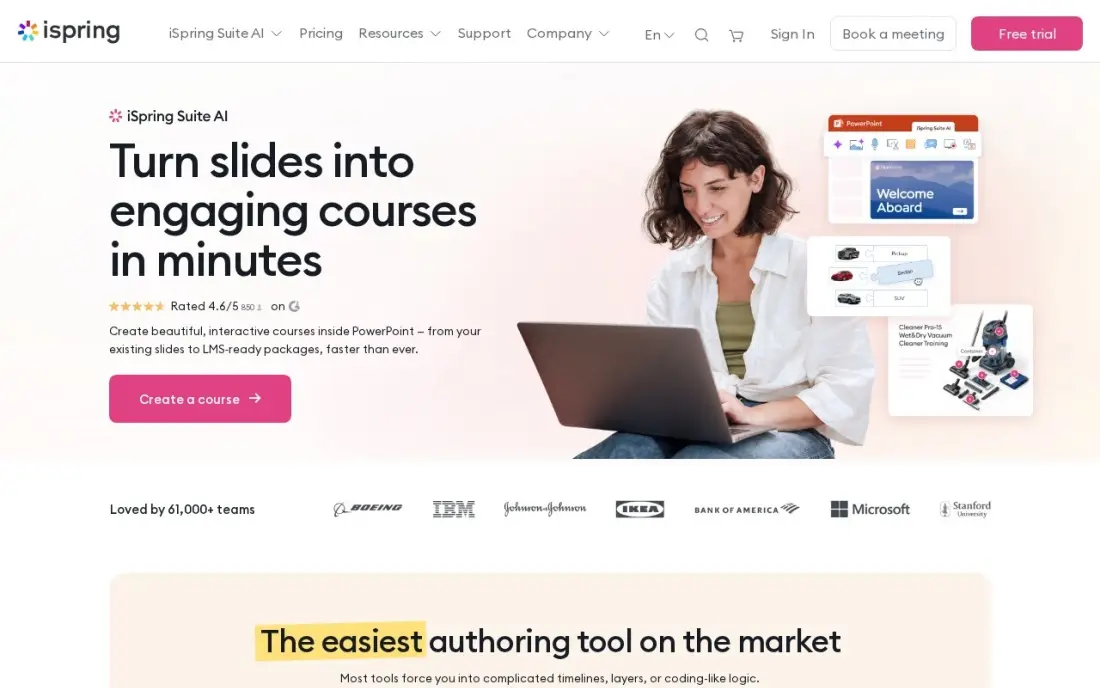
iSpring LMS, renamed from iSpring Learn in October 2025, is built for companies whose training already exists as PowerPoint decks. The iSpring Suite authoring tool is included, so decks become interactive courses, and only active users count: anyone who logs in at least once in the month. Business is $6.91 per user a month for 100 users, $8,286 a year billed annually, falling to $4.46 at 300 users and $3.97 at 500.
The entry point is the catch: the published price starts at 100 users, so a team of 40 pays $690.50 a month for seats it does not use. Teams under 100 users are priced on request, and SSO needs Enterprise. A 30-day trial needs no credit card. Buy iSpring when the content is already in PowerPoint; buy LearnWorlds when the courses will be sold, not assigned.
What we like
- You pay only for active users: anyone who logs in at least once in the month
- The iSpring Suite authoring tool is included, so decks become interactive courses in place
- Published per-user pricing falls with scale: $6.91 at 100 users, $4.46 at 300, $3.97 at 500
- Unlimited registered users — only active learners count toward the band
Watch out for
- The published entry point is 100 users at $8,286 a year, so a team of 40 pays for seats it does not use
- SSO needs Enterprise, which is quoted rather than published
- Reporting is thinner than the dedicated LMS suites, per G2 reviewers

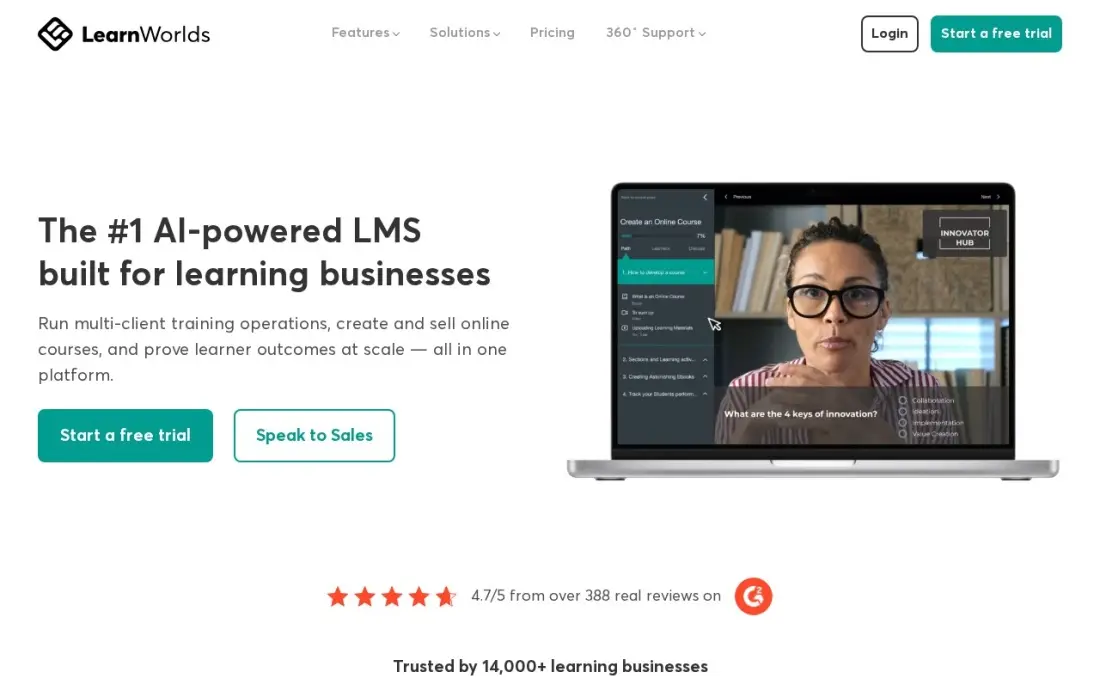
LearnWorlds is the strongest interactive-video platform here: in-video quizzes, clickable hotspots and SCORM support, with an AI course builder, quizzes and exams included from Starter. Courses run on your own domain with Stripe, PayPal or Shopify checkout, and the 30-day trial needs no credit card. Starter is $29 a month billed monthly, or $24 on annual billing, for one admin and 1,000 active learners a month.
The $5 fee per paid enrollment is the catch: 20 sales a month add $100 to the bill, and subscriptions, memberships and SCORM uploads are not on Starter. There is no free plan, and the support score is the highest in this list at 9.6 out of 10 on G2. Buy LearnWorlds when video is the course; buy Thinkific when the course is structured text, quizzes and assessments.
What we like
- The strongest interactive video here: in-video quizzes, clickable hotspots and SCORM support
- AI course builder, quizzes and exams are included from Starter
- Courses run on your own domain with Stripe, PayPal or Shopify checkout
- The highest G2 support score in this list, 9.6 out of 10
Watch out for
- Starter charges $5 for every paid enrollment, so 20 sales a month add $100 to the bill
- No subscriptions, memberships or SCORM uploads on Starter
- No free plan — only a 30-day trial before the subscription starts

Thinkific is the structured-course seller: quizzes, exams, drip content and certificates, with 0% platform fees on Thinkific Payments across every plan. Start is $109 a month billed monthly, or $82 on annual billing, after a rise of about 10% in August 2026 — its first increase since 2022. Every self-serve plan covers up to 10,000 active students, and the free plan was retired in March 2026 in favour of a full-access 30-day trial.
The fees sit elsewhere: using Stripe or PayPal instead of Thinkific Payments adds a 2% surcharge on Start, and removing Thinkific branding needs Grow at $219 a month. A branded mobile app is a $199-a-month add-on. Buy Thinkific when the course is a structured program with assessments; buy Teachable when the goal is to launch one first course as fast as possible.
What we like
- 0% platform fee on Thinkific Payments across every plan
- Strong assessment tools: quizzes, exams, drip content and certificates
- Every self-serve plan covers up to 10,000 active students
- The free plan was retired in March 2026, replaced by a full-access 30-day trial
Watch out for
- Start rose about 10% in August 2026, to $109 a month, after Thinkific's first increase since 2022
- Using Stripe or PayPal instead of Thinkific Payments adds a 2% surcharge on Start
- Removing Thinkific branding needs Grow at $219 a month

Teachable is the fastest on-ramp in this list: a school, checkout and student management in one place, with unlimited students on every plan. Starter is $39 a month billed monthly, or $29 on annual billing, with five published products and a 7-day trial plus a 30-day money-back guarantee. Built-in checkout, coupons and affiliates mean no extra commerce stack is needed.
The 7.5% transaction fee on Starter is the catch: once sales pass about $670 a month, Builder at $89 a month with 0% fees costs less. Starter also allows only five published products, so a sixth forces an upgrade, and there is no free plan. Buy Teachable to launch a first course quickly; buy LearnWorlds when interactive video is the product.
What we like
- The fastest on-ramp here: a school, checkout and student management in one place
- Builder at $89 a month drops the transaction fee to 0%, with 10 products
- Built-in checkout, coupons and affiliates, so no extra commerce stack is needed
- Unlimited students on every plan
Watch out for
- Starter takes 7.5% of every sale, which costs more than Builder once sales pass about $670 a month
- Starter allows only 5 published products, so a sixth product forces an upgrade
- No free plan — only a 7-day trial and a 30-day money-back guarantee

Udemy Business
Best for: Teams that want a ready course library instead of building courses
Udemy Business is the only tool here where the team does not build anything: 28,000-plus ready courses, with certification prep for more than 200 exams included on the Team plan. Learning paths and adoption reports show who is actually finishing courses, and a free trial lets a team test the library before committing. Team is $30 a user a month billed annually, $360 a user a year, for 2 to 50 people.
The commitment is the catch: Team is annual-billing only, with no monthly option, and Enterprise starts above 20 users, so a 30-person team pays the Team rate or negotiates. Reviewers flag high costs for international users and growing teams. Buy Udemy Business when training means a ready library; buy 360Learning when the courses should come from the team's own experts.
What we like
- 28,000-plus ready courses, so training starts without authoring anything
- Certification prep for more than 200 exams is included on the Team plan
- Learning paths and adoption reports show who is actually finishing courses
- Free trial lets a team test the library before the annual commitment
Watch out for
- Team is annual-billing only at $360 a user a year, with no monthly option
- Enterprise starts above 20 users, so a 30-person team pays the Team rate or negotiates
- Reviewers flag high costs for international users and growing teams

Coassemble
Best for: Small teams turning internal knowledge into short courses
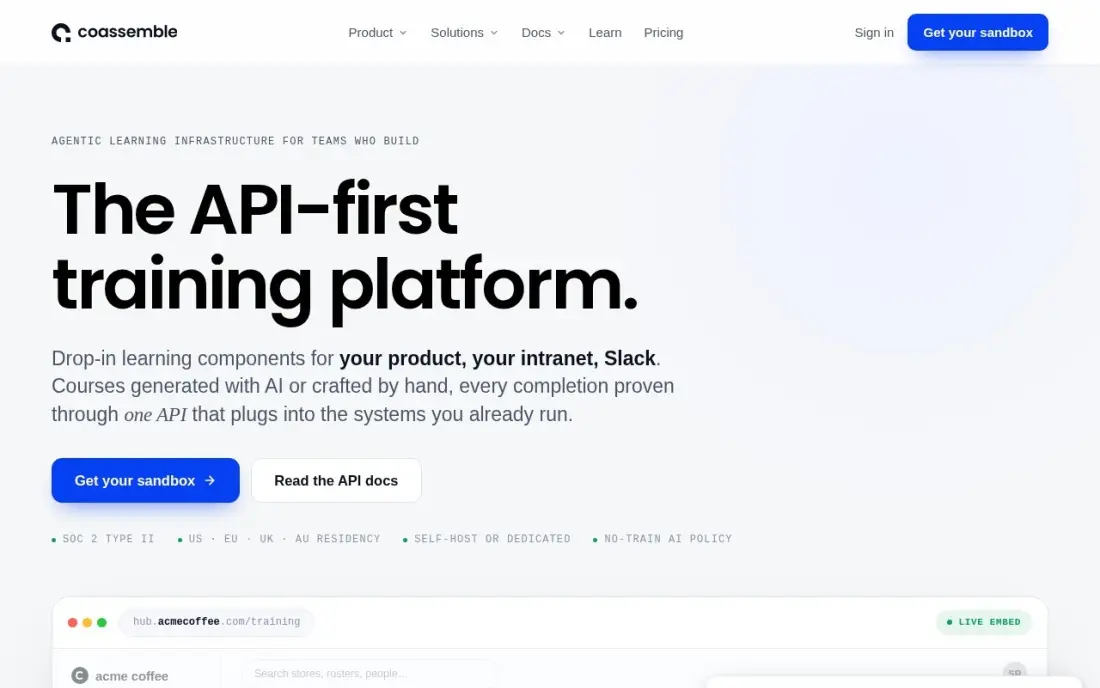
Coassemble turns internal knowledge into short courses: AI-powered course creation converts existing documents into branded lessons, and templates plus a simple editor keep authoring fast for non-designers. A free sandbox lets a team test the builder before paying, and Build is $250 a month, or $2,500 a year on annual billing. G2's vendor-supplied listing confirms Build at $2,500 a year.
The price is the problem: $250 a month is dear for a small team when TalentCards covers 50 users for $50, and Scale at $500 a month is the next step, with no middle tier between the two. There is no free plan, only the sandbox. Buy Coassemble when the training material already exists as documents; buy 7taps when the courses need to be built from scratch, fast.
What we like
- AI-powered course creation turns existing documents into branded short courses
- Templates and a simple editor keep authoring fast for non-designers
- The free sandbox lets a team test the builder before paying
- G2's vendor-supplied listing confirms Build at $2,500 a year
Watch out for
- Build at $250 a month is dear for a small team when TalentCards covers 50 users for $50
- Scale at $500 a month is the next step, with no middle tier between the two
- No free plan — only a free sandbox to try the authoring tools

Docebo is the enterprise option: separate branded portals for employees, customers and partners from one system, with AI covering content generation, auto-tagging and skills intelligence. It is the most reviewed enterprise LMS here, with 752 G2 reviews at 4.3, and it is aimed at organizations training 250 or more learners. Its own AWS Marketplace listing prices Elevate at $35,900 a year for 500 users on a three-year agreement.
There are no published prices at all — every plan needs a sales conversation — and contracts typically run one to three years, with AI credits priced per use. There is no free plan or trial, only a demo on request. Buy Docebo when training serves employees, customers and partners at enterprise scale; buy TalentLMS when a single team needs an LMS this quarter.
What we like
- Separate branded portals for employees, customers and partners from one system
- AI covers content generation, auto-tagging and skills intelligence
- The most reviewed enterprise LMS here, with 752 G2 reviews
- Its own AWS Marketplace listing prices Elevate at $35,900 a year for 500 users
Watch out for
- No published prices at all — every plan needs a sales conversation
- Aimed at organizations training 250 or more learners, so small teams are not the fit
- Contracts typically run one to three years, with AI credits priced per use
The best platforms for microlearning turn training into short lessons people actually finish — a two-minute video before a shift, a card deck on the phone, a quiz between jobs. The 12 tools below are ranked by fit for the most common buyer, a small to mid-size US company starting microlearning for 40 learners, and every price was checked on the vendor's own pricing page or a fresh crawl of it on November 12, 2026.
How to choose the best platforms for microlearning
- Price the pricing unit, not the headline. Flat, per-user and per-seat prices turn a cheap-looking plan into a dear one at 40 learners: 360Learning costs $320 a month, Mitti $1,160, and iSpring $690.50 because of its 100-user minimum. Count the learners you will have next year.
- Check the free plan's real cap. TalentLMS, Mitti, 7taps and TalentCards all have free plans, but TalentLMS stops at 5 users and 10 courses, Mitti at 10 users and 7taps at one shared course. A free plan that runs out in week two is not a free plan.
- Match the tool to the audience's device. Field and frontline teams learn on phones: Mitti, TalentCards and 7taps are built for that. Desk teams can use a full LMS such as TalentLMS or 360Learning.
- Check what the entry plan leaves out. SSO, branding removal and SCORM export sit on higher tiers at most tools here. If compliance needs SCORM or xAPI, confirm the export is on the plan you will buy, not just on the platform.
- Ask who authors the courses. If employees should write them, 360Learning's collaborative authoring is the fit. If the material already exists, Mitti and Coassemble turn documents into courses with AI.
- Try the trial with a real lesson. Trials run 7 to 30 days. Build one real lesson, send it to five real learners, and check completion data before paying.
Microlearning trains the team, but it does not bring new customers to the business. If the company is not showing up when people nearby search, our AI search optimization service covers that side. And before the team writes its first lesson, the free readability checker shows whether the draft reads at the level the audience needs.
Whatever you shortlist, try it with real learners before you pay. The trials in this list run 7 to 30 days, which is long enough to build a real lesson, send it to a real team and check the completion data. Check two things in the trial: that learners can finish a lesson on a phone without logging in twice, and that the reports show who finished and who did not. Every tool here offers a trial, a free plan or a free sandbox, so there is no reason to buy before the team has run a real week on it.
Platforms for microlearning pricing: what you will actually pay
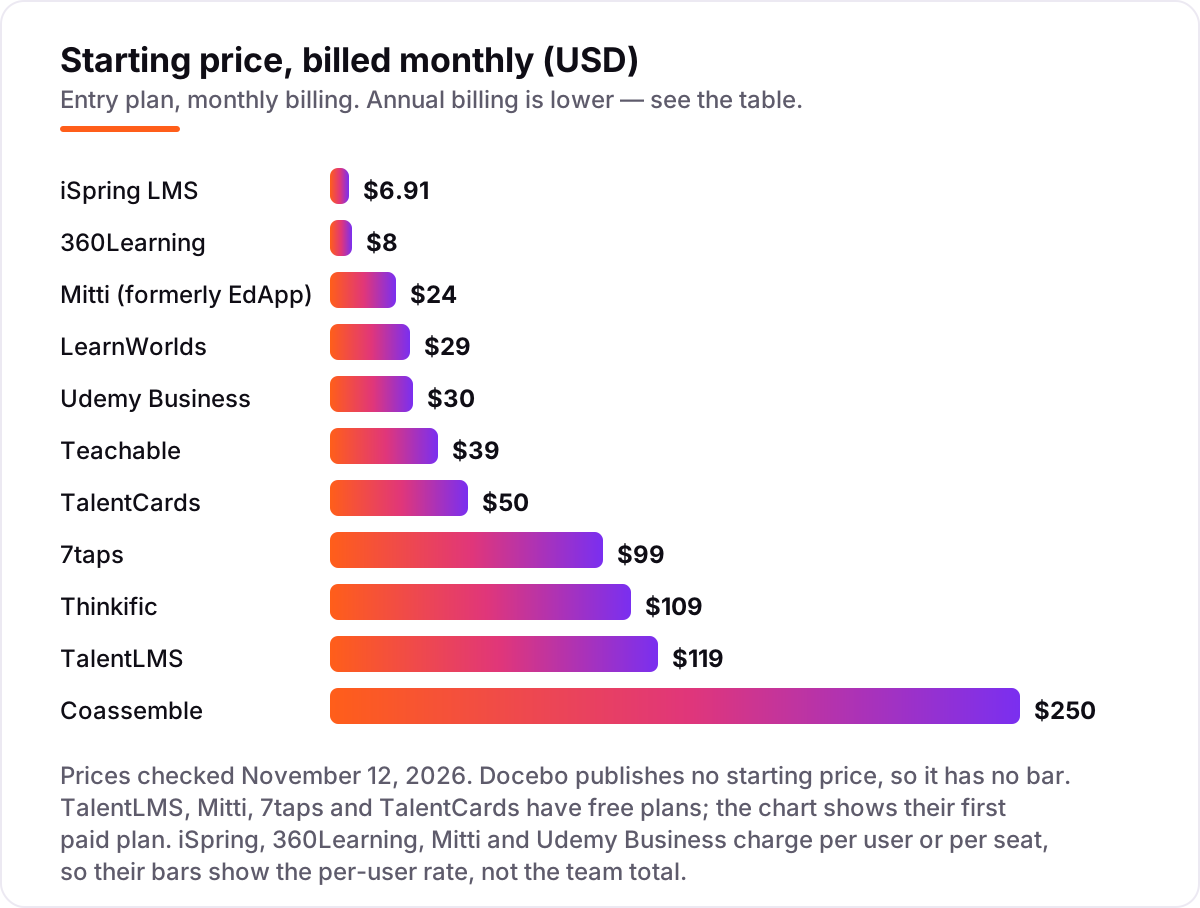
Take a 40-learner team on monthly billing. On list prices, the subscription costs $29 a month on LearnWorlds Starter, $39 on Teachable Starter, $50 on TalentCards Standard, $109 on Thinkific Start, $99 on 7taps Pro, $149 on TalentLMS Core, $250 on Coassemble Build, $320 on 360Learning Team, $690.50 on iSpring Business, $1,160 on Mitti Premium and $1,200 on Udemy Business Team. Docebo publishes no price, so it has no figure here.
Over a year on monthly billing, that is $348 on LearnWorlds, $468 on Teachable, $600 on TalentCards, $1,308 on Thinkific, $1,188 on 7taps, $1,788 on TalentLMS, $3,000 on Coassemble, $3,840 on 360Learning, $8,286 on iSpring, $13,920 on Mitti and $14,400 on Udemy Business. Annual billing cuts most of these: TalentLMS Core drops to $1,428 a year, Thinkific Start to $984, Teachable Starter to $348, LearnWorlds Starter to $288, Mitti Premium to $11,520 and Coassemble Build to $2,500.
Three costs sit outside every number above. First, the pricing unit: iSpring charges for 100 users even when the team has 40, Mitti charges per seat for the whole platform rather than training alone, and LearnWorlds adds $5 per paid enrollment while Teachable takes 7.5% of sales on Starter. Second, the add-ons: branding removal, SSO and SCORM export sit on higher tiers at most tools. Third, the time to author: a tool that needs a course built from scratch costs staff hours that a ready library such as Udemy Business or Mitti's 1,000-plus editable courses avoids.
Know the difference: microlearning platforms and full LMS suites
The confusion in this category is the scope, not the feature list. A microlearning platform is built for short lessons on phones: Mitti, 7taps and TalentCards ship bite-size courses, gamification and offline access, and they measure completion in minutes. A full LMS such as TalentLMS, iSpring LMS or Docebo manages the whole training program: branches, learning paths, certifications, compliance reporting and user groups. The same 40 learners cost $50 a month on TalentCards and $149 on TalentLMS Core — two different answers for the same team, decided by how much structure the training needs.
The scope matters most when training grows. A team that starts with one onboarding deck and ends up running compliance, product training and customer academies outgrows a microlearning tool and needs the LMS features it skipped. A team that only ever needs short refreshers pays for LMS structure it will never open. A third group, the course sellers — LearnWorlds, Thinkific and Teachable — are neither: they sell courses to the public, with checkout, coupons and affiliates, and they charge per enrollment or per sale rather than per learner.
There is a second, quieter confusion: a free plan is not a free program. TalentLMS Free, Mitti Free, 7taps Free and TalentCards Free all cost $0 a month, but every one of them caps users or courses, and the features that prove training worked — reporting, SSO and branding — need a paid plan. Budget on the subscription plus the authoring time, not on the $0 headline.
Quick comparison: tool type by need
| Buyer | Best pick | Why |
|---|---|---|
| A company that wants a real LMS fast | TalentLMS | Free plan; Core is $119/month billed annually for 40 users |
| A frontline team learning on phones | Mitti | Free for 10 users; Premium is $24/seat/month billed annually |
| A team that needs courses built this week | 7taps | Free plan; Pro is $99/month per editor, unlimited learners |
| A field team that learns in card decks | TalentCards | Free plan; Standard is $50/month for 50 users |
| A company where staff write the courses | 360Learning | $8/user/month, billed monthly, no annual contract |
| A company selling courses to the public | LearnWorlds | Starter is $29/month; interactive video included |
Mistakes to avoid
- Budgeting on the headline price alone. A $6.91 per-user price is $690.50 a month at iSpring's 100-user minimum, and Mitti's $24 a seat is $1,160 a month for 40 seats. Price the team you will have, not the rate on the page.
- Comparing monthly prices without checking billing. The annual price is usually about 20% lower — TalentLMS Core drops from $149 to $119 a month — and Udemy Business and iSpring Business have no monthly option at all.
- Ignoring the pricing unit. A tool can be cheap for one person and dear for forty: TalentCards and 360Learning charge per user, TalentLMS per bracket, LearnWorlds per enrollment and Teachable per sale. Price the team you will have next year, not the team you have today.
- Buying a microlearning tool for an LMS job. Short lessons on phones do not run compliance programs, certifications or customer academies. If the training needs branches, paths and audit reports, buy the LMS first.
- Forgetting the free-plan caps. TalentLMS stops at 5 users and 10 courses, Mitti at 10 users and 7taps at one shared course. A free plan that runs out mid-month forces an upgrade at the worst moment.
How we chose
We checked each vendor's own pricing page on November 12, 2026 — directly where it opened, and by fresh search-index crawls of the same page where it did not — and recorded the starting price exactly as shown, including the annual-billing figure where the page lists one, and we ranked the tools by fit for the most common buyer, a small to mid-size US company starting microlearning for 40 learners, not by brand size. Two prices needed extra care. 7taps publishes Pro at $99 a month per editor, but G2's vendor-supplied listing shows a Starter plan at $4,995 a year; we used the vendor's own price and note the conflict here. Docebo publishes no prices, so it has no bar in the chart and no starting price in the list; its AWS Marketplace listing prices Elevate at $35,900 a year for 500 users, which we mention in its card but do not treat as the vendor's starting price. Coassemble's Build price at $250 a month is confirmed by ITQlick's vendor-published listing and G2's vendor-supplied pricing, which shows $2,500 a year. Ratings come from G2 pages crawled within the last three days: TalentLMS 4.6 from 819 reviews, Mitti 4.6 from 486, 7taps 4.8 from 293, TalentCards 4.8 from 26, 360Learning 4.6 from 659, iSpring LMS 4.6 from 175, LearnWorlds 4.7 from 404, Thinkific 4.4 from 427, Teachable 3.8 from 53, Udemy Business 4.5 from 725 and Docebo 4.3 from 752. Coassemble shows no rating because its G2 page was last crawled four days ago, outside our three-day window. No vendor paid for a place in this list, and none of the links here are affiliate links.
What to do next
Start with the free plan or trial of your top pick and run one real lesson through it with five real learners. Check that the lesson works on a phone, that completion shows up in the reports, and that the price for your full team matches the figure in the chart above. If the training is sorted but new customers are not finding the business, our monthly SEO service handles the visibility side. Once your tools are in place, find out what's holding your rankings back.
Frequently asked questions
What is the best platform for microlearning?
For most small and mid-size companies, TalentLMS: a real free plan, Core at $119 a month billed annually for up to 40 learners, and a full LMS behind it. For frontline teams learning on phones, Mitti is the better fit, free for up to 10 users. For speed, 7taps builds and ships a course fastest, with unlimited learners on every plan.
How much do microlearning platforms cost?
From $0 on a free plan to $1,200 a month for 40 learners on Udemy Business Team. For 40 learners on monthly billing, LearnWorlds is $29, Teachable $39, TalentCards $50, Thinkific $109, 7taps $99 and TalentLMS $149. Per-user tools look cheap until you multiply: Mitti is $1,160 a month for 40 seats. Docebo is quoted only.
Are there free microlearning apps?
Yes. Four of the tools here have genuinely free plans: TalentLMS for up to 5 users and 10 courses, Mitti for up to 10 users, 7taps for one shared course with unlimited learners, and TalentCards for up to 5 users. Coassemble offers a free sandbox instead of a free plan. If you want the best microlearning apps free to try, start with Mitti or 7taps for phone-first training.
What is the difference between microlearning and a traditional LMS?
Microlearning platforms deliver short lessons on phones — Mitti, 7taps and TalentCards — and measure completion in minutes. A traditional LMS such as TalentLMS or Docebo manages the whole program: branches, learning paths, certifications and compliance reporting. Small teams that only need refreshers can stop at microlearning; teams running compliance need the LMS.
Can I use a microlearning platform for compliance training?
Yes, if the platform covers the audit trail. TalentLMS and iSpring LMS include certifications, reporting and user groups on their entry plans, and Docebo adds audit-ready reporting at enterprise scale. Mitti, 7taps and TalentCards cover completion tracking, but check that the plan includes the reports your auditor needs before you commit.
How long should a microlearning lesson be?
Short enough to finish between jobs — a few minutes, not a half-hour module. The tools here are built around that shape: Mitti and TalentCards deliver card and video lessons designed for a phone, and 7taps ships courses learners finish in one sitting. If a lesson needs more than a few minutes, split it into two cards rather than one long video.
Can I switch microlearning platforms later?
Yes, but exports vary. 7taps needs Enterprise for SCORM and xAPI export, so a free or Pro library does not travel cleanly. TalentLMS, iSpring LMS and LearnWorlds support SCORM on their entry plans. Before you buy, check that the plan you choose exports the format your next platform imports.
Sources we checked (23)
- TalentLMS pricing — talentlms.com/prices (checked November 12, 2026)
- Mitti pricing — mitti.com/pricing (checked November 12, 2026)
- 7taps pricing — 7taps.com/pricing (checked November 12, 2026)
- TalentCards pricing — talentcards.com/pricing (checked November 12, 2026)
- 360Learning pricing — 360learning.com/pricing (checked November 12, 2026)
- iSpring LMS pricing — ispringsolutions.com/ispring-learn/pricing (checked November 12, 2026)
- LearnWorlds pricing — learnworlds.com/pricing (checked November 12, 2026)
- Thinkific pricing — thinkific.com/pricing (checked November 12, 2026)
- Teachable pricing — teachable.com/pricing (checked November 12, 2026)
- Udemy Business pricing — business.udemy.com/pricing (checked November 12, 2026)
- Coassemble pricing — coassemble.com/pricing (checked November 12, 2026)
- Docebo pricing — docebo.com/pricing (checked November 12, 2026)
- TalentLMS on G2 — 4.6 from 819 reviews (checked November 12, 2026)
- Mitti on G2 — 4.6 from 486 reviews (checked November 12, 2026)
- 7taps on G2 — 4.8 from 293 reviews (checked November 12, 2026)
- TalentCards on G2 — 4.8 from 26 reviews (checked November 12, 2026)
- 360Learning on G2 — 4.6 from 659 reviews (checked November 12, 2026)
- iSpring LMS on G2 — 4.6 from 175 reviews (checked November 12, 2026)
- LearnWorlds on G2 — 4.7 from 404 reviews (checked November 12, 2026)
- Thinkific on G2 — 4.4 from 427 reviews (checked November 12, 2026)
- Teachable on G2 — 3.8 from 53 reviews (checked November 12, 2026)
- Udemy Business on G2 — 4.5 from 725 reviews (checked November 12, 2026)
- Docebo on G2 — 4.3 from 752 reviews (checked November 12, 2026)
Make one of these tools?
We re-check this list every quarter. Send a correction, request a review, or ask about a clearly labeled sponsored spot.
Request a listingShamim
Founder of SerpAstra
A full-stack SEO and digital marketer who spends most days on Local SEO for dental practices, AI search visibility and lead generation.
Free SEO and AI visibility audit
Find out what is holding your rankings back
Send us your site. Within 2 business days you get a written audit, an AI visibility check and a short fix list ranked by impact. Free, with no contract attached.
Request my free audit→Related buying guides
 HR & Payroll8 Best HR Software for Small Business in 2026, ComparedCompare the 8 best hr software for small business options on price, free plans, payroll and hiring, with every price checked November 6, 2026.Read guide →
 HR & Payroll12 Best Employee Performance Review Software in 2026, ComparedCompare the 12 best employee performance review software tools on price, reviews, calibration and AI features, with prices checked November 6, 2026.Read guide →
 Marketing8 Best AI Tools for Content Creators in 2026 (Free and Paid, Compared)The 8 best ai tools for content creators, compared on price, free plans and strengths — writing, design, video. Prices checked on vendor sites, Nov 2, 2026.Read guide →