10 Best Platforms for Content for Startups in 2026, Compared
Compare the 10 best platform for content for startups options on price, free plans and features, with every price checked November 12, 2026.
 Shamim Mia, Founder, SerpAstraLast verified November 12, 202615 min read
We compare pricing pages, documentation and public reviews. We never accept payment for rankings.

Key takeaways
- Notion leads for planning at $0, with Canva from $18 a month for design and Frase from $49 a month for content that must rank.
- The single most important buying factor is the pricing unit: per-member, per-seat, per-channel and flat pricing turn a cheap solo plan into a dear team plan.
- Seven of the 10 tools have a genuinely free plan — Notion, Canva, HubSpot Content Hub, WordPress.com, Writesonic, Copy.ai and Buffer — but the features that earn revenue usually need a paid plan.
- Every price below was checked on the vendor's own pricing page on November 12, 2026. Ratings are G2, with review counts shown.
On this page
Quick comparison
| Tool | Best for | Starting price | Free plan |
|---|---|---|---|
| Notion | Startup teams that need one shared home for content plans, briefs and drafts | $12/member/mo | Yes (free plan) |
| Canva | Startups with no designer that need on-brand graphics, decks and social posts fast | $18/mo | Yes (free plan) |
| HubSpot Content Hub | Startups that want their website, blog and CRM in one place from day one | $20/seat/mo | Yes (free tools) |
| WordPress.com | Startups that want a hosted blog they can grow without touching a server | $9/mo | Yes (free plan) |
| Jasper | Startups that publish a lot and need every draft to sound like the same brand | $69/seat/mo | No (7-day trial) |
| Writesonic | Solo founders and small teams that want cheap AI drafts with SEO tools included | $20/mo | Yes (free plan) |
| Copy.ai | Small teams that want shared AI chat across GPT, Claude and Gemini for one flat price | $49/mo | Yes (free plan) |
| Frase | Startups that publish 10 or fewer articles a month and want each one to rank | $49/mo | No (7-day trial) |
| Ghost | Startups building a newsletter-led publication with memberships in mind | $18/mo | No (14-day trial) |
| Buffer | Startups that publish to a few social channels and want scheduling without a learning curve | $6/channel/mo | Yes (free plan) |
Make one of these tools?
We re-check this list every quarter. Send a correction, request a review, or ask about a clearly labeled sponsored spot.
Request a listingThe best platform for content for startups

Notion
Best for: Startup teams that need one shared home for content plans, briefs and drafts
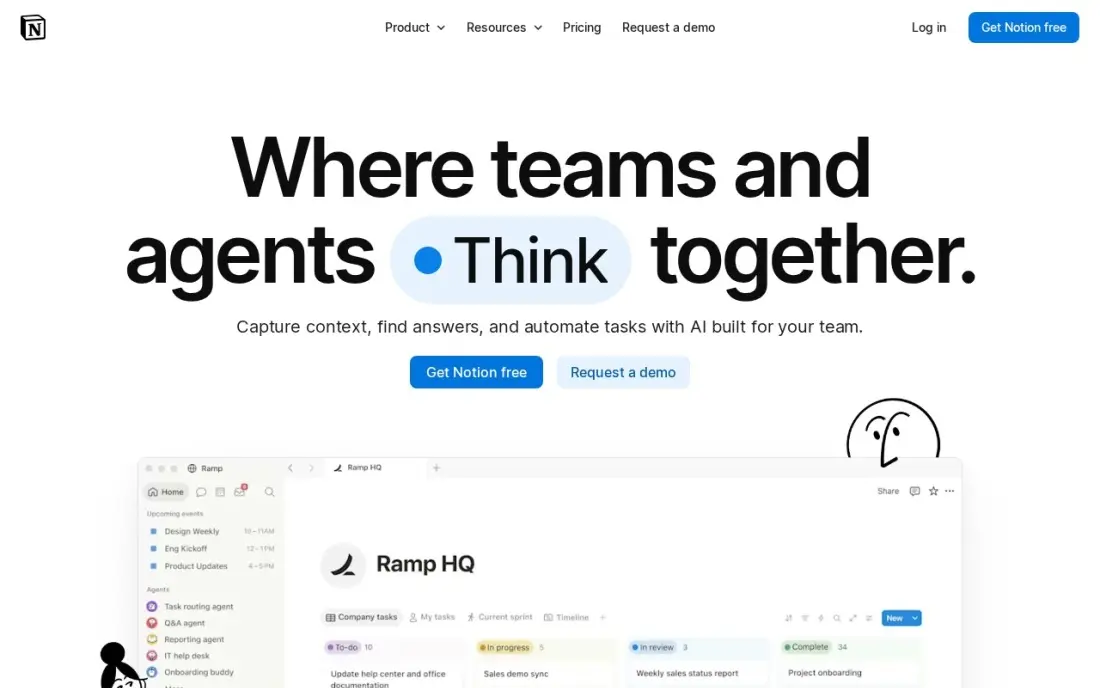
Notion is the planning hub in this list: one workspace holds the content calendar, the briefs and the drafts, so a startup team stops losing ideas in chat threads and scattered documents. Databases turn the calendar into a real workflow, with status, owner, due date and brief in a single row, and Plus adds unlimited file uploads, 30-day page history and unlimited guests for freelancers.
The catch is the setup cost of a blank page: the structure has to be built from templates before the calendar feels like a system, and the bill grows with every hire at $10 a member a month on annual billing. Pick Notion when the team needs one shared home for plans and drafts; pick Frase when the bottleneck is ranking, not organising.
What we like
- The cheapest planning hub here: a free plan for individuals and Plus at $10 a member a month billed annually
- Databases turn a content calendar into a real workflow — status, owner, due date and brief in one row
- Unlimited file uploads and 30-day page history on Plus, with unlimited guests for freelancers
- One workspace holds the calendar, the briefs and the drafts, so nothing lives in a separate doc
Watch out for
- Notion AI's full use sits on paid plans, so the free plan only gets a limited trial
- Per-member pricing grows with every hire, so a 10-person team pays $120 a month on annual billing
- The blank-page freedom is a setup cost: templates and structure take time to build

Canva
Best for: Startups with no designer that need on-brand graphics, decks and social posts fast
Canva is the design shortcut in this list: a founder with no designer can ship on-brand graphics, decks and social posts the same afternoon, using templates, drag-and-drop and 141M+ premium assets. Pro at $18 a month adds 5 Brand Kits, background remover, Magic Resize and 100 GB of storage, and the free plan is genuinely usable, with hundreds of thousands of templates at $0.
The catch is that Pro is a one-person plan: a second designer means Business at $25 a person a month, and AI use is metered, so heavy AI work can need the AI Pass add-on. Print and premium stock cost extra on top. Pick Canva when design is the bottleneck; pick a writer like Writesonic when the words are the bottleneck instead.
What we like
- The fastest way for a non-designer to ship on-brand graphics: templates, drag-and-drop and 141M+ premium assets
- Pro adds 5 Brand Kits, background remover, Magic Resize and 100 GB of storage for $18 a month
- A usable free plan with hundreds of thousands of templates, so a startup can start at $0
- Social scheduling is built in, so finished graphics can go straight to the channels
Watch out for
- Pro covers one person only — a second designer means Business at $25 a person a month
- AI use is metered, so heavy AI work can need the AI Pass add-on
- Print and premium stock costs sit outside the subscription

HubSpot Content Hub
Best for: Startups that want their website, blog and CRM in one place from day one
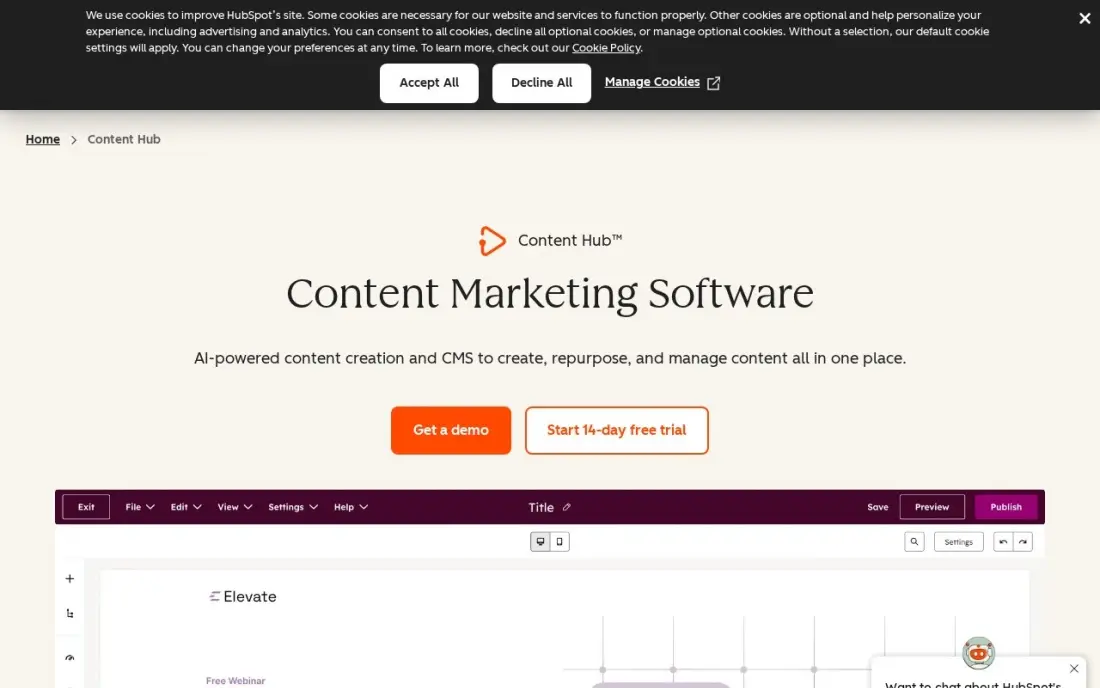
HubSpot Content Hub is the all-in-one in this list: the website, the blog and the CRM live in one subscription, so a lead captured by a blog post lands in the same system that sends the follow-up email. Starter is $20 a seat a month, with new customers currently seeing a $7-a-seat annual promo, and the free tools cover a blog, forms and the CRM for up to two users at $0.
The catch is the ceiling: Starter stops at 30 website pages and one blog, and the next step, Professional, jumps to $500 a month — the steepest climb here. A/B testing, smart content and memberships all wait for that tier. Pick HubSpot when the CRM matters as much as the blog; pick WordPress.com when the site alone is enough.
What we like
- The only tool here that combines the website, the blog and the CRM in one subscription
- Starter removes HubSpot branding and adds SEO recommendations and dynamic content
- Free tools cover a blog, forms and the CRM, so a startup can start at $0 and upgrade later
- New customers currently see a $7-a-seat annual promo against the $20 list price
Watch out for
- Starter caps at 30 website pages and one blog, so a growing site outgrows it fast
- Professional jumps to $500 a month — the steepest step up in this list
- A/B testing, smart content and memberships all wait for Professional

WordPress.com
Best for: Startups that want a hosted blog they can grow without touching a server
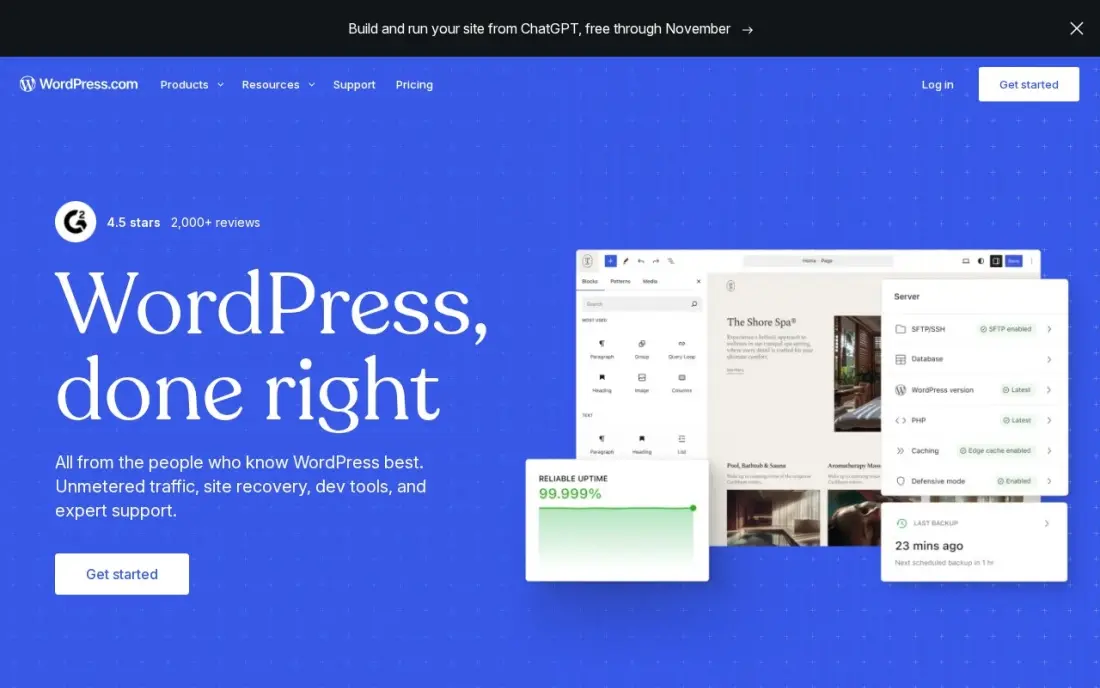
WordPress.com is the cheapest publishing home here: Personal is $9 a month, or $4 billed annually, and it buys a custom domain for the first year, ad-free browsing and managed hosting, with security, backups and speed handled and no server to maintain. Plugin installation now comes with every paid plan, and the free plan is genuinely free forever, so a startup can publish before it pays.
The catch is the first-year price: the $4 annual rate rises in year two, with WordPress.com's own cost guide putting it at $5 a month, and Personal storage is only 6 GB. The free plan shows WordPress.com ads and locks the site to a subdomain. Pick WordPress.com when the blog is the business; pick Ghost when the newsletter matters more.
What we like
- The cheapest publishing home here: Personal is $9 a month, or $4 billed annually
- A custom domain for the first year and ad-free browsing from the first paid plan
- Managed hosting — security, backups and speed are handled, with no server to maintain
- The free plan is genuinely free forever, so a startup can publish before it pays
Watch out for
- The free plan shows WordPress.com ads to visitors and locks the site to a subdomain
- Storage is 6 GB on Personal, so a media-heavy site outgrows it fast
- Monetisation tools and advanced SEO controls sit on higher tiers

Jasper
Best for: Startups that publish a lot and need every draft to sound like the same brand
Jasper is the brand-voice writer in this list: Brand Voice trains on real writing samples and holds the tone across blog posts, ads and emails, so a startup that publishes a lot still sounds like one company. Pro is $69 a seat a month, or $59 billed annually, and covers one seat with the Canvas workspace, agents for core marketing workflows, 2 Brand Voices and 5 Knowledge assets.
The catch is the price of that consistency: there is no free plan, only a 7-day trial, so the first month costs $69 before the value is proven, and a second writer means a custom Business quote. API access and the GEO hub also wait for Business. Pick Jasper when volume and a single voice matter most; pick Writesonic when $20 a month is the budget.
What we like
- Brand Voice trains on real writing samples and holds the tone across blog posts, ads and emails
- Canvas workspace plus agents for core marketing workflows, with 2 Brand Voices and 5 Knowledge assets on Pro
- The highest-rated AI writer here on G2 at 4.7 from 1,319 reviews
- Agents handle core marketing workflows, and Canvas keeps long-form drafts organised in one place
Watch out for
- Pro covers one seat — adding a teammate means a custom Business quote
- No free plan, only a 7-day trial, so the first month is $69 before the value is proven
- API access, custom agents and unlimited Brand Voices all wait for Business

Writesonic
Best for: Solo founders and small teams that want cheap AI drafts with SEO tools included
Writesonic is the budget AI writer in this list: Individual is $20 a month, or $16 billed annually, and covers one user with 100 credits a month, the full template library, Article Writer and Chatsonic. Article Writer 6.0 checks facts against live web data, so drafts start from current information, and a free plan with a small credit allowance lets a startup test real output before paying.
The catch is the credit meter: a heavy month burns through 100 credits faster than expected, and a second writer needs Standard at $99 a month — a five-fold jump. The plan names and credit limits have also changed during 2026, so confirm them at checkout. Pick Writesonic when $20 is the budget; pick Frase when the articles must rank.
What we like
- The cheapest AI writer here at $20 a month, with 100 credits a month on Individual
- Article Writer, Chatsonic and the full template library are included from the entry plan
- A free plan with a small credit allowance lets a startup test real output before paying
- Article Writer 6.0 checks facts against live web data, so drafts start from current information
Watch out for
- Individual covers one user — a second writer needs the Standard plan at $99 a month
- Credit limits mean heavy months burn through the allowance faster than expected
- The plan names and credit limits have changed during 2026, so confirm them at checkout

Copy.ai
Best for: Small teams that want shared AI chat across GPT, Claude and Gemini for one flat price
Copy.ai is the team chat option in this list: Starter is $49 a month, or $36 billed annually, and buys one seat with unlimited words in chat, unlimited chat projects and access to GPT, Claude and Gemini models in one place. A free plan with 2,000 words in Chat lets a startup test real output before paying, and the chat format suits teams that brainstorm and draft together.
The catch is the seat count: Starter covers one person, so a five-seat team needs Advanced at $249 a month, and workflow automation with workflow credits waits for that tier too. Chat alone cannot automate a pipeline. Pick Copy.ai when the team thinks in chat; pick Jasper when long-form drafts with a set brand voice are the job.
What we like
- One flat price for a single seat: $49 a month buys unlimited words in chat and unlimited chat projects
- Chat works across GPT, Claude and Gemini models, so the team is not locked to one provider
- A free plan with 2,000 words in Chat lets a startup test real output before paying
- A good fit for teams that brainstorm and draft in chat rather than in long-form documents
Watch out for
- Starter covers one seat only — a five-seat team needs Advanced at $249 a month
- Workflow automation and workflow credits wait for Advanced, so Chat alone cannot automate
- No free trial beyond the free plan, and the free plan stops at 2,000 words in Chat

Frase
Best for: Startups that publish 10 or fewer articles a month and want each one to rank

Frase is the ranking specialist in this list: Starter is $49 a month, or $39 billed annually, and covers research, briefs, AI drafting and optimisation for 10 articles a month, with 50 audit pages and AI visibility tracking across the major AI engines from the entry plan. At 4.8 from 311 G2 reviews it carries the highest score here, and the 7-day trial needs no card.
The catch is the hard cap: Starter stops at 10 articles a month with no overage option, so an 11th article forces an upgrade to Professional at $129 a month. It is also one seat and one site only, and internal linking waits for Professional. Pick Frase when each article must rank; pick Writesonic when volume matters more than the score.
What we like
- The highest G2 score here at 4.8 from 311 reviews, and the only tool built around SERP research
- Starter covers research, briefs, AI drafting and optimisation for 10 articles a month
- AI visibility tracking covers the major AI engines from the entry plan
- A 7-day trial with no card required, so a startup can run a real article through it first
Watch out for
- Starter stops at 10 articles a month with no overage option — an 11th article needs an upgrade
- One seat and one site only, so a second writer or a second site means Professional
- Internal linking is a Professional feature, not included on Starter

Ghost
Best for: Startups building a newsletter-led publication with memberships in mind
Ghost is the newsletter publisher in this list: a fast website, email newsletter and memberships in one open-source platform, with unlimited email sends on every plan and hosting, SSL, CDN and backups included. Starter is $18 a month, or $15 billed annually, for up to 1,000 members, and the editor is the cleanest here — writing feels like writing, not filling in a form.
The catch is that Starter cannot sell paid subscriptions — that needs Publisher at $29 a month billed annually, where Ghost still takes 0% of the revenue. Starter also allows only one staff user and one newsletter, with the default theme only, and the price rises with member count past 1,000. Pick Ghost when the newsletter is the product; pick WordPress.com when the blog alone is enough.
What we like
- A fast website, email newsletter and memberships in one open-source platform
- Ghost takes 0% of paid membership revenue on plans that support subscriptions
- Unlimited email sends on every plan, with hosting, SSL, CDN and backups included
- The cleanest editor here — writing feels like writing, not filling in a form
Watch out for
- Starter cannot sell paid subscriptions — that needs Publisher at $29 a month billed annually
- Only one staff user and one newsletter on Starter, with the default theme only
- The price rises with member count, including free members, past 1,000

Buffer
Best for: Startups that publish to a few social channels and want scheduling without a learning curve
Buffer is the simple scheduler in this list: Essentials is $6 a channel a month, or $5 billed annually, for one user with unlimited scheduled posts, an AI assistant that rewrites per network and analytics with unlimited history. The free plan covers 3 channels with 10 scheduled posts each, and a week of posts queues in one sitting across 12 channels, including LinkedIn, TikTok, Threads and Bluesky.
The catch is the per-channel meter: a brand on eight networks pays $48 a month, eight times the entry price, and a second person means Team at $12 a channel — double the rate. Approvals and draft review also wait for Team. Pick Buffer when the channels are few and the team is one; pick a per-seat scheduler when the channel count grows.
What we like
- The cheapest distribution here at $6 a channel a month, with a free plan for 3 channels
- Unlimited scheduled posts on Essentials, with an AI assistant that rewrites per network
- The simplest scheduler in this list — a week of posts queues in one sitting
- Publishes to 12 channels including LinkedIn, TikTok, Threads and Bluesky
Watch out for
- Priced per channel, so a brand on eight networks pays eight times the entry price
- Essentials is a one-user plan — a second person means Team at double the rate
- Approvals and draft review sit on Team, not on Essentials
The best platform for content for startups is not one tool but a small stack that covers three jobs: planning the calendar, writing and designing the pieces, and publishing them where buyers look. The 10 tools below are ranked by fit for the most common buyer, a startup team of one to five people publishing about eight pieces a month, and every price was checked on the vendor's own pricing page on November 12, 2026.
How to choose the best platform for content for startups
- Count who pays first. Notion and HubSpot Content Hub charge per member or seat, Buffer charges per channel, and WordPress.com and Frase charge one flat price. The pricing unit decides what a growing team pays, not the headline price.
- Check the free-plan caps. Buffer stops at 10 scheduled posts per channel, Copy.ai at 2,000 words in Chat, and WordPress.com shows ads on the free plan. A free plan that runs out mid-month is not a free plan.
- Check what the entry plan leaves out. Approvals wait for Buffer Team, paid subscriptions wait for Ghost Publisher, and Jasper's GEO hub waits for Business. The missing feature is usually the one the startup needs next.
- Check the AI limits. Writesonic meters by credits, Canva meters AI use, and Jasper covers one seat on Pro. A writer that runs out mid-month stalls the whole calendar.
- Check where the content lives. Notion plans it, Jasper and Writesonic write it, Canva designs it, WordPress.com and Ghost publish it, and Buffer sends it out. One tool rarely does all five jobs well.
- Think about the next year, not the next month. A solo founder who hires two writers needs a plan that grows by the person, not one that jumps to an enterprise tier.
Content tools make the pieces, but they do not bring readers on their own. If the startup is not showing up when buyers search or ask AI assistants, our AI search optimization service covers that side. And before the team publishes its next article, the free keyword density checker shows whether the target phrase appears often enough without stuffing.
Whatever you shortlist, try it with real content before you pay. The trials in this list run 7 to 14 days, which is long enough to plan one week, draft one article, design one graphic and publish it to a live channel. Check two things in the trial: that the whole workflow fits in the one tool or stack you picked, and that the price stays the same when a second person joins. Every tool here offers a trial or a free plan, so there is no reason to buy before the team has run a real week on it.
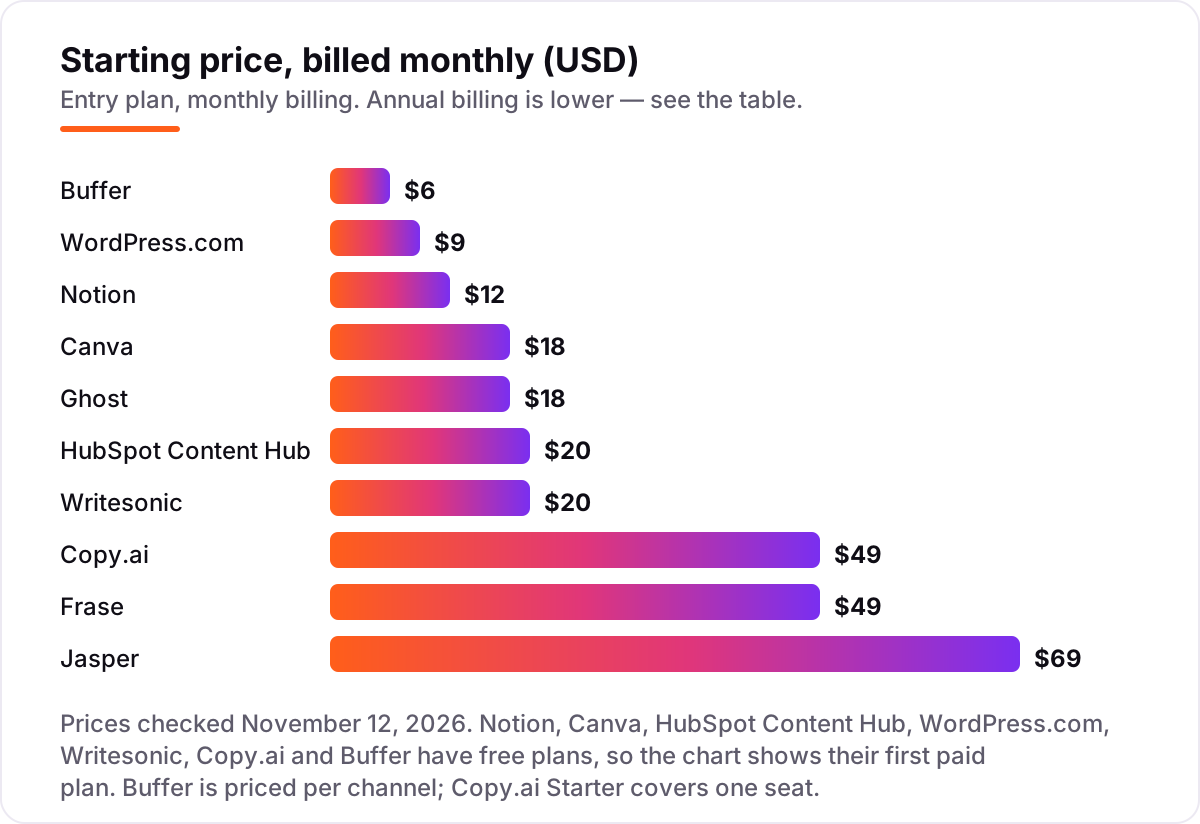
Platform for content for startups pricing: what you will actually pay
Take a five-person startup publishing eight pieces a month to four social channels. On annual billing, a practical stack costs $102 a month: Notion Plus at $10 a member for five people ($50), Canva Pro at $12, WordPress.com Personal at $4, Writesonic Individual at $16 and Buffer Essentials at $5 a channel for four channels ($20). On monthly billing the same stack costs $131 a month: $60 for Notion, $18 for Canva, $9 for WordPress.com, $20 for Writesonic and $24 for Buffer. Over a year that is $1,224 on annual billing against $1,572 on monthly billing — a $348 saving for paying yearly.
The swaps show where the money goes. Replacing Writesonic with Jasper Pro at $59 a month on annual billing lifts the stack to $145 a month. Replacing it with Frase Starter at $39 lifts it to $125. Replacing WordPress.com with HubSpot Content Hub Starter for one seat at $20 lifts it to $118, or $105 while the $7 new-customer annual promo lasts. Replacing Writesonic with Copy.ai Starter at $36 a month on annual billing lifts it to $122. Each swap buys one thing — brand voice, ranking, or the CRM — and the stack stays under $150 a month on annual billing in every case.
Three costs sit outside every number above. First, the second seat: Jasper Pro and Copy.ai Starter each cover one person, so a second writer means a Business quote or Advanced at $249 a month. Second, the channel count: Buffer at $5 a channel means eight channels cost $40 a month, not $20. Third, the step up: HubSpot Professional at $500 a month and Frase Professional at $103 are the prices that bite when the startup outgrows the entry tier, so check them before the team depends on the tool.
Know the difference: planning, writing and publishing are three different jobs
The confusion in this category is the job, not the feature list. Planning tools organise the work: Notion holds the calendar, the briefs and the drafts in one workspace, and HubSpot Content Hub holds the site, the blog and the CRM together. Writing tools produce the words: Jasper holds one brand voice across every draft, Writesonic drafts cheaply with SEO tools included, Copy.ai drafts in chat across three model families, and Frase researches the search results first and then writes to beat them. Publishing tools put the words in front of readers: WordPress.com and Ghost host the site and the newsletter, Canva makes the graphics that carry the post, and Buffer sends it to the channels.
The mistake is buying one tool to do all three jobs. A planner with no writer still leaves a blank page at the end of the week; a writer with no planner still leaves five drafts with no owner and no due date; a publisher with no distribution still leaves a good article that nobody reads. The stack in the pricing example works because each tool does one job: Notion plans, Writesonic writes, Canva designs, WordPress.com publishes and Buffer distributes. Buy the tool for the job that hurts most today, and add the next one when that job is covered.
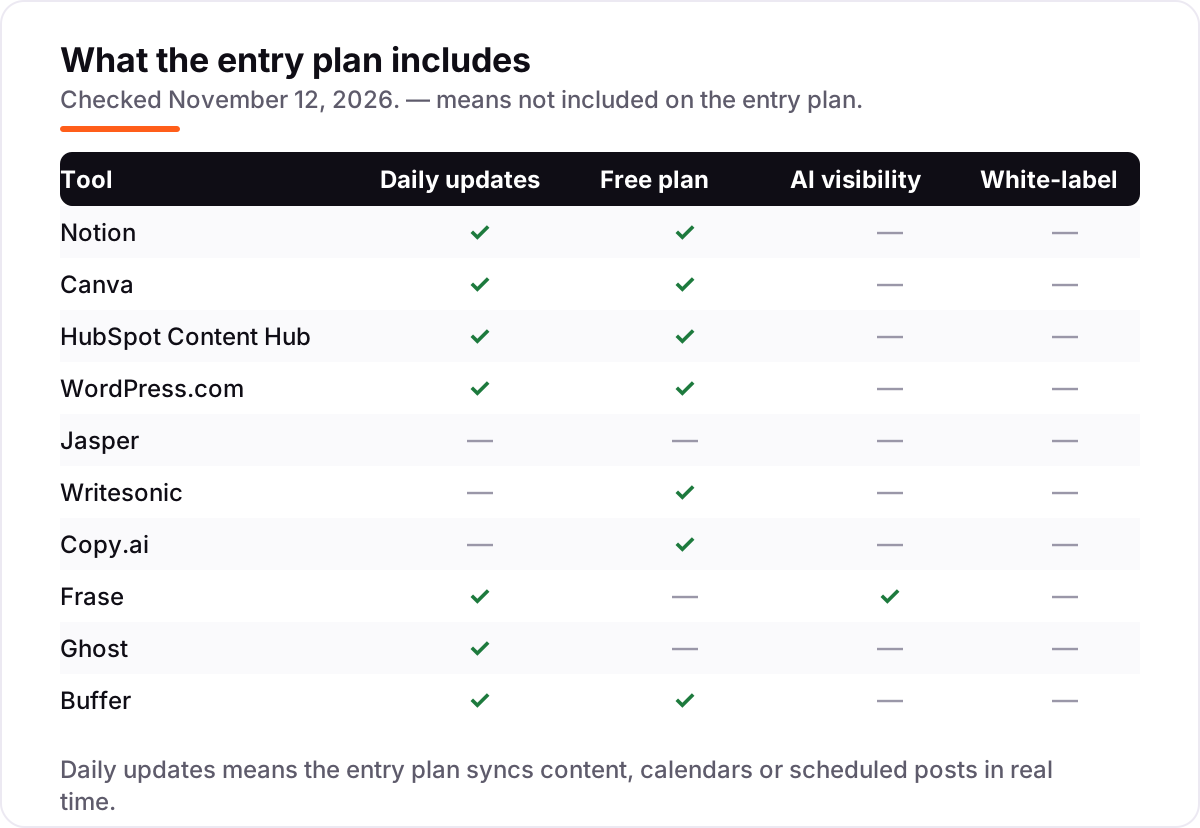
There is a second, quieter confusion: a free plan is not a free content operation. Notion, Canva, HubSpot Content Hub, WordPress.com, Writesonic, Copy.ai and Buffer all cost $0 a month to start, but the features that earn revenue — paid subscriptions on Ghost, approvals on Buffer, the GEO hub on Jasper — need a paid plan. Budget on the subscription plus the next tier, not on the $0 headline.
Quick comparison: tool type by need
| Buyer | Best pick | Why |
|---|---|---|
| Startup that needs one home for plans and drafts | Notion | Free plan, Plus is $10/member/month billed annually |
| Startup with no designer | Canva | Free plan, Pro is $18/month for one person |
| Startup that wants website, blog and CRM together | HubSpot Content Hub | Free tools, Starter is $20/seat/month |
| Startup that wants the cheapest hosted blog | WordPress.com | Free plan, Personal is $9/month, $4 billed annually |
| Startup publishing 10 articles a month that must rank | Frase | Starter is $49/month, AI visibility included |
| Startup that needs social scheduling only | Buffer | Free plan for 3 channels, Essentials is $6/channel/month |
Mistakes to avoid
- Budgeting on the subscription alone. The second seat, the fourth channel and the next tier are where the money goes: Jasper Pro and Copy.ai Starter each cover one person, and Buffer charges per channel. Price the team you will have next year, not the team you have today.
- Comparing monthly prices without checking annual billing. The annual price is usually 15–20% lower — Notion Plus drops from $12 to $10 a member a month, Writesonic from $20 to $16 — and a few tools have no annual option at all.
- Buying an AI writer before the calendar exists. A writer with no plan still leaves five drafts with no owner and no due date. Start with Notion at $0, add the writer when drafting is the bottleneck.
- Paying for a seat the team does not fill. Canva Pro covers one person, Jasper Pro one seat and Copy.ai Starter one seat. A solo founder pays for capacity nobody uses when the plan is built for a team.
- Forgetting the free-plan caps. Buffer stops at 10 scheduled posts per channel, Copy.ai at 2,000 words in Chat and WordPress.com shows ads on the free plan. A free plan that runs out mid-month forces an upgrade at the worst moment.
How we chose
We checked each vendor's own pricing page on November 12, 2026 through fresh search-index crawls of the vendor's own pages, most crawled within a day, and recorded the starting price exactly as shown, including the annual-billing figure where the page lists one, and we ranked the tools by fit for the most common buyer — a startup team of one to five people publishing about eight pieces a month — not by brand size. Three prices needed extra care. Copy.ai's $29 Chat plan for five seats, listed in earlier drafts, is retired: its own site pages now show a free plan, Starter at $49 a month for one seat ($36 billed annually) and Advanced at $249 a month for up to five seats, so the entry price here is Starter. Writesonic's Individual allowance is now 100 credits a month, not 100,000 words, and its AI visibility tracking sits above the entry plan. Jasper's GEO hub runs on the Business plan, not Pro, so Jasper shows no AI visibility on its entry plan. WordPress.com's $4 annual figure is a first-year rate; its own cost guide puts year two at $5 a month. HubSpot's $7 annual promo is for new customers only, with a $10 monthly promo alongside it. Ratings come from G2 pages crawled within three days of November 12, 2026: Frase 4.8 from 311 reviews, Canva 4.7 from 7,529, Jasper 4.7 from 1,319, Writesonic 4.7 from 2,149, Notion 4.6 from 13,976, HubSpot Content Hub 4.5 from 2,205, WordPress.com 4.4 from 2,716, Buffer 4.3 from 1,043 and Ghost 4.0 from 40. Copy.ai shows no rating because no G2 product page for it could be verified. No vendor paid for a place in this list, and none of the links here are affiliate links.
What to do next
Start with the free plan or trial of your top pick and run one real week of content through it: plan the week in Notion, draft one article, design one graphic and publish it to a live channel. Check that the workflow fits in the stack you picked and that the price stays the same when a second person joins. If the stack is sorted but buyers are not finding the content, our monthly SEO service handles the visibility side — or compare providers in our guide to SEO companies for small business. Once your tools are in place, find out what's holding your rankings back.
Frequently asked questions
What is the best platform for content for startups?
Notion is the best starting point for most startups at $0, because the calendar, briefs and drafts live in one place. Add Canva from $18 a month for design and Frase from $49 a month when articles must rank. Startups that want the website, blog and CRM together should look at HubSpot Content Hub instead.
How much does a content platform cost for a startup?
Most startups pay $0 to $69 a month for the first subscription. A practical five-tool stack — Notion, Canva, WordPress.com, Writesonic and Buffer — costs $102 a month on annual billing, or $131 on monthly billing. Swapping in Jasper or Frase pushes the stack to $145 or $125 a month on annual billing.
Is there a free platform for content for startups?
Yes, with limits. Seven tools here have free plans: Notion, Canva, HubSpot Content Hub, WordPress.com, Writesonic, Copy.ai and Buffer. The caps matter most: Buffer stops at 10 scheduled posts per channel, Copy.ai at 2,000 words in Chat, and WordPress.com shows ads and locks the site to a subdomain.
What is the difference between per-seat, per-channel and flat pricing?
Per-seat pricing, like Jasper and HubSpot Content Hub, charges for each person, so the bill grows with every hire. Per-channel pricing, like Buffer, charges for each network, so eight channels cost eight times the entry price. Flat pricing, like WordPress.com and Frase, charges one price no matter how many people use it.
Do startups need an AI writer, or is a planner enough?
Start with the planner. Notion at $0 holds the calendar, briefs and drafts, and most early startups write too little for an AI writer to pay for itself. Add Writesonic at $20 a month when drafting is the bottleneck, Jasper at $69 when every draft must sound like the same brand, and Frase at $49 when articles must rank.
Can a startup switch content platforms later?
Yes, but move in a quiet week. Export the content calendar, drafts, brand assets and scheduled posts, then import them into the new tool and test publishing before going live. Keep the old tool open until the new one is proven, because a mid-week switch is how drafts and scheduled posts get lost.
What should a startup check before paying for a content platform?
Check how the price grows with the team, whether the free plan caps will bind in the first month, and what the entry plan leaves out — usually AI limits, approvals and paid subscriptions. Then run the trial with real content: plan one week, draft one article, design one graphic and publish it to a live channel.
Sources we checked (19)
- Notion pricing — notion.com/pricing (checked November 12, 2026)
- Notion on G2 — 4.6/5, 13,976 reviews (checked November 12, 2026)
- Canva pricing — canva.com/pricing (checked November 12, 2026)
- Canva on G2 — 4.7/5, 7,529 reviews (checked November 12, 2026)
- HubSpot Content Hub pricing — hubspot.com/pricing/content (checked November 12, 2026)
- HubSpot Content Hub on G2 — 4.5/5, 2,205 reviews (checked November 12, 2026)
- WordPress.com pricing — wordpress.com/pricing (checked November 12, 2026)
- WordPress.com on G2 — 4.4/5, 2,716 reviews (checked November 12, 2026)
- Jasper pricing — jasper.ai/pricing (checked November 12, 2026)
- Jasper on G2 — 4.7/5, 1,319 reviews (checked November 12, 2026)
- Writesonic pricing — writesonic.com/pricing (checked November 12, 2026)
- Writesonic on G2 — 4.7/5, 2,149 reviews (checked November 12, 2026)
- Copy.ai pricing — copy.ai/prices (checked November 12, 2026)
- Frase pricing — frase.io/pricing (checked November 12, 2026)
- Frase on G2 — 4.8/5, 311 reviews (checked November 12, 2026)
- Ghost pricing — ghost.org/pricing (checked November 12, 2026)
- Ghost on G2 — 4.0/5, 40 reviews (checked November 12, 2026)
- Buffer pricing — buffer.com/pricing (checked November 12, 2026)
- Buffer on G2 — 4.3/5, 1,043 reviews (checked November 12, 2026)
Make one of these tools?
We re-check this list every quarter. Send a correction, request a review, or ask about a clearly labeled sponsored spot.
Request a listingShamim
Founder of SerpAstra
A full-stack SEO and digital marketer who spends most days on Local SEO for dental practices, AI search visibility and lead generation.
Free SEO and AI visibility audit
Find out what is holding your rankings back
Send us your site. Within 2 business days you get a written audit, an AI visibility check and a short fix list ranked by impact. Free, with no contract attached.
Request my free audit→Related buying guides
 Data, Analytics & AI11 Best AI Content Generation Tools in 2026 (Free and Paid, Compared)11 best ai content generation tools compared on price, free plans, SEO scoring and AI visibility. Prices checked on the vendor pricing page, November 2, 2026.Read guide →
 SEO & AI Search VisibilityBest AI Writing Tools for SEO in 2026: 7 Picks Ranked by What You Need7 best ai writing tools for seo compared on price, live scoring, and drafting power. Prices checked on each vendor pricing page, November 1, 2026.Read guide →
 Marketing10 Best Content Marketing Software in 2026, Compared10 best content marketing software tools compared on price, planning, optimization and publishing, with starting prices and the right pick for every team size.Read guide →