7 Best PIM Software for Ecommerce Sites in 2026, Compared
Compare the 7 best PIM software for ecommerce sites on catalog size, channels, free editions and real cost, with every price checked on vendor pages.
 Shamim Mia, Founder, SerpAstraLast verified November 10, 20268 min read
We compare pricing pages, documentation and public reviews. We never accept payment for rankings.

Key takeaways
- Plytix is the easiest PIM to start with: a free plan for 500 SKUs with unlimited users, and paid plans from $699 a month on a monthly commitment.
- Akeneo Community Edition and Pimcore Community are free and open source, but you host, secure and upgrade them yourself — budget developer time, not licence fees.
- Salsify is the enterprise pick for brands that syndicate to retailers and marketplaces, and it publishes no price at all.
- Under about 1,000 SKUs and one sales channel, a spreadsheet-style database such as Airtable often does the job until a real PIM pays for itself.
On this page
Quick comparison
| Tool | Best for | Starting price | Free plan |
|---|---|---|---|
| Plytix | Small and mid-size ecommerce teams that want a hosted PIM with a free start | Free; from $699/mo | Yes (500 SKUs) |
| Akeneo | Ecommerce teams with developers who want a free, open-source PIM they can customize | Free (self-hosted) | Yes (open source) |
| Salsify | Brands that syndicate product content to retailers and marketplaces at scale | Custom quote | No (demo) |
| Pimcore | Developer-led ecommerce businesses that want PIM, DAM and data hub in one open-core platform | Free (Community) | Yes (Community) |
| Airtable | Small catalogs that need a shared product database before a full PIM pays off | $24/seat/mo | Yes (free plan) |
| Cloudinary | Ecommerce sites that need product images resized and delivered fast alongside a PIM | $99/mo | Yes (free) |
| Bynder | Larger brands that need governed product photos and brand assets next to their PIM | Custom quote | No (demo only) |
Make one of these tools?
We re-check this list every quarter. Send a correction, request a review, or ask about a clearly labeled sponsored spot.
Request a listingThe best PIM software for ecommerce sitess

Plytix
Best for: Small and mid-size ecommerce teams that want a hosted PIM with a free start
Plytix is the hosted PIM a small ecommerce team can actually try before buying. The free plan holds 500 SKUs with 5GB of file storage and unlimited users, so you can import a real catalog, build attribute sets and see whether a central product record fixes your messy spreadsheets. Plytix also stores images and files next to each product, which covers the light DAM needs of most stores.
The jump to paid is steep. Paid plans start from $699 a month on a monthly commitment, and outputs — each product feed or brand portal — are bought separately on top. The free plan has no outputs at all, so it is a modelling sandbox, not a live tool. Buy Plytix when you sell on several channels and the feeds justify the price.
What we like
- Free plan holds 500 SKUs with 5GB of file storage, enough to model a real catalog
- Every plan includes unlimited users, so merchandisers and agencies do not cost extra seats
- Monthly commitment on all plans, with cancellation at any time
- Channels (product feeds) and brand portals let one catalog feed several sales channels
Watch out for
- The free plan includes no outputs, so you cannot push feeds to channels until you pay
- Paid plans start at $699 a month, a big step up from the free tier
- Outputs are bought separately, so the bill grows with every feed or catalog you add

Akeneo
Best for: Ecommerce teams with developers who want a free, open-source PIM they can customize
Akeneo is the best-known open-source PIM, and its Community Edition remains free for small and mid-size businesses. You get the standard PIM functions — product families, attributes, completeness tracking and enrichment workflows — with the full source code, REST and Events APIs, and more than 100 community-built connectors, including ones for the main ecommerce platforms.
Free licence does not mean free to run. Community Edition is self-hosted, so a developer has to install it, secure the server and keep upgrading: Akeneo only ships security and bug fixes for the latest release. Cloud hosting, support and advanced features come with the paid Growth package, which Akeneo prices by quote. Choose Akeneo when you have developer time and want control over the data model.
What we like
- Community Edition is free and open source, with access to the full source code
- REST and Events APIs plus 100+ community connectors and extensions
- A community of more than 3,000 members for free support
- A clear upgrade path to the hosted Growth package when you outgrow self-hosting
Watch out for
- You download, install, host and upgrade Community Edition yourself
- Paid packages publish no price on the vendor site
- Only the latest release keeps getting security and bug fixes, so upgrades are not optional

Salsify
Best for: Brands that syndicate product content to retailers and marketplaces at scale
Salsify sells a product experience platform rather than a plain PIM. Alongside the central product record it handles syndication to retailer and marketplace endpoints, enhanced below-the-fold content, a GDSN data pool and digital shelf analytics that show how listings perform once they go live. For a brand whose products appear on many retailer sites, that last part is what the spreadsheets never gave them.
It is also the least transparent buy in this list. Salsify publishes no prices and every deal starts with a guided demo, so expect an annual contract sized to your catalog and channels. If you sell only through your own store, Salsify is more platform than you need; if retailers set your content rules, it is the one built for that work.
What we like
- PIM, syndication to retailer and marketplace endpoints, and enhanced content in one platform
- Digital shelf analytics show how product content performs once it is live
- GDSN data pool sync for supply chain and ecommerce attributes
- Catalog sites and automation tools for large catalogs
Watch out for
- No published prices — every deal goes through a demo and a quote
- Built for brands selling through retailers, which is more than a single-store site needs
- Implementation is a project, not an afternoon setup

Pimcore
Best for: Developer-led ecommerce businesses that want PIM, DAM and data hub in one open-core platform
Pimcore is an open-core data platform that runs product information, digital assets and content from one data model. The Community edition is free for commercial companies with annual revenue under EUR/USD 5 million and includes Pimcore Studio, the Data Hub and the Data Importer, which is enough to centralise a catalog and push it to a storefront through APIs.
The trade-off is effort. Pimcore is closer to a framework than a finished app, so expect a developer or agency to model products and build the connectors. Companies over the revenue limit need the Professional edition, and modules such as the e-commerce framework and web-to-print sit in Enterprise; Pimcore lists no prices for any paid edition. Pick it when PIM is part of a bigger data project.
What we like
- Community edition is free for commercial companies with under EUR/USD 5 million in annual revenue
- Data Hub and Data Importer come in the free edition
- One platform can also run digital assets and an e-commerce framework on Enterprise
- Managed cloud hosting is available on Enterprise PaaS
Watch out for
- Professional, Enterprise and PaaS need a paid subscription with no price published
- A framework more than a ready app, so it needs developers to configure
- Companies over the revenue threshold lose access to the free edition

Airtable
Best for: Small catalogs that need a shared product database before a full PIM pays off
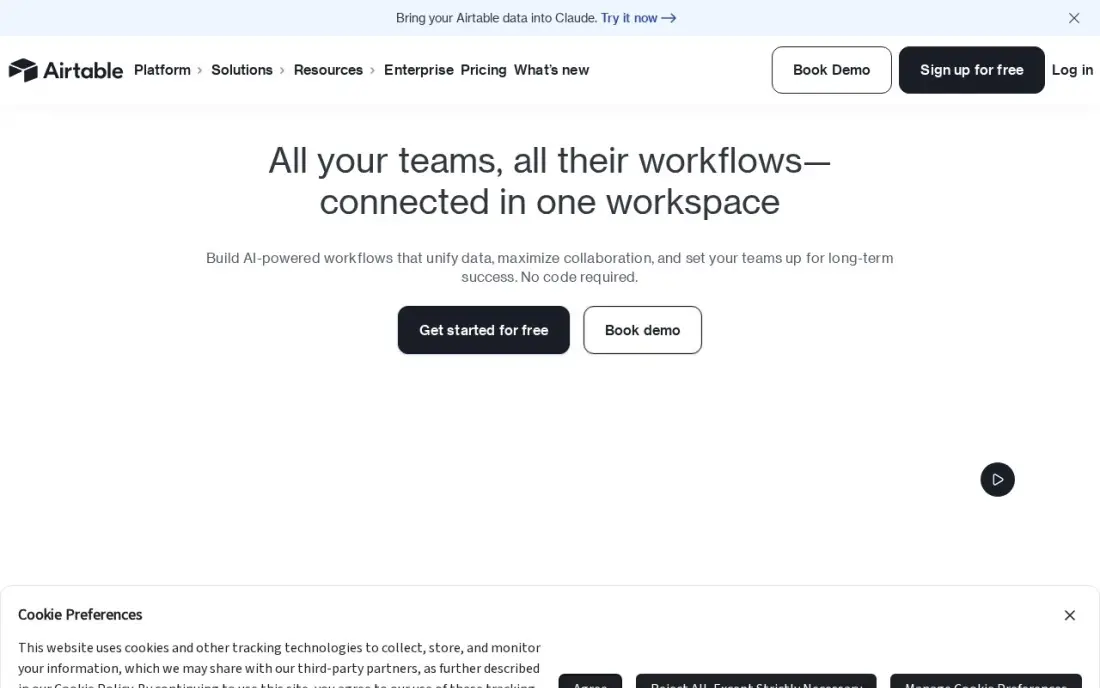
Airtable is not a PIM, but for a store with a few hundred products it often does the PIM's first job: one shared table for titles, descriptions, attributes, images and status, with gallery and kanban views so a team can see what still needs copy or photos. The Free plan covers 1,000 records per base, which is enough to hold a small catalog and its variants.
Team costs $20 a seat a month billed annually, or $24 monthly, and adds extensions and AI credits. What it lacks is the PIM plumbing: no channel feeds, no completeness scoring, and syncing to your store needs an integration or a script. Use it to clean and structure the catalog now, and move the data into a PIM when channels multiply.
What we like
- A database you shape into a tracker: kanban, calendar and gallery views over the same records
- Team adds Gantt and timeline views, extensions and 15,000 AI credits per seat a month from $20 a seat
- Free plan covers 1,000 records per base, enough to prove the setup before paying
- Interfaces let a team build a simple front end for clients without code
Watch out for
- The dearest per-seat price here at $20, and Team bills Commenters as paid seats
- No native time tracking or workload planning — those need extensions or another tool
- Performance slows on very large bases, and two-way sync waits for Business at $45 a seat

Cloudinary
Best for: Ecommerce sites that need product images resized and delivered fast alongside a PIM
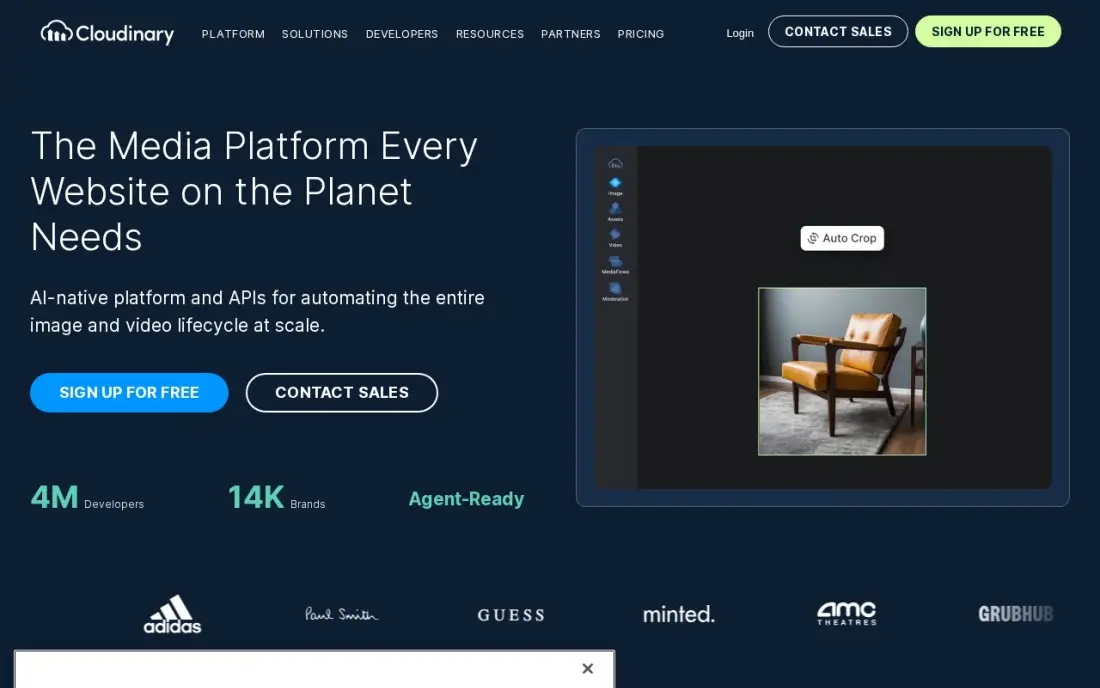
Most PIMs store images; few transform and deliver them. Cloudinary does that half: upload one product photo and its APIs serve every size, crop and format the storefront, marketplaces and email need, which keeps page speed and image consistency under control. It sits next to a PIM, holding the media while the PIM holds the product data and links to it.
The free plan gives 25 credits a month to 3 users, and Plus costs $99 a month billed monthly, or $89 billed annually. Credits cover transformations, storage and bandwidth, so a catalog with video can burn through them fast. Add Cloudinary when product images are slowing the site or when each channel wants different image specs.
What we like
- The only free plan here with real production use: 25 credits a month for 3 users
- One credit covers 1,000 transformations, 1 GB of storage or 1 GB of image bandwidth
- Auto-tagging search, S3 backup and role-based administration from the Plus plan
- APIs and transformations turn one upload into every size and format a site needs
Watch out for
- Credit-based pricing is hard to forecast, and heavy video use burns credits fast
- The dedicated DAM product is Enterprise custom; Plus is the image and video API plan
- AI add-ons such as auto-tagging are billed separately on top of the plan price

Bynder
Best for: Larger brands that need governed product photos and brand assets next to their PIM
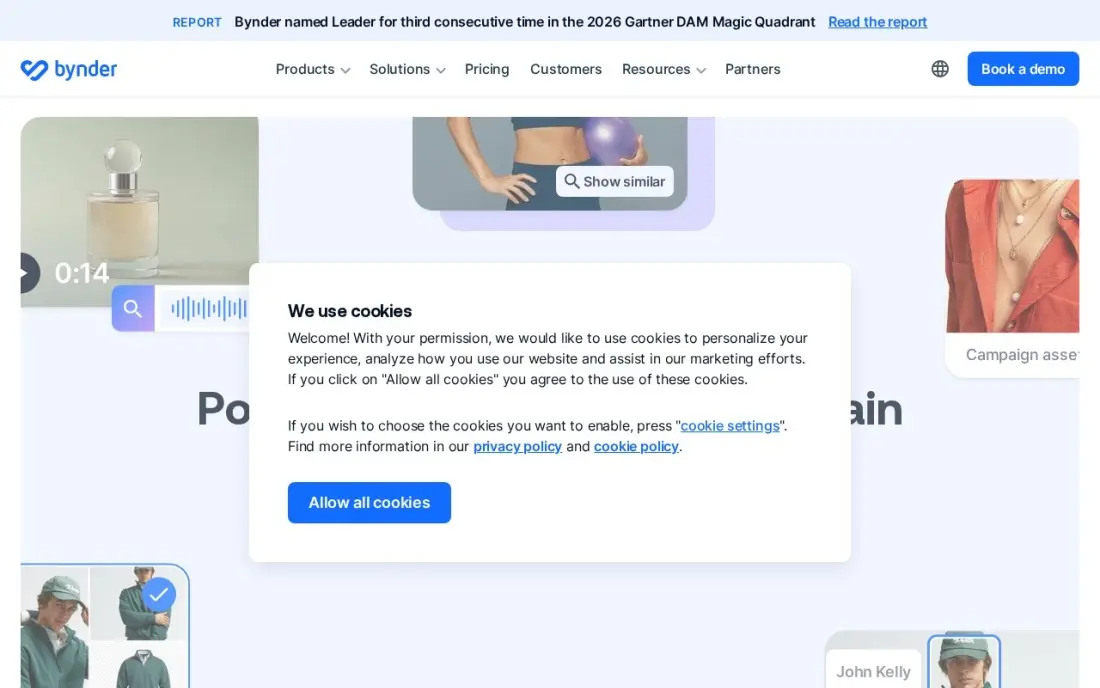
Bynder is the asset side of a serious product content stack. Product photos, lifestyle shots, videos and spec sheets live in one library with AI search, auto-tagging, permissions and rights management, so the image that reaches a retailer or your product page is always an approved one. Most enterprise PIMs, including Akeneo and Salsify, connect to a DAM like it.
Bynder publishes no prices, so every package is a custom quote, and implementation is quoted separately. That makes it a buy for a brand with thousands of assets and several teams, not for a single store. If your PIM's built-in file storage is coping, you do not need Bynder yet; if nobody can find the right packshot, you probably do.
What we like
- AI-powered search and auto-tagging find the right product photo, video or CAD file in seconds
- Taxonomy, permissions and rights management keep dealers and distributors on approved assets only
- Brand guidelines, templates and portals come in the same system as the asset library
- Onboarding, 24/7 support, single sign-on and a custom URL come with every package
Watch out for
- No published prices at all: every package is a custom quote from sales
- Implementation and migration are quoted separately and can add 15–30% in year one
- The modular model means AI search, workflow and analytics may each be a paid add-on
The best PIM software for an ecommerce site gives every product one clean master record — titles, descriptions, attributes, images and variants — and sends it to the store, marketplaces and feeds without anyone retyping it. We compared seven tools: four product information managers, from a free hosted plan to an enterprise platform, plus a database and two media tools that small teams use alongside or instead of a PIM. Every price below comes from the vendor's own page, checked in November 2026.
How to choose the best PIM software for an ecommerce site
- Count SKUs and channels first. A few hundred products on one store rarely needs a PIM; thousands of SKUs across a store, Amazon and Google Shopping almost always does.
- Decide hosted or self-hosted. Plytix and Salsify are hosted; Akeneo Community Edition and Pimcore Community are free but you run the servers and the upgrades.
- Check how feeds are priced. Plytix sells outputs separately, so every extra channel or catalog raises the bill — price the channels you will actually use.
- Look at the data model. You need product families, variant handling and required-field rules, or the PIM just becomes a bigger spreadsheet.
- Plan where images live. Some PIMs store files well enough; a large photo library needs a DAM such as Bynder or a media API such as Cloudinary next to it.
- Test the connector to your store. Ask for the exact Shopify, BigCommerce or WooCommerce connector and run a real import before you sign.
Clean product data is also the base of product-page SEO: unique descriptions, complete attributes and consistent titles are what search engines and AI answers read. Our ecommerce SEO guide covers how to turn that data into pages that rank, and an SEO audit shows where thin or duplicate product copy is holding the store back.
PIM software for ecommerce sites pricing: what you will actually pay
Take a store with 2,000 SKUs selling on its own site plus two marketplaces. Plytix's free plan stops at 500 SKUs and has no outputs, so this store needs a paid plan from $699 a month on a monthly commitment, or $8,388 a year before outputs, which are bought separately per feed or catalog. Akeneo Community Edition and Pimcore Community cost $0 in licence fees, so the real cost is hosting plus a developer to install, connect and upgrade them.
Salsify and the paid editions of Akeneo and Pimcore publish no prices, so get the first-year total in writing, including implementation. The smaller tools give useful comparison points: Airtable Team costs $20 a seat a month billed annually, or $24 monthly, so a three-person team pays $720 a year on annual billing, and Cloudinary Plus costs $99 a month billed monthly, or $89 billed annually, for the media side.
Know the difference: PIM vs DAM
A PIM is about product data. It holds the attributes, descriptions, translations, prices and variant structure, scores whether each product is complete, and publishes the right version to each channel. Plytix, Akeneo, Salsify and Pimcore are PIMs, and most can attach images to a product record.
A DAM is about files. It stores, tags, versions and controls the rights on photos, videos and documents, and some, like Cloudinary, also resize and deliver them. Bynder and Cloudinary are DAM and media tools. Large brands run both and link them, so the PIM points to the approved asset in the DAM; small stores usually get by with the PIM's own file storage.
Quick comparison: tool type by need
| Buyer | Best pick | Why |
|---|---|---|
| Small multi-channel stores | Plytix | Free for 500 SKUs, paid from $699/month with unlimited users |
| Teams with developers | Akeneo | Free open-source Community Edition with APIs and connectors |
| Brands selling through retailers | Salsify | PIM, syndication and shelf analytics, priced by quote |
| Data-heavy builds | Pimcore | Free under EUR/USD 5M revenue, PIM and DAM in one model |
| Catalogs under 1,000 records | Airtable | Free plan, Team from $20/seat/month billed annually |
| Image-heavy storefronts | Cloudinary | Image transformation and delivery, free plan for 3 users |
| Large asset libraries | Bynder | Governed DAM with AI search, custom quote |
Mistakes to avoid
- Buying a PIM before cleaning the data. Importing messy spreadsheets into a PIM just moves the mess; agree attribute names and required fields first.
- Ignoring the cost of outputs and connectors. The licence is only part of the bill when each feed or connector is priced separately.
- Treating open source as free. Self-hosted Akeneo or Pimcore needs hosting, security patches and upgrades, and that is developer time every month.
- Copying manufacturer descriptions into every channel. A PIM makes it easy to syndicate duplicate text; use it to hold unique copy for your own site.
- Skipping a pilot. Run 50 real products through import, enrichment and export to your store before committing the whole catalog.
How we chose
We read each vendor's pricing or edition page in November 2026 and recorded what it shows: Plytix's free and paid plans, Akeneo's and Pimcore's free editions, and the absence of published prices for Salsify, Bynder and the paid editions. We judged PIMs on catalog structure, channel output, hosting model and the effort to get started, and included Airtable, Cloudinary and Bynder because small teams use them before or beside a PIM. Ratings come from G2 pages checked on the dates shown in the sources; the four PIMs show no rating because we did not read a review page for them. No vendor paid for a place in this list, and none of the links here are affiliate links.
What to do next
Export your current catalog, count the SKUs and channels, and load 50 products into Plytix's free plan or a test install of Akeneo to see how your data fits a real PIM. If the bigger problem is product pages that do not rank, book a free call and we will show you where the catalog is costing you traffic.
Frequently asked questions
What is the best PIM software for an ecommerce site?
For most small and mid-size stores, Plytix is the easiest start, with a free plan for 500 SKUs and paid plans from $699 a month. Akeneo Community Edition and Pimcore Community are the free open-source options if you have developers, and Salsify is the enterprise pick for brands that syndicate to retailers.
Is there free PIM software?
Yes. Plytix has a free hosted plan for up to 500 SKUs with no outputs, Akeneo Community Edition is free and open source for self-hosting, and Pimcore Community is free for companies with under EUR/USD 5 million in annual revenue.
Do I need a PIM if I only sell on Shopify?
Usually not until the catalog or channel count grows. A single store with a few hundred products can manage data in the platform or a shared database such as Airtable. A PIM pays off when you sell on several channels, run several languages or have a team editing the same products.
What is the difference between PIM and DAM?
A PIM manages product data — titles, descriptions, attributes, prices and variants — and sends it to channels. A DAM manages the files — photos, videos and documents — with search, rights and transformations. Plytix and Pimcore cover both lightly; Bynder and Cloudinary are DAM and media tools that sit next to a PIM.
How much does PIM software cost?
On published pricing, Plytix paid plans start from $699 a month plus outputs. Akeneo Community Edition and Pimcore Community cost nothing to license but need hosting and developer time. Salsify, Akeneo's hosted Growth package and Pimcore's paid editions are custom quotes.
How does PIM software help SEO?
A PIM keeps titles, descriptions and attributes complete and consistent, which gives every product page unique, structured content. It also makes it practical to write proper copy for thousands of SKUs instead of copying manufacturer text, which is a common cause of thin and duplicate pages.
Sources we checked (10)
- Plytix — www.plytix.com/pim-software-pricing (checked November 16, 2026)
- Akeneo — akeneo.com/akeneo-pim-community-edition (checked November 16, 2026)
- Salsify — www.salsify.com/demo (checked November 16, 2026)
- Pimcore — docs.pimcore.com/platform/Pimcore_Platform/Pimcore_Editions (checked November 16, 2026)
- Airtable — airtable.com/pricing (checked November 12, 2026)
- Airtable reviews on G2 (checked November 12, 2026)
- Cloudinary — cloudinary.com/pricing (checked November 10, 2026)
- Cloudinary reviews on G2 (checked November 10, 2026)
- Bynder — www.bynder.com/pricing (checked November 12, 2026)
- Bynder reviews on G2 (checked November 12, 2026)
Make one of these tools?
We re-check this list every quarter. Send a correction, request a review, or ask about a clearly labeled sponsored spot.
Request a listingShamim
Founder of SerpAstra
A full-stack SEO and digital marketer who spends most days on Local SEO for dental practices, AI search visibility and lead generation.
Free SEO and AI visibility audit
Find out what is holding your rankings back
Send us your site. Within 2 business days you get a written audit, an AI visibility check and a short fix list ranked by impact. Free, with no contract attached.
Request my free audit→Related buying guides
 Marketing12 Best Digital Asset Management Software in 2026, ComparedCompare the 12 best digital asset management software options with prices checked November 10, 2026 — from $25/month self-serve tools to quote-only DAMs.Read guide →
 Ecommerce7 Best Ecommerce Platforms for SEO in 2026 (Pros, Cons and Pricing)The 7 best ecommerce platform for SEO picks compared on price, SEO controls and ease of use, with real 2026 prices checked on each vendor's pricing page.Read guide →
 StrategySEO for ecommerce: product and category pages that rankSEO for ecommerce: product and category pages that rank, with the structure, schema and internal links that turn search traffic into paying customers.Read guide →