8 Best Ecommerce Platforms for Nonprofits in 2026, Compared
Compare the 8 best ecommerce platforms for nonprofits selling merch, tickets and memberships, on fees, free plans and real cost, with prices checked in 2026.
 Shamim Mia, Founder, SerpAstraLast verified November 8, 20268 min read
We compare pricing pages, documentation and public reviews. We never accept payment for rankings.

Key takeaways
- Zeffy is the best ecommerce platform for nonprofits on a $0 budget: tickets, memberships and donation forms with no platform or card processing fees.
- Bonfire is the easiest way to sell fundraising merch, with no monthly fee, no stock to hold and printing and shipping handled for you.
- A nonprofit with a real shop — books, crafts or a year-round merch range — needs a store builder: Squarespace starts at $19 a month billed annually and Ecwid at $5.
- Givebutter and Donorbox combine selling tickets and memberships with donor records, which a plain store builder does not give you.
On this page
Quick comparison
| Tool | Best for | Starting price | Free plan |
|---|---|---|---|
| Zeffy | Small nonprofits that want to sell tickets and memberships and take donations with no fees at all | Free | Yes (free forever) |
| Bonfire | Nonprofits that want to sell fundraising t-shirts and merch with no stock and no upfront cost | Free | Yes |
| Givebutter | Nonprofits that want ticket sales, auctions and donations tied to one donor database | Free; Plus $29/mo | Yes (free plan) |
| Donorbox | Nonprofits that want ticketing, memberships and donation forms with a free start and lower fees at volume | Free; Pro $150/mo | Yes (free Standard) |
| Squarespace | Nonprofits that want a polished website with a shop, memberships and donations in one place | $25/mo | No (14-day trial) |
| Shopify | Larger nonprofits running a year-round merch or charity shop online and at events | $39/mo | No (trial) |
| Wix | Community organizations that want a website, shop, events and bookings in one dashboard | $36/mo | Yes (free plan) |
| Ecwid | Nonprofits with an existing website that want to add a small shop cheaply | $5/mo | No |
Make one of these tools?
We re-check this list every quarter. Send a correction, request a review, or ask about a clearly labeled sponsored spot.
Request a listingThe best ecommerce platforms for nonprofits

Zeffy
Best for: Small nonprofits that want to sell tickets and memberships and take donations with no fees at all
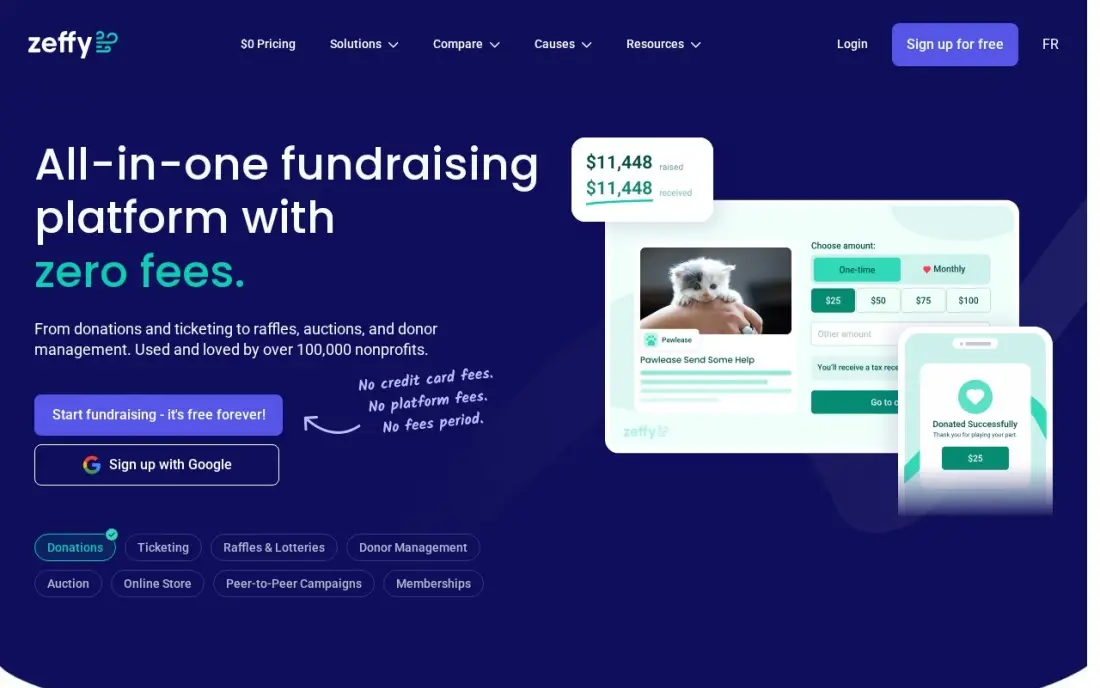
Zeffy is the only option here where the nonprofit keeps every dollar: donation forms, event ticketing, memberships, peer-to-peer campaigns and raffles are all free, with no platform fee and no card processing fee. It funds itself from optional tips donors can add at checkout, and Zeffy says more than 100,000 nonprofits have raised over $2 billion through it.
It is not a general online store or a full donor CRM. A charity selling a large merch range needs a store builder alongside it, and a team that needs moves management or grant tracking will outgrow it. For tickets, memberships and gifts on a $0 budget, start here.
What we like
- Truly $0: no platform fee, no card processing fee, no paid plan at all
- Donation forms, events, memberships, peer-to-peer campaigns and raffles all included
- Zeffy says more than 100,000 nonprofits have raised over $2 billion through it
- On $50,000 raised a nonprofit keeps the full $50,000, per Zeffy's own pricing page
Watch out for
- Not a full donor CRM: no moves management, grant tracking or deep reporting
- No paid tier to upgrade into when the organization needs more database depth
- Funded by optional donor tips, so the model depends on donors choosing to tip

Bonfire
Best for: Nonprofits that want to sell fundraising t-shirts and merch with no stock and no upfront cost
Bonfire takes the risk out of fundraising merch. You design a shirt or other item, set the price, and supporters pre-order during a campaign of up to 21 days; Bonfire then prints and ships every order, so there is no stock to buy and nothing left over. The selling tools are free with zero monthly fees.
Bonfire covers payout transaction fees, so the nonprofit keeps 100% of the profit above each item's base cost, and plus sizes carry no upcharge. The trade-off is timing: supporters wait for the campaign to close before printing. It is merchandise only, so pair it with a donation tool.
What we like
- Free selling tools with zero monthly fees
- Bonfire prints and ships every order after the campaign closes, so there is no stock to hold
- Bonfire covers payout transaction fees, so you keep 100% of the profit
- No upcharge on plus-size apparel
Watch out for
- Merchandise only: it is not a donation form or a general online store
- Pre-order campaigns run up to 21 days, so supporters wait for printing before delivery

Givebutter
Best for: Nonprofits that want ticket sales, auctions and donations tied to one donor database
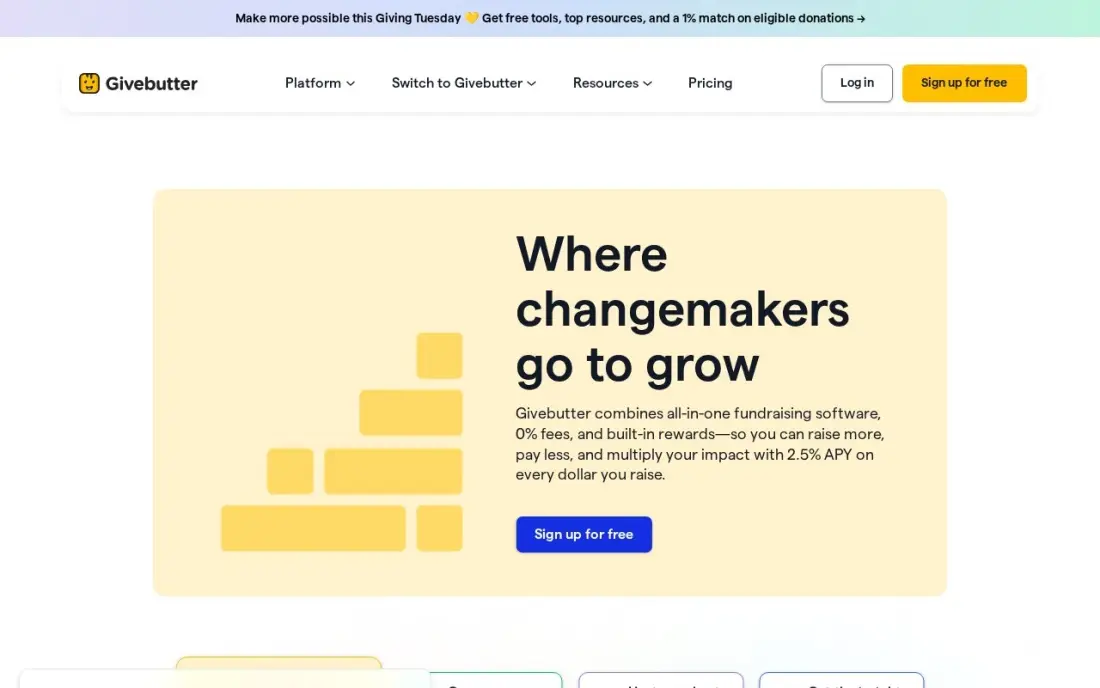
Givebutter suits a nonprofit whose sales are mostly tickets, auction items and fundraising experiences rather than a product catalog. The free Core plan includes events, auctions, peer-to-peer and text-to-give, and every buyer lands in the same donor database, so a gala ticket buyer can be thanked and asked again.
Core is funded by optional donor tips; turn tips off and a 3% platform fee applies on top of card processing. Plus at $29 a month billed annually adds workflows, texting and QuickBooks sync. For a merch store, add Bonfire or a store builder; for events and donors, Givebutter covers it.
What we like
- Free Core plan is a real CRM with fundraising tools, not a stripped trial
- Modern, easy interface that volunteers learn in an afternoon
- Fundraising built in: auctions, events, peer-to-peer and text-to-give
- Rated 4.7 out of 5 on G2 from more than 2,600 reviews
Watch out for
- Full CRM depth is lighter than Bloomerang or DonorPerfect
- With tips off, a 3% platform fee applies on top of card fees
- Plus features such as workflows and QuickBooks sync need the paid tier

Donorbox
Best for: Nonprofits that want ticketing, memberships and donation forms with a free start and lower fees at volume
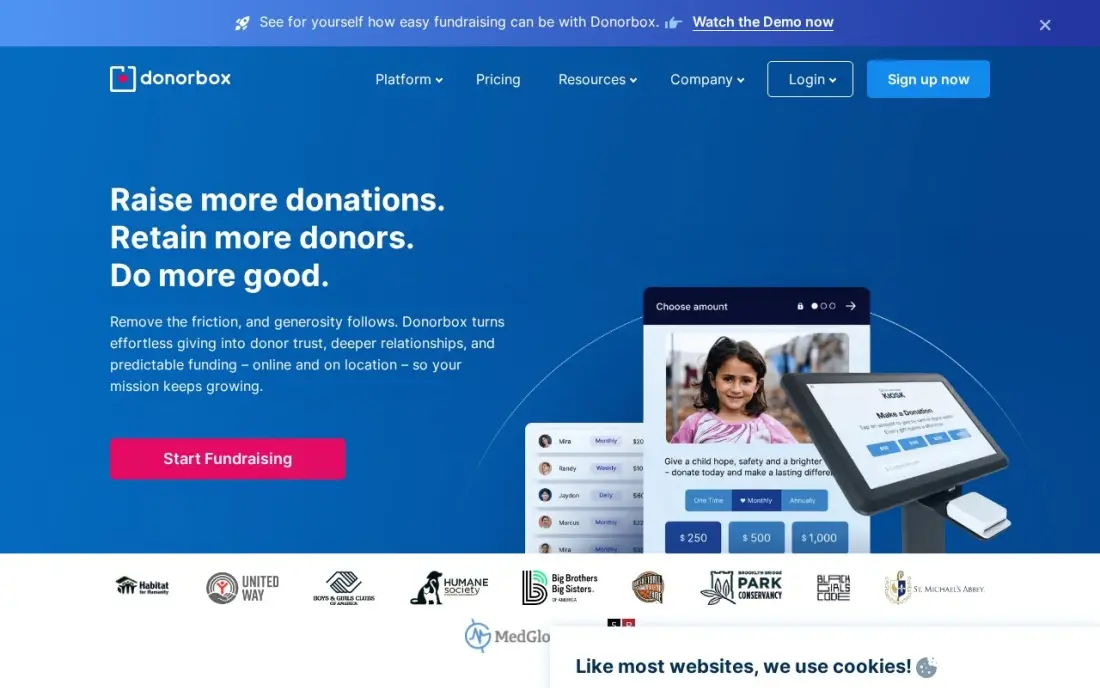
Donorbox's free Standard plan covers unlimited donation forms, pages, crowdfunding, peer-to-peer campaigns and event ticketing, with memberships and a donor portal, which covers the selling most nonprofits do outside a merch shop. Donorbox says more than 100,000 nonprofits use it.
The fees are the cost. Standard takes 2.95% to 3.95% of each payment, so $50,000 raised across 500 gifts costs about $1,625. Pro at $150 a month cuts the rate to 1.75% to 2% and adds analytics and API access, which pays off only once a nonprofit processes a high volume of gifts and tickets.
What we like
- Standard is free and covers unlimited forms, pages, crowdfunding and event ticketing
- Pro at $150/month cuts fees to 1.75% to 2% and adds analytics and API access
- Donorbox says more than 100,000 nonprofits use the platform
- QuickDonate, donor portal, memberships and text-to-give cover most fundraising needs
Watch out for
- Standard takes 2.95% to 3.95% of each gift, which adds up fast at volume
- Pro at $150/month only pays off once donation volume is high
- Premium plan is custom-quoted with no published price

Squarespace
Best for: Nonprofits that want a polished website with a shop, memberships and donations in one place
Squarespace gives a nonprofit a polished website and a store on one subscription: unlimited products, memberships, digital content and abandoned cart recovery on every plan, with hosting and SSL included. A charity selling books, prints or a small merch range alongside its story can launch quickly for $25 a month, or $19 billed annually.
The 2% fee on Basic matters for a nonprofit. On $2,000 a month of shop sales it adds $40 a month, on top of card processing, and only two contributors fit on Basic. Higher plans remove the fee; compare them once the shop is selling steadily.
What we like
- Polished templates with strong photography and video presentation
- Unlimited products, subscription products and abandoned cart recovery on every plan
- Hosting, SSL and a free custom domain for the first year are included on annual billing
- Invoices, memberships and digital content are built in, not add-ons
Watch out for
- Basic adds a 2% Squarespace fee on every online store sale, on top of card processing
- Only two contributors on Basic, so a team quickly outgrows it
- No code injection on Basic, which limits custom tracking and widgets

Shopify
Best for: Larger nonprofits running a year-round merch or charity shop online and at events
Shopify fits a nonprofit that runs its shop like a business: a year-round merch range, a charity shop selling donated goods online, or a museum gift shop. POS is included on Basic for sales at events, and apps add round-up donations at checkout. Basic costs $39 a month, or $29 billed annually.
It is more platform than a small charity needs. Apps and a paid theme add to the bill, only the owner gets a staff account on Basic, and a 2% fee applies on third-party gateways. Choose it when shop revenue is large enough to justify a proper retail setup.
What we like
- The largest app and theme ecosystem of any hosted ecommerce platform
- Unlimited products, hosting, SSL and checkout included, with AI-chat selling on the entry plan
- Shopify Payments charges 2.9% + 30c online with no extra platform fee
- POS for in-person sales at markets and pop-ups is included on Basic
Watch out for
- Apps and a paid theme push the real bill well above the $39 headline price
- A 2% fee applies on sales through a third-party payment gateway on Basic
- Only the store owner gets a staff account on Basic, so a small team must upgrade

Wix
Best for: Community organizations that want a website, shop, events and bookings in one dashboard
Wix suits a community group, club or small charity that needs a website first and a shop second. Bookings for classes, a blog for news, marketing tools and a store sit in one dashboard, and a free plan exists for the website itself, so the group can build before paying.
Selling starts at Core, $36 a month or $29 billed annually, because Light cannot take payments. Core takes payments with no platform fee through Wix Payments at 2.9% + 30c a card sale, and caps storage at 50 GB with five collaborators, which is enough for most small groups.
What we like
- Core takes payments with 0% platform fee through Wix Payments, at 2.9% + 30c a card sale
- Bookings, a blog and marketing tools sit in the same dashboard as the store
- Hundreds of templates and an app market, with no code needed to launch
- A free plan exists for the website, so the brand can build before it pays
Watch out for
- Light at $17 a month billed annually cannot take payments, so selling starts at Core
- Core's 50 GB of storage and 5 collaborators cap a growing catalog and team
- Wix runs 50%-off first-year promotions often, so the renewal price is the honest one to budget

Ecwid
Best for: Nonprofits with an existing website that want to add a small shop cheaply
Ecwid is the cheapest way to add a shop to the website a nonprofit already has. It embeds into WordPress, Wix or a custom site, so there is no new site to build and no hosting bill, and Starter costs $5 a month for up to 10 products. No plan charges a platform transaction fee.
The 10-product cap is tight: an 11th item moves the store to Venture at $35 a month, or $29 billed annually, which also adds selling on Facebook and Instagram. There is no free plan for new sign-ups. It suits a handful of mugs, shirts and calendars, not a full charity shop.
What we like
- A $5-a-month paid start that embeds in a WordPress, Wix or custom site
- Zero platform transaction fees on every plan, so only the payment processor takes a cut
- Sells on Facebook and Instagram from the Venture plan
- No separate hosting bill, since the store lives inside the site you already run
Watch out for
- The free plan ended in 2025, so even a 10-product store now costs $5 a month
- Starter stops at 10 products, so an 11-product catalog pays $35 a month for Venture
- No free trial is advertised on the paid plans
The best ecommerce platform for nonprofits turns supporters into buyers without eating the money raised in fees: merch that funds a cause, tickets to the gala, memberships and the occasional charity shop item. We compared eight platforms across three types — free fundraising platforms that sell tickets and memberships, a print-on-demand merch tool and general store builders — and every price below comes from the vendor's own pricing page as checked in November 2026.
How to choose the best ecommerce platform for nonprofits
- Decide what you are actually selling. Tickets and memberships fit fundraising platforms; t-shirts for a campaign fit print-on-demand; a year-round range of products needs a store builder.
- Add up every fee. Platform fees, card processing and per-sale percentages all come out of the money raised. Compare the total on a realistic month, not the headline.
- Avoid holding stock you cannot sell. Leftover boxes of shirts are money spent and not raised. Pre-order or print-on-demand protects a small budget.
- Keep buyers in the donor database. A merch buyer is a supporter. Tools that record buyers as donors make the next ask easier.
- Check who can run it. Volunteers change. Pick something a new volunteer can learn in an afternoon.
- Ask about sales tax. Tax-exempt status rarely removes sales tax on goods; confirm the platform can collect it where required.
A shop only raises money if supporters can find it. Our local SEO service helps a nonprofit show up in local search for its cause, and the free Google review link generator makes it easy for supporters to leave reviews after an event.
Ecommerce platforms for nonprofits pricing: what you will actually pay
Take a small nonprofit that expects $2,000 a month in sales of tickets, memberships and merch. On Zeffy, the platform and card processing cost $0, so it keeps the full $2,000. On Donorbox Standard, fees of 2.95% to 3.95% cost about $59 to $79 a month. On Givebutter Core, fees depend on whether donors tip; turn tips off and a 3% platform fee — $60 a month — applies on top of card processing.
A store builder adds a subscription. Squarespace Basic costs $25 a month billed monthly or $19 billed annually, plus a 2% fee, so $2,000 in sales adds $40 a month — about $65 a month, or $780 a year, billed monthly. Shopify Basic costs $39 a month or $29 billed annually, $468 or $348 a year, with no extra platform fee on Shopify Payments. Ecwid costs $5 a month for up to 10 products, or $35 a month for Venture.
Merch on Bonfire has no subscription at all: the nonprofit sets a sale price, Bonfire takes the base cost of each item, and the profit is paid out with payout fees covered.
Know the difference: fundraising platform vs store builder
A fundraising platform such as Zeffy, Givebutter or Donorbox is built around supporters. It sells tickets, memberships and auction items, records every buyer as a donor and issues receipts, and it usually charges nothing or a small percentage. It is not designed for a catalog of products with stock, shipping and variants.
A store builder such as Shopify, Squarespace, Wix or Ecwid is built around products. It handles stock, shipping rates, sizes and a proper shop front, and charges a monthly subscription plus card fees. Most nonprofits that sell regularly use both: a fundraising platform for tickets and gifts, and a store builder or Bonfire for merchandise.
Quick comparison: tool type by need
| Buyer | Best pick | Why |
|---|---|---|
| $0 budget, tickets and memberships | Zeffy | No platform or card processing fees |
| Campaign merch with no stock | Bonfire | Free, print-on-demand, payout fees covered |
| Events tied to donor records | Givebutter | Free Core plan with auctions and ticketing |
| Ticketing with lower fees at volume | Donorbox | Free Standard plan, Pro $150/month |
| Polished site with a shop | Squarespace | From $19/month billed annually, plus 2% on Basic |
| Year-round charity shop | Shopify | POS for events included, Basic $39/month |
| Community groups | Wix | Website, shop and bookings in one, Core $36/month |
| A few products on an existing site | Ecwid | Embeds in your site, $5/month for 10 products |
Mistakes to avoid
- Ordering stock before demand. Bulk-buying merch ties up funds. Use pre-orders or print-on-demand until you know what sells.
- Treating buyers as customers only. Someone who buys a gala ticket is a supporter. Record them in your donor database and thank them.
- Forgetting fees in fundraising totals. Report net money raised, and compare platforms on net, not on the sticker price.
- Paying for a full store too early. A Shopify plan and paid theme are hard to justify for six t-shirts a year. Start small.
- Ignoring sales tax. Charitable status does not automatically exempt goods sales. Check before you sell.
How we chose
We checked each vendor's own pricing page in November 2026 and recorded the starting price exactly as shown, including annual-billing figures where the page lists one. We compared total fees on a realistic month of sales, how each tool handles tickets, memberships and merchandise, and how easy it is for volunteers to run, and ranked them by fit for the most common buyer: a small nonprofit selling to its own supporters. Ratings come from G2 pages where we checked them, on the dates shown in the sources. No vendor paid for a place in this list, and none of the links here are affiliate links.
What to do next
List what you sold last year — tickets, memberships, merch, shop items — and roughly how much of each. If it is mostly tickets and memberships, set up Zeffy this week; if merch, run one Bonfire campaign. Once supporters can buy online, book a free review of how your nonprofit shows up in search.
Frequently asked questions
What is the best ecommerce platform for nonprofits?
Zeffy is the best fit for most small nonprofits because tickets, memberships and donation forms carry no platform or card fees. Bonfire is best for fundraising merch with no stock, and Squarespace or Shopify suit nonprofits running a full online shop.
Is there a free ecommerce platform for nonprofits?
Yes. Zeffy is free with no platform or processing fees, Bonfire has no monthly fee for merch campaigns, and Givebutter Core and Donorbox Standard are free plans that charge per-transaction fees or rely on donor tips.
How can a nonprofit sell merchandise without buying stock?
Use a print-on-demand campaign tool such as Bonfire. Supporters pre-order during a campaign of up to 21 days, Bonfire prints and ships each order, and the nonprofit keeps the profit above each item's base cost.
Do nonprofits pay sales tax on online store sales?
Often yes. Tax-exempt status usually covers income tax, not sales tax on goods sold, and rules vary by state and country. Check with your accountant before launching a shop.
Should a nonprofit use Shopify or Squarespace?
Squarespace suits a nonprofit that wants a polished website with a small shop from $19 a month billed annually, though Basic adds a 2% fee on sales. Shopify suits a larger year-round shop that also sells at events, from $39 a month or $29 billed annually.
Can a nonprofit add donations to an online store checkout?
Yes. Shopify apps can add round-up or donation options at checkout, and tools such as Givebutter and Donorbox combine donations with ticket and membership sales in one checkout.
Sources we checked (13)
- Zeffy — www.zeffy.com/pricing (checked November 8, 2026)
- Bonfire — www.bonfire.com/how-it-works (checked November 16, 2026)
- Givebutter — givebutter.com/pricing (checked November 12, 2026)
- Givebutter reviews on G2 (checked November 12, 2026)
- Donorbox — donorbox.org/pricing (checked November 8, 2026)
- Squarespace — www.squarespace.com/pricing (checked November 12, 2026)
- Squarespace reviews on G2 (checked November 12, 2026)
- Shopify — shopify.com/pricing (checked November 12, 2026)
- Shopify reviews on G2 (checked November 12, 2026)
- Wix — www.wix.com/plans (checked November 12, 2026)
- Wix reviews on G2 (checked November 12, 2026)
- Ecwid — www.ecwid.com/pricing (checked November 12, 2026)
- Ecwid reviews on G2 (checked November 12, 2026)
Make one of these tools?
We re-check this list every quarter. Send a correction, request a review, or ask about a clearly labeled sponsored spot.
Request a listingShamim
Founder of SerpAstra
A full-stack SEO and digital marketer who spends most days on Local SEO for dental practices, AI search visibility and lead generation.
Free SEO and AI visibility audit
Find out what is holding your rankings back
Send us your site. Within 2 business days you get a written audit, an AI visibility check and a short fix list ranked by impact. Free, with no contract attached.
Request my free audit→Related buying guides
 Nonprofit & Church11 Best Nonprofit Software for Small Business in 2026, ComparedCompare the 11 best nonprofit software for small business picks on price, free plans and donor tools, with every price checked November 8, 2026.Read guide →
 Nonprofit & Church11 Best CRM Software for Nonprofits in 2026, ComparedCompare the 11 best crm software for nonprofits on price, free plans and donor features, with every price checked November 12, 2026 on the vendor's own page.Read guide →
 Nonprofit & Church11 Best Email Platforms for Nonprofits in 2026, ComparedCompare the best email platform for nonprofits: 11 tools ranked on price, free plans and nonprofit discounts, with every price checked November 6, 2026.Read guide →