7 Best Digital Risk Protection Platforms in 2026, Compared
Compare the 7 best digital risk protection platforms on coverage, takedown speed and price, with every price checked on the vendor's page on November 12, 2026.
 Shamim Mia, Founder, SerpAstraLast verified November 12, 202612 min read
We compare pricing pages, documentation and public reviews. We never accept payment for rankings.

Key takeaways
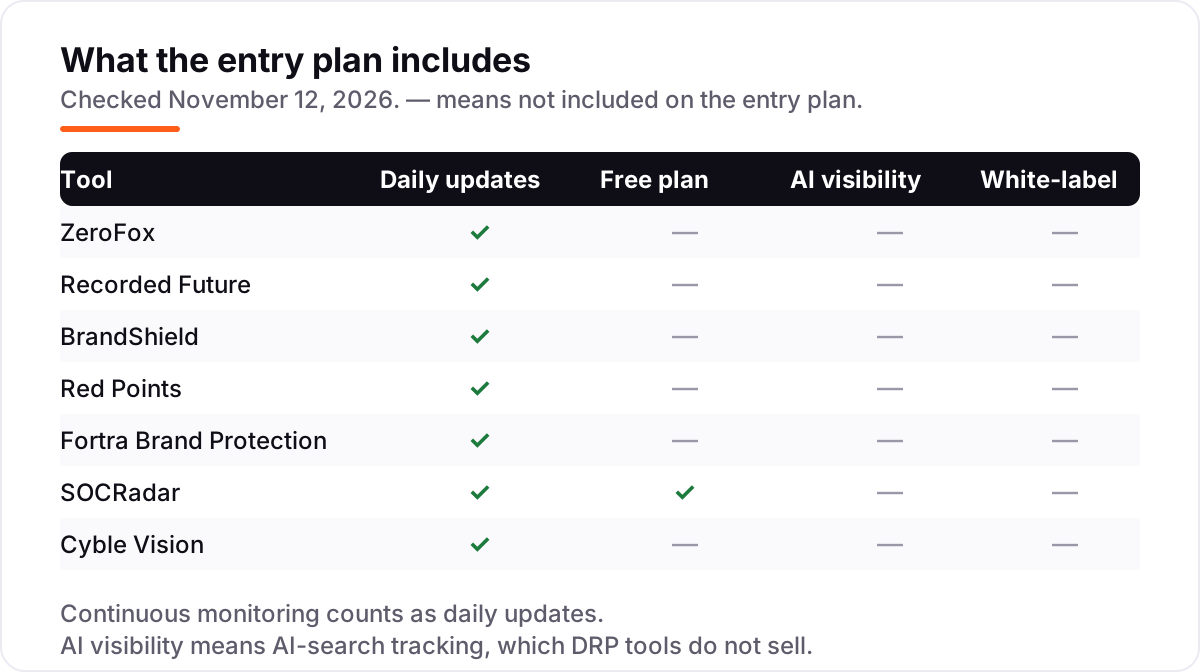
- ZeroFox leads for most teams that need broad coverage, with Recorded Future close behind for intelligence depth; both are quote-only, and only SOCRadar publishes a starting price, $600 a month.
- The single most important buying factor is takedown speed and coverage: a platform that finds threats but cannot remove them fast leaves the risk in place.
- Six of the 7 platforms publish no price at all, so shortlist on coverage and takedown service first, then get scoped quotes for the same asset list.
- Every price below was checked on the vendor's own pricing page on November 12, 2026. Ratings are G2, with review counts shown.
On this page
Quick comparison
| Tool | Best for | Starting price | Free plan |
|---|---|---|---|
| ZeroFox | Mid-market and enterprise security teams that need the broadest external threat coverage in one platform | Custom quote | No (demo only) |
| Recorded Future | Enterprise security teams that already buy threat intelligence and want DRP on the same platform | Custom quote | No (demo only) |
| BrandShield | Consumer and retail brands that need human-verified takedowns across phishing, counterfeits and social impersonation | Custom quote | No (demo only) |
| Red Points | Brands losing revenue to counterfeits, piracy and marketplace infringements that need automated enforcement | Custom quote | No (demo only) |
| Fortra Brand Protection | Banks and regulated enterprises that want a fully managed, analyst-run takedown service | Custom quote | No (demo only) |
| SOCRadar | Small and mid-size security teams that want published pricing and a free plan to start with | $600/mo | Yes (Freemium) |
| Cyble Vision | Enterprise SOCs that need deep dark web intelligence with attack surface and brand monitoring in one platform | Custom quote | No (demo only) |
Make one of these tools?
We re-check this list every quarter. Send a correction, request a review, or ask about a clearly labeled sponsored spot.
Request a listingThe best digital risk protection platforms

ZeroFox
Best for: Mid-market and enterprise security teams that need the broadest external threat coverage in one platform
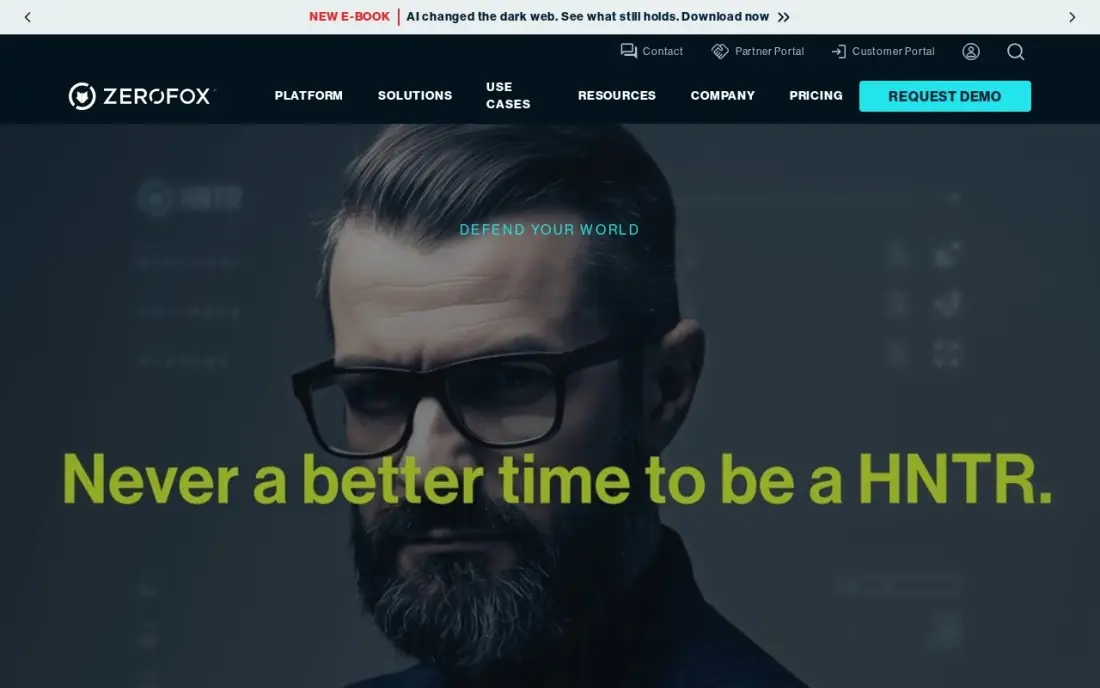
ZeroFox is the broadest platform in this list: it watches social media, domains, the deep and dark web, app stores and executive profiles from one console, and pairs automated detection with analyst-run takedowns. That breadth is why it is often used as shorthand for the whole digital risk protection category, and why it fits teams that want one vendor covering every surface where their brand can be impersonated.
The trade-off is that everything is sold as a scoped annual contract, priced by the protected assets, with no published starting price — small teams cannot budget without a sales call. G2 reviewers praise the dashboard and timely alerts but report alert noise and false alarms, so plan for triage time. Pick ZeroFox when coverage breadth matters most; pick SOCRadar when you need a published price.
What we like
- Broadest coverage here: social media, domains, deep and dark web, app stores and executive protection in one console
- Automated detection paired with analyst-run takedowns, so threats are removed, not just reported
- G2 reviewers praise the intuitive dashboard and timely, relevant alerts
Watch out for
- No published starting price — every contract is a scoped annual quote priced by protected assets
- G2 reviewers report alert noise and false alarms, so the team needs triage time
- Some reviewers report slow takedowns and an interface that lacks granularity

Recorded Future
Best for: Enterprise security teams that already buy threat intelligence and want DRP on the same platform
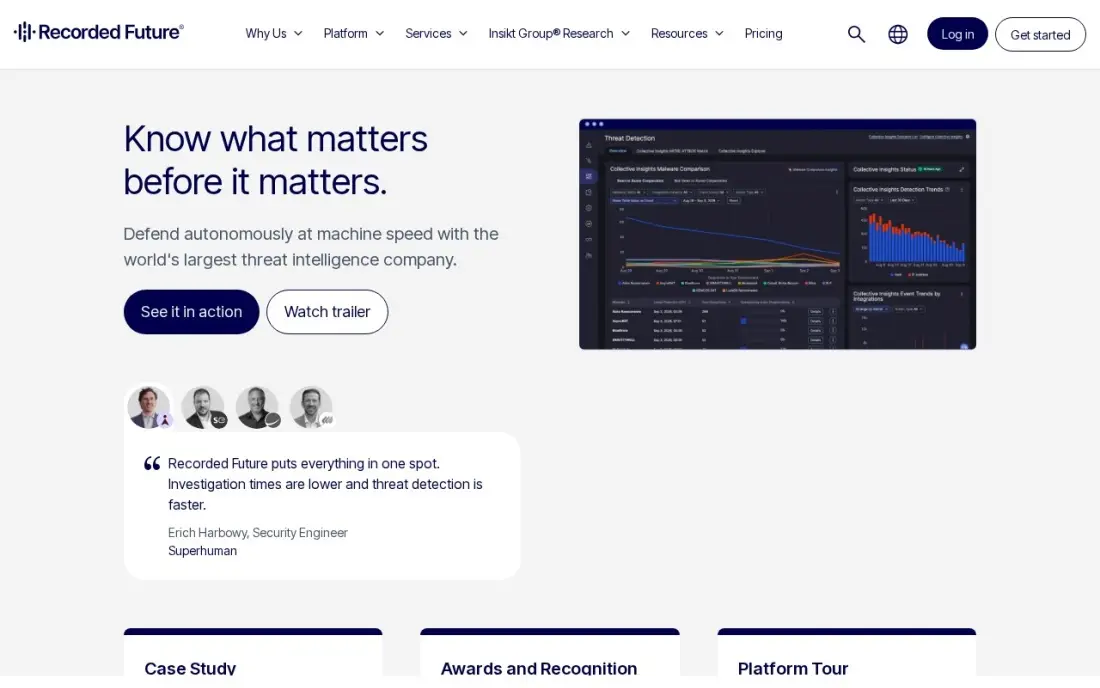
Recorded Future is the intelligence-depth pick in this list. Its Intelligence Graph correlates over 1.2 million sources and 26 billion entities, so a brand alert arrives with the infrastructure, actor and campaign context behind it, not just a screenshot. In 2026 the company launched a dedicated Digital Risk Protection solution covering five use cases — malicious sites, impersonation, code repositories, dark web brand monitoring and identity exposure — with an AI Triage Agent that verdicts detections.
The cost is the catch: pricing is quote-only and modular, and third-party buyer data puts a single module at $40,000 to $60,000 a year, so a small team pays enterprise money. G2 reviewers also note a learning curve. Buy Recorded Future when your team already lives in threat intelligence; buy SOCRadar when you only need the monitoring.
What we like
- Intelligence Graph correlates over 1.2 million sources and 26 billion entities behind every alert
- Dedicated Digital Risk Protection solution launched in 2026, with an AI Triage Agent that verdicts detections
- 2026 packages include unlimited users and integrations, so intelligence reaches the whole team
Watch out for
- Quote-only modular pricing, with third-party buyer data putting a single module at $40,000-$60,000 a year
- G2 reviewers note a learning curve and a query language that takes time to master
- DRP is one solution inside a much larger platform, so narrow buyers pay for breadth they may not use

BrandShield
Best for: Consumer and retail brands that need human-verified takedowns across phishing, counterfeits and social impersonation
BrandShield is the human-verified pick in this list. Its platform pairs AI detection with a dedicated threat-hunting team that checks flagged threats before escalation, which is why G2 ranked it the number one Leader in its Fall 2025 Brand Protection category. Coverage spans phishing sites, counterfeit marketplace listings, social impersonation, rogue apps and trademark abuse, with a named enforcement manager on each account.
There is no published price: packages are tailored to company size, threat profile and enforcement needs, and the only public price signal is a $22,000-a-year managed anti-phishing listing on AWS Marketplace. The public terms also make fees non-cancelable and non-refundable. Pick BrandShield when takedown accuracy matters more than a self-serve price.
What we like
- Ranked the number one Leader in G2's Fall 2025 Brand Protection category
- Human analysts verify flagged threats before escalation, which cuts false positives
- Covers phishing, counterfeit listings, social impersonation, rogue apps and trademark abuse
Watch out for
- No published pricing — packages are tailored and quoted by the sales team
- Public terms make fees non-cancelable and non-refundable, and contracts renew automatically
- Some G2 reviewers report a confirmation step before takedown that can delay response

Red Points
Best for: Brands losing revenue to counterfeits, piracy and marketplace infringements that need automated enforcement
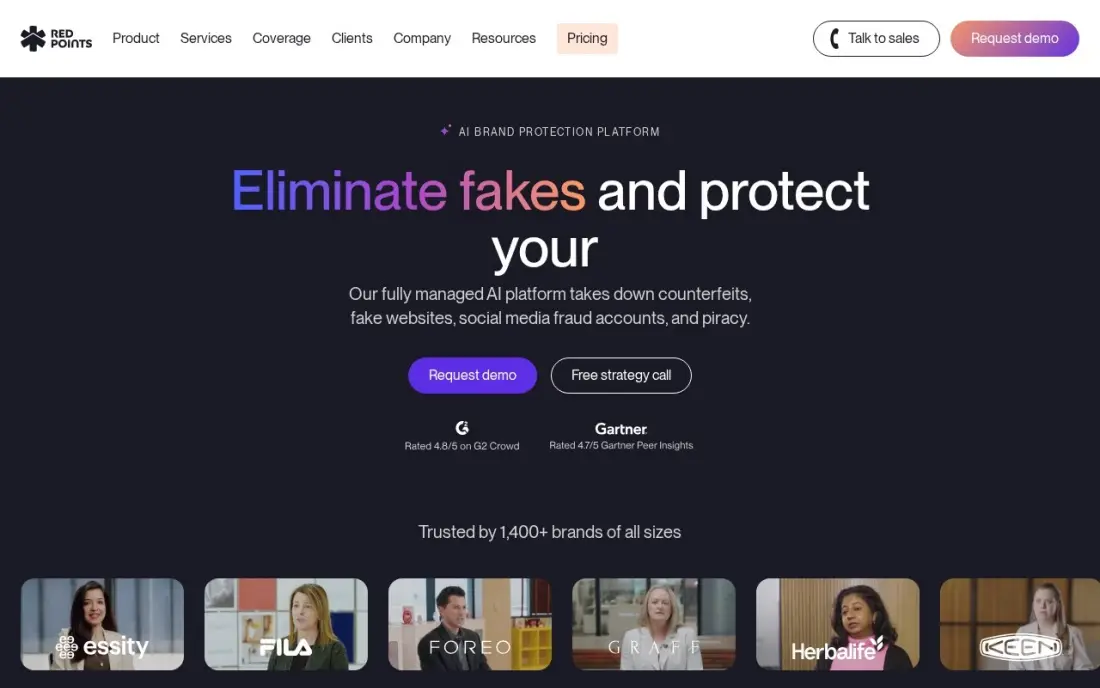
Red Points is the enforcement pick in this list, and it holds the highest G2 score here at 4.9 out of 5 across 71 reviews. It is a fully managed, AI-led brand protection platform: its system detects counterfeits, piracy and impersonation across marketplaces, websites and social channels, then removes them with automated enforcement checked by human reviewers. Reviewers consistently praise the automated monitoring and the speed of removals.
The limit is scope. Red Points is built for brand and IP enforcement, so a security team that also needs dark web credential intelligence or attack surface data will need a second tool. Pricing is quote-only with no self-serve tier. Pick Red Points when counterfeits and piracy are the revenue leak; pick ZeroFox when the threat is broader.
What we like
- Highest G2 score in this list at 4.9 out of 5 across 71 reviews
- Automated enforcement pairs AI detection with human validation for fast removals
- Strongest on counterfeits, piracy and marketplace listings, where revenue loss is direct
Watch out for
- Quote-only pricing with no self-serve tier, so smaller brands cannot start without a sales call
- G2 reviewers note pricing sits on the higher side for the coverage bought
- Built for brand and IP enforcement, so teams needing deep threat-intel feeds will want a second tool
Fortra Brand Protection
Best for: Banks and regulated enterprises that want a fully managed, analyst-run takedown service
Fortra Brand Protection, formerly PhishLabs, is the hands-off pick in this list. It is a managed digital risk protection service: Fortra's analysts own collection, vetting and mitigation across domains, social media, email and the dark web, so the day-to-day work stays off your team's plate. The phishing heritage runs deep — PhishLabs was founded in 2008, and Fortra acquired it in 2021 — and the service won Frost and Sullivan's 2022 Company of the Year award for the category.
The price of hands-off is opacity: no published price, no self-serve plan, and G2 reviewers mention limited reporting and a learning curve. One 2026 review reports slow takedowns, so ask for median takedown times and get them in the contract. Pick Fortra when your team has no spare analysts; pick ZeroFox when you want to run the console yourself.
What we like
- Fully managed service: Fortra's analysts run collection, vetting and takedowns around the clock
- Phishing detection heritage since 2008, with browser-blocking and takedown APIs built over a decade
- Named Frost and Sullivan's 2022 Company of the Year for Digital Risk Protection
Watch out for
- Quote-only pricing with no published starting price and no self-serve plan
- G2 reviewers mention limited reporting and a learning curve on the platform
- At least one 2026 review reports slow takedowns, so get median times in writing before signing

SOCRadar
Best for: Small and mid-size security teams that want published pricing and a free plan to start with
SOCRadar is the budget pick in this list, and the only tool here with a price you can read before the sales call: Advanced Dark Web Monitoring Essential costs $4,550 a year, or $600 a month on monthly billing. The Freemium plan is genuinely free and covers threat hunting, dark web intelligence and a malware analysis sandbox, so a small team can start monitoring the same week without a purchase order.
The published price covers one module, not the whole platform: cyber threat intelligence Essential is $14,750 a year, and the full extended threat intelligence suite is custom-quoted. G2 reviewers also warn that alert volume needs tuning. Pick SOCRadar when you need a real price and a free start; pick Recorded Future when the budget allows the full intelligence suite.
What we like
- The only published price in this list: Advanced Dark Web Monitoring Essential at $4,550 a year
- A genuinely free Freemium plan covers threat hunting, dark web intelligence and a malware sandbox
- One platform spans dark web monitoring, attack surface management, brand protection and supply chain risk
Watch out for
- Full extended threat intelligence needs higher tiers and custom quotes beyond the published plans
- G2 reviewers note the volume of alerts can overwhelm without careful tuning
- The free plan is limited to 5 threat search credits and 1 customizable search deck
Cyble Vision
Best for: Enterprise SOCs that need deep dark web intelligence with attack surface and brand monitoring in one platform
Cyble Vision is the dark web depth pick in this list. Its platform has analyzed over 350 billion dark web records across more than 15,000 active dark web and cybercrime sources, and it unifies that intelligence with attack surface management, brand protection and third-party risk in one console. Forrester recognized Cyble in its External Threat Intelligence Service Providers Landscape in the first quarter of 2026, and the vendor claims a 98.5 percent takedown success rate.
Like most of this list, pricing is modular and quote-only, so there is no published starting price to budget against. G2 reviewers praise the real-time intelligence but note a complex interface and alert noise that needs validation. Pick Cyble when dark web depth is the priority; pick SOCRadar when a published price matters more.
What we like
- Over 350 billion dark web records analyzed across 15,000-plus active dark web and cybercrime sources
- Vendor-claimed 98.5 percent takedown success rate across its monitoring and removal workflow
- Recognized by Forrester in its External Threat Intelligence Service Providers Landscape, Q1 2026
Watch out for
- Quote-only modular pricing with no published starting price
- G2 reviewers note the interface can feel complex and needs training for new users
- Reviewers report alert noise and occasional false positives that need validation
The best digital risk protection platforms watch the internet outside your firewall — lookalike domains, fake social accounts, rogue apps, leaked credentials and dark web chatter — and remove the threats before your customers fall for them. The 7 tools below are ranked by fit for the most common buyer, a mid-size US company with a brand worth impersonating, and every price was checked on the vendor's own pricing page on November 12, 2026.
How to choose the best digital risk protection platforms
- Count the surfaces first. Domains, social accounts, app stores, marketplaces and the dark web are five different monitoring jobs — a platform that covers four of them still leaves one open.
- Ask who files the takedown. Automated takedowns are fast on clear-cut phishing; analyst-managed takedowns handle the edge cases. Ask for the median takedown time, not the best case.
- Check alert quality, not alert volume. A platform that fires thousands of alerts a week costs analyst hours; ask how it scores severity and what its false-positive rate looks like on a trial.
- Price the assets you will protect. Quote-only platforms price by domains, accounts and executives monitored, so two quotes for different asset lists are not comparable.
- Check the integrations. SIEM, SOAR and ticketing integrations decide whether an alert becomes a workflow or another inbox to check.
- Test it against your own brand. A demo on generic data proves nothing; ask the vendor to monitor your real domains and executive names for the trial period.
Digital risk protection guards the brand, but it does not bring in customers on its own — our monthly SEO service covers the visibility side, so the people who search for your brand find the real you first. When you publish a page warning customers about a scam using your name, check how it will look in search with the free SERP snippet preview tool before it goes live. Shortlist three vendors, not seven: one broad platform, one specialist for your biggest threat, and SOCRadar as the priced baseline — then run the same asset list past all three and compare the quotes side by side. If a vendor will not quote against your asset list in writing, strike it from the shortlist — a platform that hides its price usually hides its limits too.
Digital risk protection platforms pricing: what you will actually pay
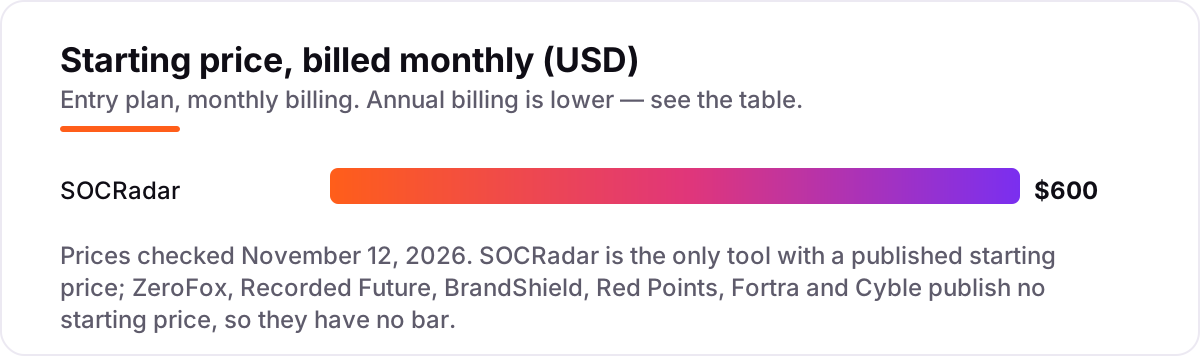
Take a mid-size US company with one brand, 5 domains and 2 executives to protect. On published prices, only SOCRadar gives you a number: Advanced Dark Web Monitoring Essential costs $4,550 a year, or $600 a month on monthly billing, which is $7,200 a year — so annual billing saves $2,650. Cyber Threat Intelligence Essential, the tier that adds deeper intelligence, is $14,750 a year, or $1,625 a month.
The other six platforms publish no price, so the worked example has to use third-party-reported figures, which are estimates, not vendor prices. Buyer data puts a single Recorded Future module at $40,000 to $60,000 a year, Red Points at roughly $35,000 to $70,000 a year, and ZeroFox buyer-reported contracts at $56,000 to $307,000 a year. BrandShield's only public price signal is a $22,000-a-year managed anti-phishing listing on AWS Marketplace. A realistic year-one budget is therefore $4,550 for SOCRadar alone, or $22,000 to $60,000 for a managed enterprise platform covering the same 5 domains and 2 executives — and the quote will move with every domain, account and executive you add.
Two costs sit outside every number above. First, onboarding: most enterprise platforms charge an implementation fee on top of the subscription, and the quote you receive rarely itemizes it until the contract stage. Second, renewal: third-party buyer guides report that Recorded Future contracts may carry annual escalation clauses of 3 to 5 percent, so a $50,000 first year can be $52,500 in year two before any scope grows. Ask for the renewal cap in writing, and price a three-year total, not a first-year teaser.
For a smaller team protecting a single domain and one executive, the math changes completely: SOCRadar Freemium covers the monitoring at $0, and the first paid step is $4,550 a year. The quote-only platforms do not scale down to that size — their entry contracts start in five figures, which is why a small brand should start on the free plan and only move to a quote when the threat volume justifies it.
Know the difference: digital risk protection vs brand protection
The confusion in this category is the boundary between the two terms, and vendors use them interchangeably. Digital risk protection is the wider discipline: it watches domains, social media, app stores, marketplaces, the deep and dark web, leaked credentials and executive impersonation, and it adds the threat intelligence that explains who is behind an attack. Brand protection is the enforcement subset inside it — trademark surveillance, counterfeit removal, piracy takedowns and paid-ad scams.
The practical test is the quote. A digital risk protection quote should list dark web and credential monitoring, attack surface coverage and intelligence feeds; a brand protection quote lists trademark watches, marketplace enforcement and takedown volumes. Recorded Future notes that Americans reported $15.9 billion in fraud and scam losses in 2025, and most of that starts with an impersonation somewhere outside the victim company's network — which is exactly the ground digital risk protection covers and a pure brand protection tool only partly does.
Which one you need follows the threat. If the leak is counterfeit listings, piracy or fake products eating revenue, a brand protection specialist like Red Points or BrandShield is the direct answer. If the leak is stolen credentials, executive impersonation or phishing kits aimed at your customers, you need the wider digital risk protection net — ZeroFox, Recorded Future or Cyble. Many teams end up with both: a broad platform for monitoring and a specialist for enforcement, which is why the quotes in this category overlap so much. Ask for each quote in writing with the surfaces itemized, and compare it line by line against the next vendor's quote before you sign anything.
Quick comparison: tool type by need
| Buyer | Best pick | Why |
|---|---|---|
| Team that wants the broadest coverage | ZeroFox | Social, domains, dark web, apps and executives in one console |
| Team that wants intelligence depth | Recorded Future | Intelligence Graph with AI triage across five use cases |
| Brand that wants human-verified takedowns | BrandShield | Dedicated hunters, G2's number one in brand protection |
| Brand losing money to counterfeits | Red Points | Automated enforcement, 4.9/5 on G2 |
| Team with no spare analysts | Fortra Brand Protection | Fully managed 24/7 analyst service |
| Team that needs a published price | SOCRadar | $600/month, with a free Freemium plan |
Mistakes to avoid
- Comparing quote-only platforms on headline price. There is no headline price — get scoped quotes for the same list of domains, accounts and executives, or the numbers are meaningless.
- Buying detection without takedown. Alerts without removal leave the phishing site live while your team triages; check that takedown is in the contract, not just monitoring.
- Ignoring what counts as a protected asset. Each domain, social account and executive moves the quote, so a platform that looks cheap for 5 domains can be dear for 50.
- Trusting a directory price. Capterra still lists a $99-a-month starting price for ZeroFox, but ZeroFox publishes no price list — always check the vendor's own page.
- Skipping a trial on your own brand. A demo on generic data proves nothing; run the trial against your real domains and executive names before you sign.
How we chose
We checked each vendor's own pricing page on November 12, 2026 and recorded the starting price exactly as shown: six of the seven platforms publish no price, so they are listed as custom quote, and SOCRadar's $600-a-month figure comes from its own pricing page. The other figures in this guide — Recorded Future's $40,000 to $60,000 module range, Red Points at roughly $35,000 to $70,000 a year, ZeroFox buyer-reported contracts and BrandShield's $22,000 AWS Marketplace listing — are third-party-reported estimates, not vendor prices, and should be treated as budgeting guides only. Ratings come from G2 pages checked on November 12, 2026, using fresh search-index copies of the exact G2 product pages crawled within the previous three days, with score and review count visible in each copy. We ranked the tools by fit for the most common buyer — a mid-size US company protecting one brand — not by brand size. No vendor paid for a place in this list, and none of the links here are affiliate links.
What to do next
Start with the free option: run SOCRadar Freemium against your real domains for a week and see what it finds. Then take your asset list — every domain, social account and executive name — to two quote-only vendors and compare scoped quotes for the same list. Ask each one for its median takedown time in writing before you sign. Once your tools are in place, find out what's holding your rankings back.
Frequently asked questions
What is the best digital risk protection platform?
ZeroFox is the best fit for most teams: the broadest coverage across social, domains, the dark web, app stores and executive protection, with analyst-run takedowns. Recorded Future is the better pick for intelligence depth, and SOCRadar is the best choice when you need a published price, at $600 a month.
How much does digital risk protection cost?
Only SOCRadar publishes a price here: $600 a month, or $4,550 a year, for its Advanced Dark Web Monitoring Essential plan. The other six platforms are quote-only. Third-party buyer data puts entry enterprise contracts at roughly $22,000 to $60,000 a year, depending on the assets protected and the modules bought.
Is there a free digital risk protection platform?
SOCRadar is the only tool in this list with a free plan: its Freemium tier covers threat hunting, dark web intelligence and a malware sandbox at no cost. The other six offer a demo on request only. Free single-purpose tools exist for one-off checks, but none of them monitors a whole brand continuously.
What is the difference between digital risk protection and brand protection?
Digital risk protection is the wider discipline: it covers domains, social media, app stores, the dark web, leaked credentials and executive impersonation, plus the intelligence behind them. Brand protection is the enforcement subset — trademark surveillance, counterfeit removal and takedowns. Most vendors sell both, so check which surfaces a quote actually covers.
How fast do takedowns work?
It varies widely, and vendors rarely publish a figure, so ask for the median takedown time in the demo and get it written into the contract. Automated takedowns can clear clear-cut phishing domains in hours, while cases needing registrar or platform review take days. A managed service should report its own times; if it will not, treat that as a warning sign.
Can I switch digital risk protection platforms later?
Yes, but overlap the coverage for a month. List every domain, social account, executive and keyword the old platform monitors, hand the same list to the new one, and run both in parallel until the new platform's alerts match. Takedown history and analyst notes rarely transfer, so export any open cases before the old contract ends.
Sources we checked (13)
- ZeroFox platform — zerofox.com/platform (checked November 12, 2026)
- ZeroFox on G2 — 4.4/5, 177 reviews (checked November 12, 2026)
- Recorded Future solutions and packages — recordedfuture.com (checked November 12, 2026)
- Recorded Future on G2 — 4.5/5, 256 reviews (checked November 12, 2026)
- BrandShield on G2 — 4.7/5, 143 reviews (checked November 12, 2026)
- Red Points on G2 — 4.9/5, 71 reviews (checked November 12, 2026)
- Fortra Brand Protection on G2 — 4.4/5, 40 reviews (checked November 12, 2026)
- SOCRadar pricing — socradar.io/pricing (checked November 12, 2026)
- SOCRadar on G2 — 4.7/5, 128 reviews (checked November 12, 2026)
- Cyble threat intelligence — cyble.com (checked November 12, 2026)
- Cyble on G2 — 4.8/5, 150 reviews (checked November 12, 2026)
- BrandShield review: cost, contract and reviews — knockoff.co (checked November 12, 2026)
- Recorded Future Digital Risk Protection launch — recordedfuture.com (checked November 12, 2026)
Make one of these tools?
We re-check this list every quarter. Send a correction, request a review, or ask about a clearly labeled sponsored spot.
Request a listingShamim
Founder of SerpAstra
A full-stack SEO and digital marketer who spends most days on Local SEO for dental practices, AI search visibility and lead generation.
Free SEO and AI visibility audit
Find out what is holding your rankings back
Send us your site. Within 2 business days you get a written audit, an AI visibility check and a short fix list ranked by impact. Free, with no contract attached.
Request my free audit→Related buying guides
 Marketing10 Best Brand Reputation Management Tools in 2026, Compared10 best brand reputation management tools compared on price, review coverage and AI replies, with prices checked on vendor sites on November 4, 2026.Read guide →
 IT Security12 Best Security Software for Small Business in 2026, ComparedCompare the 12 best security software for small business options on price, endpoint protection and passwords, with prices checked November 7, 2026.Read guide →
 IT Security7 Best Cloud Security Platform Reviews in 2026: Pricing, Features and Pros & Cons7 best cloud security platform reviews compared on price, coverage and deployment — Microsoft's published rates plus six custom quotes, checked Nov 10, 2026.Read guide →