7 Best CRM Software for Private Equity in 2026, Compared
Compare the 7 best CRM software for private equity options on price, deal pipelines and relationship intelligence, with every price checked November 12, 2026.
 Shamim Mia, Founder, SerpAstraLast verified November 12, 202612 min read
We compare pricing pages, documentation and public reviews. We never accept payment for rankings.

Key takeaways
- DealCloud leads for established PE firms, Affinity leads for network-driven deal sourcing, and Dynamo covers the full front-to-back platform — all three are quote-only, while Salesforce starts at $25 a user a month.
- The single most important buying factor is the data model: a PE-native CRM tracks funds, deals and LPs out of the box, while a generalist CRM needs custom objects to do the same job.
- Small firms can start at $0 — HubSpot's free CRM covers two users and Zoho's free plan covers three — but the PE-native tools start in the low five figures a year.
- Every price below was checked on the vendor's own pricing page on November 12, 2026. Ratings are G2, with review counts shown.
On this page
Quick comparison
| Tool | Best for | Starting price | Free plan |
|---|---|---|---|
| DealCloud | Mid-market and large private equity firms that want a purpose-built deal pipeline from sourcing to close | Custom quote | No (demo only) |
| Affinity | Small and mid-size PE and VC firms that source deals through partner networks and live in Gmail | Custom quote | No (free trial) |
| Dynamo Software | Multi-strategy PE firms that want one platform for deals, fundraising, portfolio monitoring and fund accounting | Custom quote | No (demo only) |
| Salesforce Sales Cloud | Large PE firms and enterprises that need deep customization, territories and a platform their IT team can extend | $25/user/mo | Yes (Free Suite) |
| HubSpot Sales Hub | Small PE firms and search funds that want to be live the same day with no implementation project | $20/seat/mo | Yes (free CRM) |
| Zoho CRM | Small PE firms and family offices that want the cheapest full-featured CRM with room to grow | $14/user/mo (annual) | Yes (free plan) |
| Pipedrive | Solo deal-sourcers and small PE teams that live in the pipeline view and want zero bloat | $14/user/mo (annual) | No (14-day trial) |
Make one of these tools?
We re-check this list every quarter. Send a correction, request a review, or ask about a clearly labeled sponsored spot.
Request a listingThe best crm software for private equity

DealCloud
Best for: Mid-market and large private equity firms that want a purpose-built deal pipeline from sourcing to close
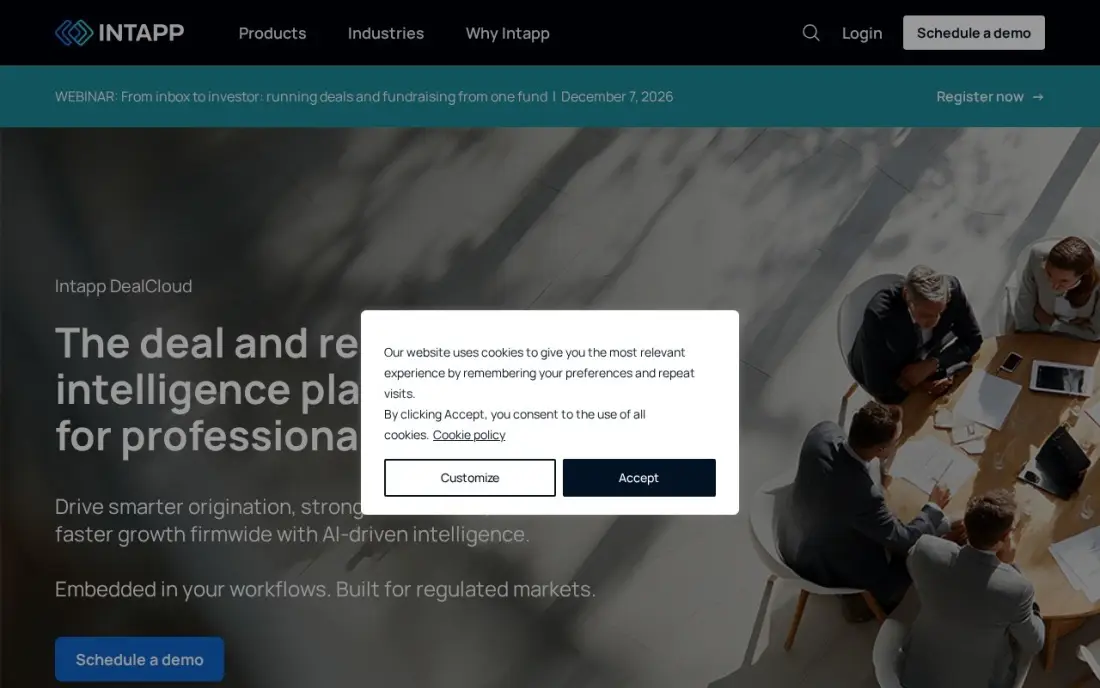
DealCloud is the default answer when a PE firm asks what its peers use, and the reason is focus: every screen is built around the deal lifecycle, from first sourcing call through diligence to close. Pipelines, companies, contacts and meetings sit in one system, and the Outlook integration logs activity without anyone typing it in. For a firm running several live processes at once, that single view of the pipeline is the product.
The catch is cost and time. Pricing is quoted annually and third-party buyer data puts typical contracts at $50,000 to $200,000-plus a year, and implementation takes 12 to 16 weeks. Smaller firms get the same deal-tracking shape for far less from Affinity or HubSpot — but neither matches DealCloud's depth once the firm runs multiple funds and a large deal team.
What we like
- Purpose-built for the deal lifecycle: sourcing, pipeline, diligence and close in one system, not a sales CRM adapted for PE
- Deep configurability: custom fields, widgets and reports that fit how an investment team actually works
- Native Outlook integration captures activity automatically, so deal notes do not depend on manual entry
- Integrations with PitchBook, Preqin and FactSet keep deal data connected to market data
Watch out for
- Quote-only annual contracts; third-party buyer data puts typical contracts at $50,000-$200,000+ a year, so it is priced for established firms
- Implementation takes 12-16 weeks, per buyer guides — a long runway before the team is live
- Reviewers note a steep learning curve and an interface that feels dated in places

Affinity
Best for: Small and mid-size PE and VC firms that source deals through partner networks and live in Gmail

Affinity wins the firms that source deals through people, not databases. It watches email and calendar traffic and builds a relationship graph automatically, scoring how strong each connection is and showing the warmest path to any founder, banker or intermediary. For a partner whose edge is a network built over twenty years, that map is the whole point — the CRM knows who can make the introduction before anyone asks.
The price is the honest trade-off. Affinity publishes no price, and third-party data puts entry around $2,000 per user per year, which buyers repeatedly call expensive for the feature set. Customization is shallow next to DealCloud, and costs climb with every hire. Buy it when relationships are the sourcing engine; buy DealCloud when the deal process itself needs the deeper system.
What we like
- Automatic activity capture from email and calendar, so no manual logging and the relationship graph builds itself
- Warm-introduction mapping shows the strongest path to any founder, banker or intermediary
- Live in 2-4 weeks, against 12-16 weeks for DealCloud, per buyer guides
- Deep Gmail integration puts the CRM inside the inbox deal teams already live in
Watch out for
- Quote-only pricing; third-party data puts entry around $2,000 per user per year, and buyers call it expensive for the feature set
- Shallow relationship scoring and limited workflow customization, per reviewers
- Costs rise steeply as the team grows, so emerging managers get the least value for the price

Dynamo Software
Best for: Multi-strategy PE firms that want one platform for deals, fundraising, portfolio monitoring and fund accounting
Dynamo is the only tool here that follows a deal all the way to the fund accounts. Its modules cover the pipeline, investor relations, portfolio monitoring and fund accounting, so capital calls, distributions and waterfall calculations live in the same system as the deal notes. For a multi-strategy firm tired of stitching five systems together, that consolidation is the pitch — one login from sourcing to LP reporting.
The breadth is also the burden. Pricing is modular and quoted, so every module beyond the base adds cost, and G2 data puts average implementation at nine months — the longest in this list. Reviewers praise the customizability and support but warn about the learning curve and slow screen loads. Pick Dynamo when the firm wants one platform; pick a point tool when it only needs the pipeline.
What we like
- One system from sourcing to fund accounting: pipeline, investor relations, portfolio analytics, capital calls and waterfall calculations
- Investor Portal gives LPs a branded, self-serve dashboard for reporting and documents
- In use since 1998 with 1,000-plus clients, per the vendor — the most established PE-native platform here
- Excel integration for fund accounting keeps finance teams in the tool they already use
Watch out for
- Quote-only modular pricing, and every module beyond the base adds cost, per G2 reviewers
- Implementation averages 9 months, per G2 data — the longest runway in this list
- Reviewers report a steep learning curve and slow load times when switching views

Salesforce Sales Cloud
Best for: Large PE firms and enterprises that need deep customization, territories and a platform their IT team can extend
Salesforce is the most powerful generalist here, and the most demanding. Custom objects, territories and workflows can model funds, portfolio companies and LPs exactly as a firm wants them, and the AppExchange connects PitchBook, Preqin and e-signature tools to the same records. For a large firm with an IT team to run it, there is no ceiling on what the CRM can be shaped into.
The entry price misleads. Starter Suite at $25 a user a month has no workflow automation, API access or forecasting, so most PE firms land on Pro Suite at $100 or Core at $195. Salesforce also repriced Sales Cloud in September 2026, retiring Enterprise and Unlimited. Buy Salesforce for depth and scale; buy HubSpot or Zoho when the firm wants to be live this week.
What we like
- Unmatched customization: custom objects, fields, workflows and territories fit any fund structure
- Largest app ecosystem in this list, with AppExchange connections to PitchBook, Preqin and e-signature tools
- Free Suite covers two users at $0, so a small team can start without a contract
Watch out for
- Starter lacks workflow automation, API access and forecasting, so most PE firms land on Pro Suite ($100) or Core ($195)
- Salesforce repriced Sales Cloud in September 2026: Enterprise and Unlimited are gone, replaced by Core ($195), Advanced ($395) and Max ($550)
- G2 reviewers most often flag high pricing and a steep learning curve

HubSpot Sales Hub
Best for: Small PE firms and search funds that want to be live the same day with no implementation project
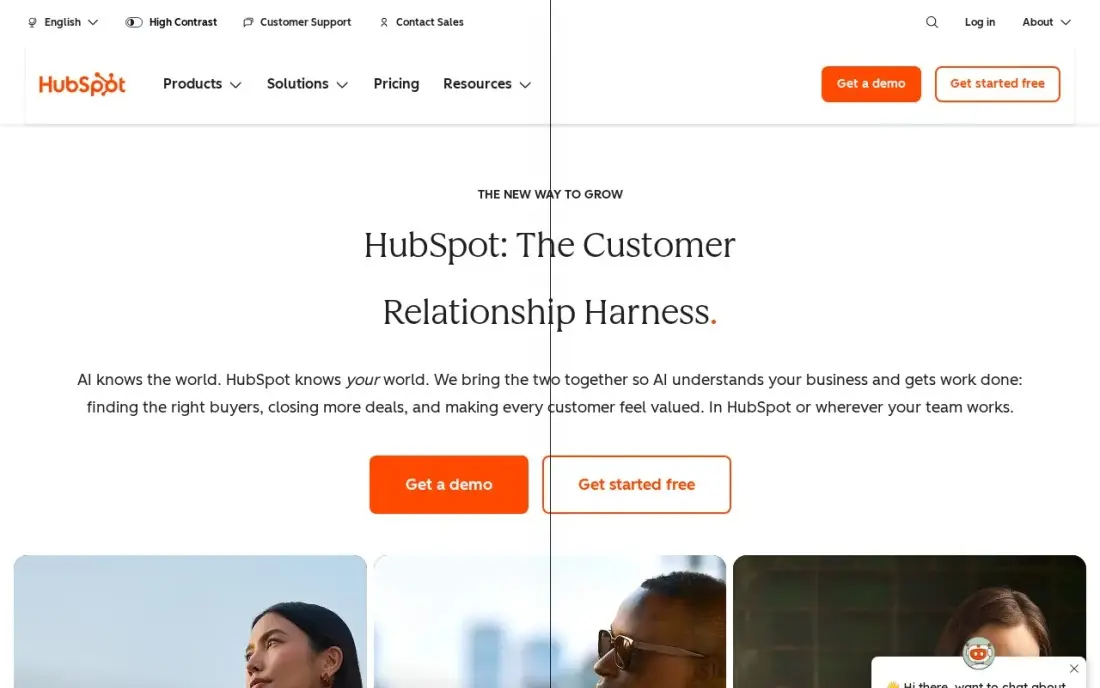
HubSpot is the easiest way for a small PE firm to stop running deals in spreadsheets. The free CRM covers two users with unlimited contacts and one pipeline, and Starter at $20 a seat a month adds a second pipeline, meeting scheduling, quotes and calling. There is no implementation project: a search fund can be logging deals the same afternoon it signs up.
The bill climbs fast past Starter. Professional is $90 a seat a month billed annually plus a mandatory $1,500 onboarding fee, and funds, portfolio companies and LPs need custom objects that only Enterprise offers. Contact-tier fees add more as the database grows. Start on HubSpot while the firm is small; move to a PE-native tool when the data model outgrows it.
What we like
- Free CRM for up to two users with unlimited contacts — the only $0 start among the generalist CRMs here
- Live the same day: no implementation project, and sequences and forecasting arrive on Professional ($90/seat/month billed annually)
- Starter removes HubSpot branding and adds a second pipeline, meeting scheduling and quotes
Watch out for
- Professional costs $90 a seat a month billed annually plus a mandatory $1,500 onboarding fee — 4.5 times the Starter seat rate
- No private-equity data model: funds, portfolio companies and LPs have to be built with custom objects on Enterprise
- Contact-tier fees and add-ons push the real bill well above the per-seat headline as the database grows

Zoho CRM
Best for: Small PE firms and family offices that want the cheapest full-featured CRM with room to grow
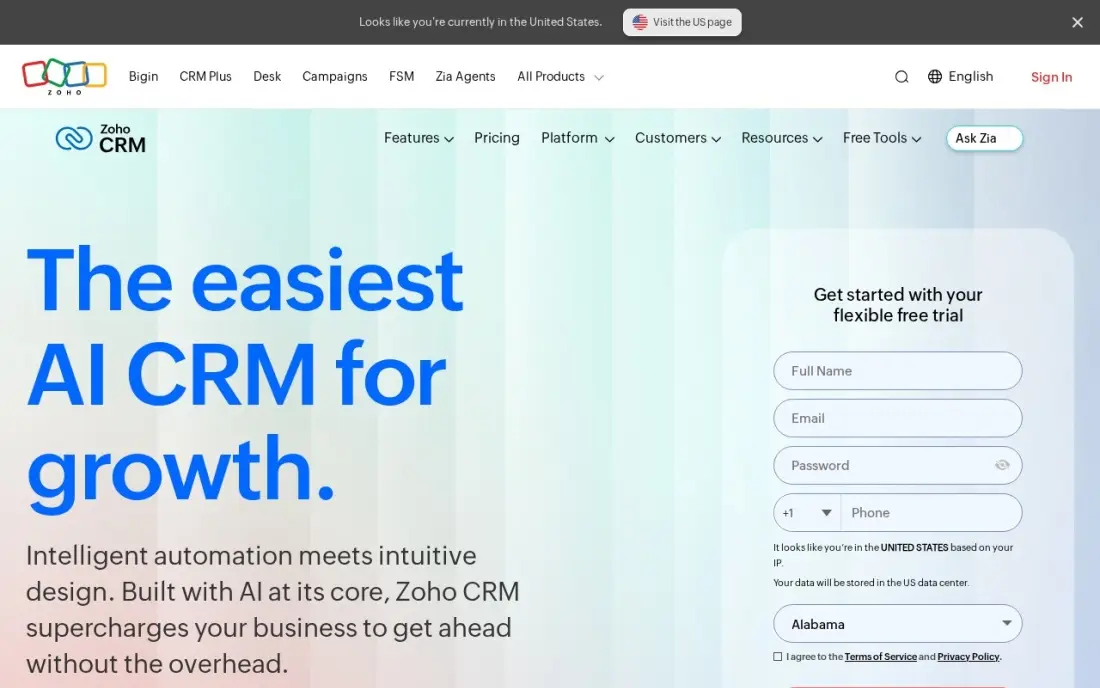
Zoho CRM is the cheapest way into a full-featured CRM, and the value is real: Standard at $14 a user a month billed annually covers email integration, calling, five pipelines, forecasting and 100,000 records, and the free plan covers three users permanently. Custom modules and Blueprint process management arrive on Professional at $23, which is still less than Salesforce Starter.
The trade-offs are support and AI. Zia, Zoho's AI assistant, and territory management wait for Enterprise at $40 a user a month, and reviewers flag support and billing friction more often than for the other generalists here. Funds and portfolio companies still need custom modules. Buy Zoho when budget decides; buy HubSpot when the team wants the gentler learning curve.
What we like
- Cheapest paid entry among the generalists: Standard at $14 a user a month billed annually
- Free plan covers three users permanently — enough for a two-person deal team to run on $0
- Deep customization: custom modules, validation rules and Blueprint process management from Professional ($23)
Watch out for
- Zia AI and territory management wait for Enterprise at $40 a user a month
- Reviewers flag support and billing friction more often than for the other generalists here
- No PE-specific data model, so funds and portfolio companies need custom modules

Pipedrive
Best for: Solo deal-sourcers and small PE teams that live in the pipeline view and want zero bloat
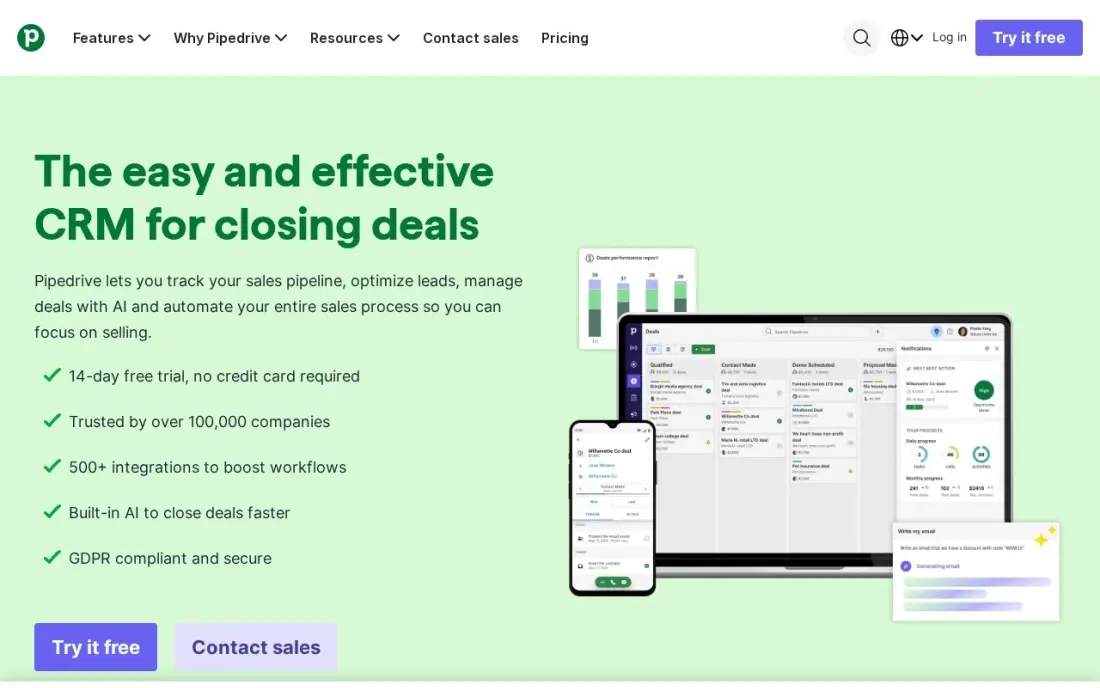
Pipedrive is the simplest pipeline in this list, and for a solo sourcer that is the whole appeal: visual deal boards, drag-and-drop stages and a clean activity feed, with nothing to configure before the first deal is logged. Lite at $14 a user a month billed annually is the joint-cheapest paid start here, and a new hire learns it in under an hour.
The simplicity has edges. There is no free plan, only a 14-day trial, and two-way email sync, real automation and forecasting all need Growth at $39 or Premium. Lead capture and enrichment sit behind paid add-ons. Buy Pipedrive when one person runs the pipeline; buy Zoho or HubSpot when the firm needs a free plan or deeper automation.
What we like
- The fastest setup here: a visual pipeline a new hire learns in under an hour
- Lite at $14 a user a month billed annually is the joint-cheapest paid start in this list
- More than 500 integrations, including email, calendar and e-signature tools
Watch out for
- No free plan — only a 14-day trial before the subscription starts
- Two-way email sync, automation beyond 30 actions and forecasting all need Growth ($29) or Premium
- Lead capture and enrichment live behind paid add-ons, so the equipped cost runs above the $14 headline
The best CRM software for private equity tracks funds, deals and investors in one place — and the right one depends on whether the firm buys a purpose-built deal platform or adapts a generalist CRM. The 7 tools below are ranked by fit for the most common buyer, a PE firm with a small deal team and a live pipeline, and every price was checked on the vendor's own pricing page on November 12, 2026.
How to choose the best crm software for private equity
- Check the data model first. A PE CRM should track funds, deals, portfolio companies and LPs natively; a generalist needs custom objects for the same job.
- Count the real users. Quote-only tools price by firm size and modules, while generalists charge per user — a 10-person team and a 30-person team buy very different products.
- Check automatic capture. If reps have to log every call and email by hand, the CRM will be empty in a month; Affinity and DealCloud capture activity from the inbox.
- Price the implementation, not just the licence. DealCloud takes 12–16 weeks to implement and Dynamo averages nine months; HubSpot and Pipedrive are live in a day.
- Check the integrations the firm actually uses. PitchBook, Preqin, FactSet and Outlook matter more than a long app list the team will never open.
- Think about the next fund, not the next quarter. A firm raising Fund II needs LP reporting and fundraising tools, not just a pipeline.
A CRM does not find deals on its own. If founders and bankers cannot find the firm when they search, our monthly SEO service covers that side. And before the firm sends its next investor update, the free SERP snippet preview tool shows exactly how its pages will look in Google.
Whatever the firm shortlists, run it with real deals before paying. The trials in this list run 14 to 15 days on the generalists, and the PE-native tools all offer demos — enough to load a live pipeline, log a week of meetings and check the reports a partner actually reads. Check two things in the trial: that email capture works without manual entry, and that the pipeline view matches how the firm really stages a deal.
CRM software for private equity pricing: what you will actually pay
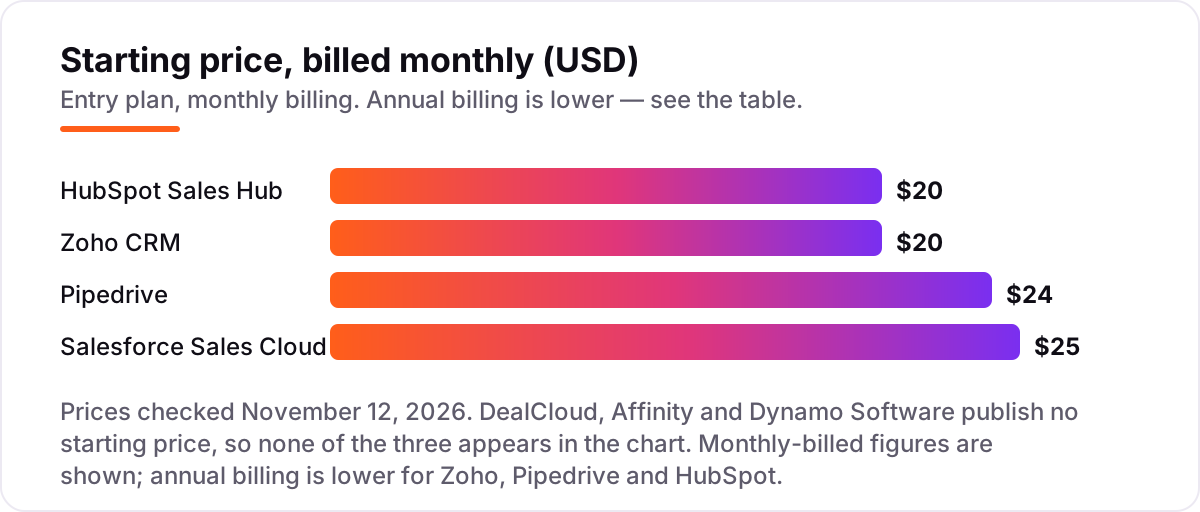
Take a 10-person deal team — five partners and associates, five operations and investor-relations staff — buying on list prices. On annual billing, Zoho Standard costs $14 a user a month, so $1,680 a year; Pipedrive Lite is the same $1,680. HubSpot Starter at the $20 standard rate costs $2,400 a year, and Salesforce Starter Suite at $25 costs $3,000. On monthly billing the same team pays $200 a month on Zoho, $240 on Pipedrive, $200 on HubSpot at the standard rate and $250 on Salesforce.
Two discounts change the picture. HubSpot's new-customer promotion cuts Starter to $7 a seat a month billed annually — $840 a year for ten seats instead of $2,400 — but renewals return to the $20 standard rate. And the step-ups are steep: Salesforce Pro Suite at $100 a user a month costs $12,000 a year for ten users, and HubSpot Professional at $90 a seat a month billed annually costs $10,800 plus the $1,500 onboarding fee in year one.
The three PE-native tools are quoted, not listed. Third-party buyer data puts Affinity at around $2,000 per user per year — about $20,000 a year for a 10-person team — and DealCloud contracts at $50,000 to $200,000-plus a year depending on firm size and modules. Dynamo is modular and quoted per firm. Add implementation on top: 12 to 16 weeks for DealCloud and an average of nine months for Dynamo, against a day for HubSpot or Pipedrive.
Three costs sit outside every number above. First, onboarding and implementation: HubSpot Professional carries a mandatory $1,500 onboarding fee, and DealCloud and Dynamo implementations are scoped projects with their own price. Second, the add-ons: Pipedrive charges separately for lead capture and enrichment, Salesforce sells AI and support as add-ons above Starter, and HubSpot's contact tiers grow the bill as the database grows. Third, the admin time: a generalist CRM needs someone to maintain the custom objects, and a PE-native tool needs someone to run the implementation. Budget all three before comparing the per-seat prices.
Know the difference: PE-native CRM vs generalist CRM
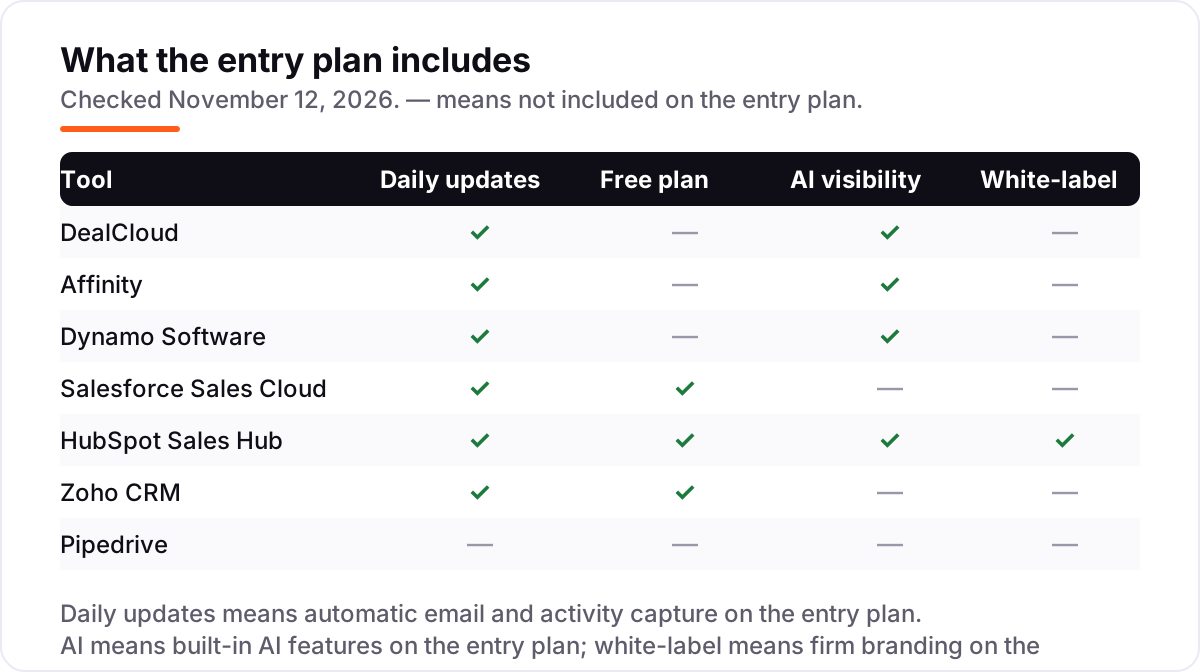
The confusion in this category is not the feature list — it is the data model. A PE-native CRM — DealCloud, Affinity or Dynamo — is built around funds, deals and investors: a deal moves from sourcing to close, a contact belongs to a fund or a portfolio company, and an LP sees reporting. A generalist CRM — Salesforce, HubSpot, Zoho or Pipedrive — is built around leads and opportunities for a sales team, and the firm has to build the fund model itself with custom objects and fields.
That difference decides the real cost. The generalists start at $14 to $25 a user a month, but the custom-object work, the integrations and the admin time are the hidden bill — Salesforce administration alone commonly costs mid-market teams $50,000 to $150,000 a year, per monday.com's comparison of the two. The PE-native tools cost far more up front and far less in workaround time. A firm with one fund and five people should buy the generalist; a firm with three funds and thirty people should buy the tool that already speaks private equity.
There is a second, quieter difference: who does the work. On a generalist CRM the firm does it — someone builds the fund model, wires the integrations and trains the team. On a PE-native tool the vendor does most of it during implementation, which is why DealCloud takes 12 to 16 weeks and Dynamo nine months. A firm buying a generalist should budget a person to own it; a firm buying a PE-native tool should budget the implementation quarter.
Quick comparison: tool type by need
| Buyer | Best pick | Why |
|---|---|---|
| PE firm that wants the industry standard | DealCloud | Purpose-built deal lifecycle, quoted annually |
| Deal team that sources through networks | Affinity | Relationship intelligence and warm introductions |
| Firm that wants deals through fund accounting | Dynamo Software | One platform from pipeline to capital calls |
| Large firm that needs deep customization | Salesforce Sales Cloud | Custom objects and territories from $25/user/month |
| Small firm that wants to start today | HubSpot Sales Hub | Free CRM for two users, Starter from $20/seat/month |
| Small firm on the tightest budget | Zoho CRM | Free for three users, Standard from $14/user/month |
| Solo sourcer who lives in the pipeline | Pipedrive | Visual pipeline from $14/user/month, 14-day trial |
Mistakes to avoid
- Buying the generalist and skipping the data model. If funds, deals and LPs need custom objects, budget the build time — or the CRM becomes a contact list with a pipeline attached.
- Comparing monthly prices without checking billing. Annual billing cuts Zoho from $20 to $14 and Pipedrive from $24 to $14; HubSpot's $7 Starter rate is a new-customer promotion, not the renewal price.
- Ignoring implementation time. DealCloud needs 12–16 weeks and Dynamo averages nine months; a firm that needs a pipeline next month should not buy a nine-month project.
- Trusting a directory price. Salesforce retired Enterprise ($165) and Unlimited ($330) in September 2026 — directories still list them, but new buyers see Core at $195. Always check the vendor's own page.
- Forgetting the quote has no ceiling. DealCloud, Affinity and Dynamo are all quoted annually; get the renewal price in writing before signing, not just year one.
How we chose
We checked each vendor's own pricing page on November 12, 2026 and recorded the starting price exactly as shown, including the annual-billing figure where the page lists one, and we ranked the tools by fit for the most common buyer — a PE firm with a small deal team and a live pipeline — not by brand size. Three prices needed extra care: DealCloud, Affinity and Dynamo publish no starting price, so they are listed as custom quote; the Affinity entry figure of about $2,000 per user per year and the DealCloud range of $50,000 to $200,000-plus a year come from third-party buyer data, not the vendors, and are labeled as such in the pricing section. Ratings come from G2, checked on November 12, 2026: DealCloud 4.2 from 41 reviews, Affinity 4.4 from 73, Dynamo 4.2 from 37, Salesforce 4.4 from 27,591, HubSpot 4.4 from 14,389, Zoho 4.1 from 2,947 and Pipedrive 4.3 from 3,109. No vendor paid for a place in this list, and none of the links here are affiliate links.
What to do next
Start with the shortlist above: pick the PE-native tool that matches the firm's size, or the generalist that matches its budget, and run a demo or trial with the firm's real pipeline. Load ten live deals, log a week of meetings and check that the reports answer the questions partners actually ask. If the firm is sorted but founders and LPs are not finding it, our monthly SEO service handles the visibility side. Once your tools are in place, find out what's holding your rankings back.
Frequently asked questions
What is the best CRM software for private equity?
DealCloud is the best fit for most established PE firms: a purpose-built deal pipeline with Outlook capture and deep reporting. Affinity is the better pick for firms that source through networks, and Dynamo for firms that want deals through fund accounting in one system. Small firms should start with HubSpot's free CRM or Zoho at $14 a user a month.
How much does CRM software for private equity cost?
Generalist CRMs start at $14 to $25 a user a month: Zoho and Pipedrive at $14, HubSpot at $20 a seat and Salesforce at $25. The PE-native tools are quoted annually: third-party data puts Affinity around $2,000 per user per year and DealCloud contracts at $50,000 to $200,000-plus a year. A 10-person team pays $1,680 to $3,000 a year on the generalists.
Is there a free CRM for private equity?
Yes, with limits. HubSpot's free CRM covers two users with unlimited contacts, and Zoho's free plan covers three users permanently. Both work for a small deal team tracking a handful of live processes. The PE-native tools — DealCloud, Affinity and Dynamo — have no free plan, only demos or trials, so a firm that needs PE-specific fields will pay from day one.
What is the difference between a PE CRM and a regular sales CRM?
A PE CRM is built around funds, deals and investors: pipeline stages follow sourcing to close, and contacts link to funds, portfolio companies and LPs. A regular sales CRM tracks leads and opportunities for a sales team, so a PE firm has to build the fund model itself with custom objects. That is why DealCloud, Affinity and Dynamo cost more — the model comes built in.
Can a small PE firm use HubSpot or Salesforce instead of DealCloud?
Yes, and many do. HubSpot's free CRM or Zoho at $14 a user a month covers a two- or three-person deal team, and Salesforce Starter at $25 models funds with custom objects. The trade-off is manual work: no built-in deal lifecycle, no relationship graph and no LP reporting. Move to DealCloud or Affinity when the firm outgrows spreadsheets and custom fields.
What should a PE firm check before paying for a CRM?
Four things: whether the data model covers funds, deals and LPs without custom work, how long implementation takes, whether email and calendar capture is automatic, and what the annual contract actually costs per user. DealCloud takes 12 to 16 weeks to implement and Dynamo averages nine months, so ask for the full timeline and the renewal price before signing.
Do PE CRMs integrate with PitchBook or Preqin?
The PE-native tools do. DealCloud integrates with PitchBook, Preqin and FactSet, and Dynamo connects to Preqin and PitchBook for fundraising. Salesforce connects through AppExchange integrations, while HubSpot, Zoho and Pipedrive rely on third-party connectors or exports. Confirm the exact integration on a trial before buying, since data depth varies by connector.
Sources we checked (14)
- DealCloud — dealcloud.com (checked November 12, 2026)
- DealCloud on G2 — 4.2/5, 41 reviews (checked November 12, 2026)
- Affinity — affinity.co (checked November 12, 2026)
- Affinity on G2 — 4.4/5, 73 reviews (checked November 12, 2026)
- Dynamo Software — dynamosoftware.com (checked November 12, 2026)
- Dynamo Software on G2 — 4.2/5, 37 reviews (checked November 12, 2026)
- Salesforce Sales Cloud pricing — salesforce.com/sales/pricing (checked November 12, 2026)
- Salesforce Sales Cloud on G2 — 4.4/5, 27,591 reviews (checked November 12, 2026)
- HubSpot Sales Hub pricing — hubspot.com/pricing/sales (checked November 12, 2026)
- HubSpot Sales Hub on G2 — 4.4/5, 14,389 reviews (checked November 12, 2026)
- Zoho CRM pricing — zoho.com/crm/pricing.html (checked November 12, 2026)
- Zoho CRM on G2 — 4.1/5, 2,947 reviews (checked November 12, 2026)
- Pipedrive pricing — pipedrive.com/en/pricing (checked November 12, 2026)
- Pipedrive on G2 — 4.3/5, 3,109 reviews (checked November 12, 2026)
Make one of these tools?
We re-check this list every quarter. Send a correction, request a review, or ask about a clearly labeled sponsored spot.
Request a listingShamim
Founder of SerpAstra
A full-stack SEO and digital marketer who spends most days on Local SEO for dental practices, AI search visibility and lead generation.
Free SEO and AI visibility audit
Find out what is holding your rankings back
Send us your site. Within 2 business days you get a written audit, an AI visibility check and a short fix list ranked by impact. Free, with no contract attached.
Request my free audit→Related buying guides
 Sales & CRMBest Marketing CRM Software for 2026: 11 Options Compared by Use CaseCompare the 11 best marketing crm software options for 2026 on price, free plans, automation and AI features, with every price checked November 5, 2026.Read guide →
 Sales & CRM12 Best CRM Email Marketing Software in 2026, Compared12 best crm email marketing software tools compared on price, CRM depth and automation, with real starting prices checked on November 4, 2026.Read guide →
 Sales & CRM11 Best B2C CRM and Marketing Automation Platforms in 2026, Compared11 best b2c crm and marketing automation platforms compared on price, free plans and automation depth, with every price checked November 4, 2026.Read guide →