7 Best CRM Software for Event Management in 2026, Compared
Compare the 7 best CRM software for event management options on price, free plans and event features, with every price checked November 12, 2026.
 Shamim Mia, Founder, SerpAstraLast verified November 12, 202612 min read
We compare pricing pages, documentation and public reviews. We never accept payment for rankings.

Key takeaways
- HubSpot Sales Hub leads for most event businesses: a free CRM for up to 2 users, with Starter from $20 a seat a month.
- HoneyBook is the event-native pick at $36 a month: proposals, contracts, invoices and payments in one place, built for planners and photographers.
- The single most important buying factor is what the price covers: per-seat CRMs charge for every team member, while HoneyBook and Dubsado charge per account.
- Every price below was checked on the vendor's own pricing page on November 12, 2026. Ratings are G2, with review counts shown.
On this page
Quick comparison
| Tool | Best for | Starting price | Free plan |
|---|---|---|---|
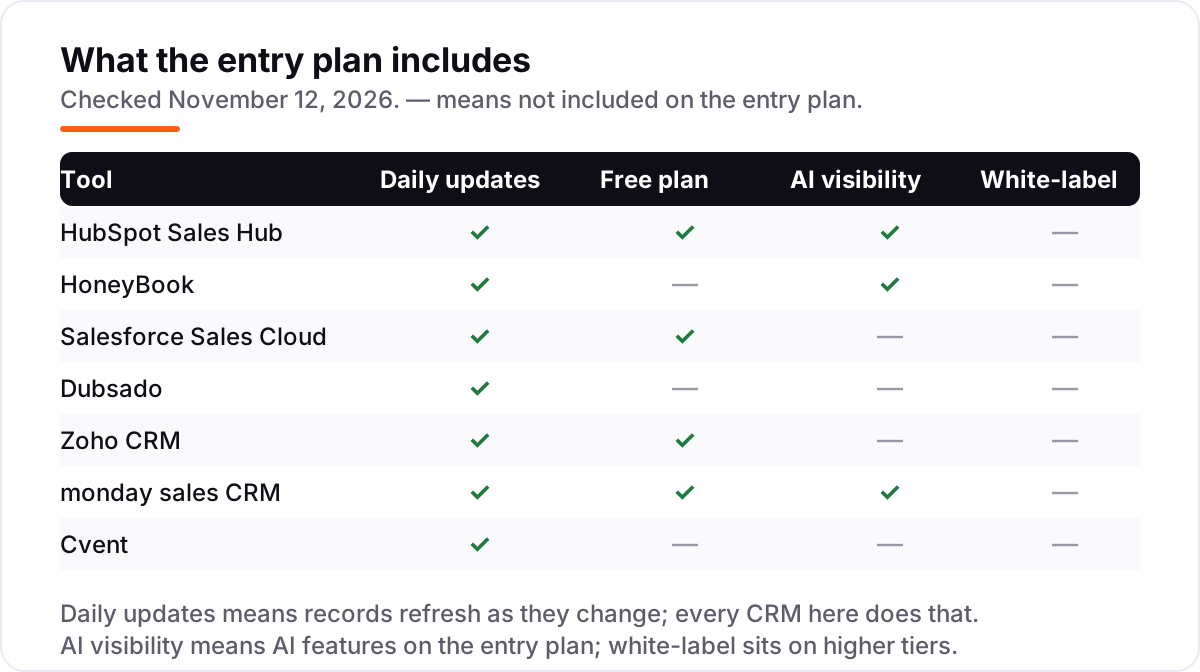
| HubSpot Sales Hub | Small event businesses that want a free CRM to start and marketing tools in the same account | $20/seat/mo | Yes (free CRM) |
| HoneyBook | Event planners and photographers who book clients with proposals, contracts and payments | $36/mo | No (30-day trial) |
| Salesforce Sales Cloud | Larger event companies that need deep customization and a CRM that scales past 50 staff | $25/user/mo | Yes (Free Suite) |
| Dubsado | Small event studios that want deep workflow customization at a flat monthly price | $35/mo | No (21-day trial) |
| Zoho CRM | Budget-conscious event teams that want a full CRM for $14 a user a month on annual billing | $20/mo | Yes (free edition) |
| monday sales CRM | Visual event teams that manage bookings as boards and want heavy automation | $18/seat/mo | Yes (free plan) |
| Cvent | Large event programs that run conferences and trade shows with venue sourcing and registration | Custom quote | No (demo only) |
Make one of these tools?
We re-check this list every quarter. Send a correction, request a review, or ask about a clearly labeled sponsored spot.
Request a listingThe best crm software for event management
HubSpot Sales Hub
Best for: Small event businesses that want a free CRM to start and marketing tools in the same account
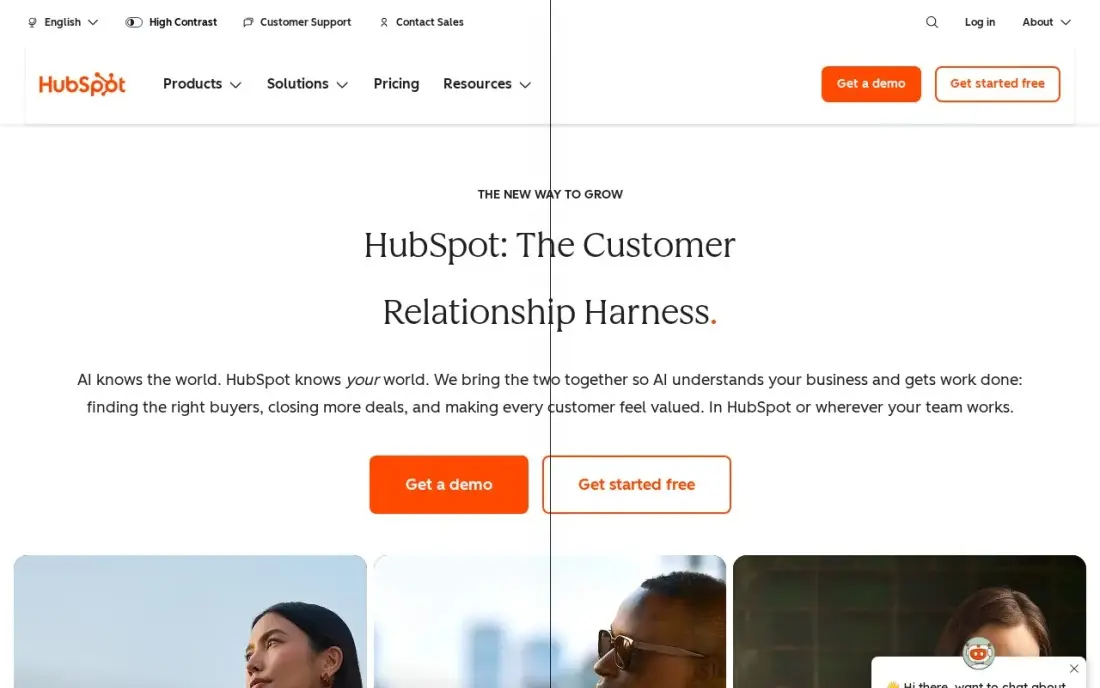
HubSpot Sales Hub is the safe default for an event business that is still growing. The free CRM covers contacts, deals and pipelines for up to two users, so a planner can run bookings before spending anything, and Starter at $20 a seat a month adds sequences, meeting scheduling and simple automation. Marketing tools sit in the same account, which matters when the team that plans the event also has to fill it.
The catch is the price you see first. Starter shows $7 a seat a month for new customers on annual billing, but the standard rate is $20, so budget on $20 and treat $7 as a first-year discount. Professional is a much bigger step at $90 a seat a month plus a $1,500 onboarding fee, so price that jump before you need the features.
What we like
- Free CRM for up to 2 users with contacts, deals and pipelines, so a small event team can start at $0
- Starter adds sequences, meeting scheduling and simple automation for $20 a seat a month at list
- Native marketing tools and a large integration library keep leads and bookings in one place
Watch out for
- The $7 a seat annual price is a new-customer promo; the standard Starter rate is $20 a seat a month
- Professional jumps to $90 a seat a month plus a $1,500 one-time onboarding fee
HoneyBook
Best for: Event planners and photographers who book clients with proposals, contracts and payments
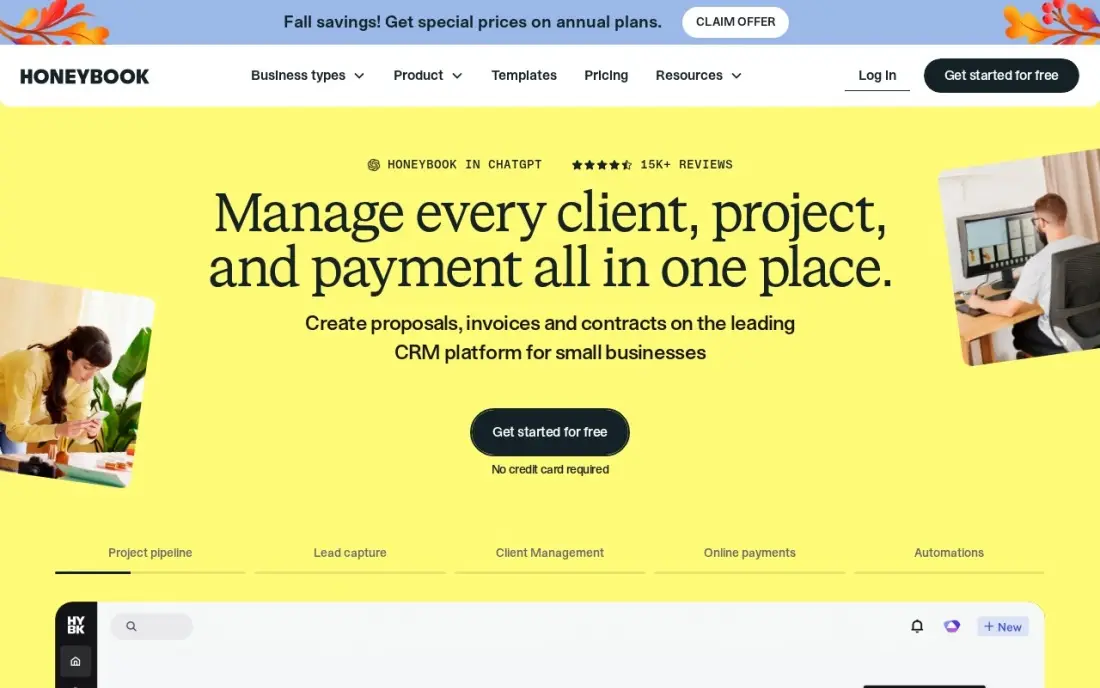
HoneyBook is the only tool here built around the way event planners actually get paid. A booking starts as a proposal, becomes a signed contract, then an invoice and a payment, and HoneyBook runs that whole chain in one account with a client portal the customer sees throughout. Starter costs $36 a month billed monthly, or $29 on annual billing, and covers unlimited clients and projects with HoneyBook AI included.
The limits sit on the cheapest plan. Starter has no scheduler and no automations, so a planner who wants clients to book a call or a tasting without emailing back and forth needs Essentials at $49 a month billed annually. Card processing also adds about 2.9% plus $0.25 per transaction, and payments work only for businesses in the US and Canada, so planners elsewhere should look at Dubsado instead.
What we like
- Built for event work: proposals, contracts, invoices, payments and a client portal in one account
- Unlimited clients and projects on every plan, with HoneyBook AI included from Starter
- Flat per-account pricing, so adding a second planner does not multiply the bill on Premium
Watch out for
- Starter has no scheduler and no automations; those start on Essentials at $49 a month billed annually
- Card processing adds about 2.9% plus $0.25 per transaction, and payments work only in the US and Canada

Salesforce Sales Cloud
Best for: Larger event companies that need deep customization and a CRM that scales past 50 staff
Salesforce Sales Cloud is the pick when the event business is already big or plans to be. Starter Suite at $25 a user a month covers contacts, leads, pipeline and email, and the platform behind it is the most customizable CRM here, with the largest marketplace of add-ons for events, finance and marketing. A company running dozens of events a year can shape it around its own process instead of bending the process around the tool.
That power costs more than the license. Pro Suite costs $100 a user a month, and Salesforce replaced Enterprise and Unlimited with Core at $195 and Advanced at $395 in September 2026, so older price lists are stale. Most teams need an admin or a partner to set it up, making Salesforce the most expensive option here once implementation is counted.
What we like
- The deepest customization here, with the largest app marketplace for event and finance add-ons
- Starter Suite covers contacts, leads, pipeline and email integration for $25 a user a month
- Industry add-ons let a large event business build a full client system on one platform
Watch out for
- Pro Suite costs $100 a user a month, and the September 2026 reprice replaced Enterprise with Core at $195
- Implementation usually needs an admin or a partner, so the license is not the full cost

Dubsado
Best for: Small event studios that want deep workflow customization at a flat monthly price
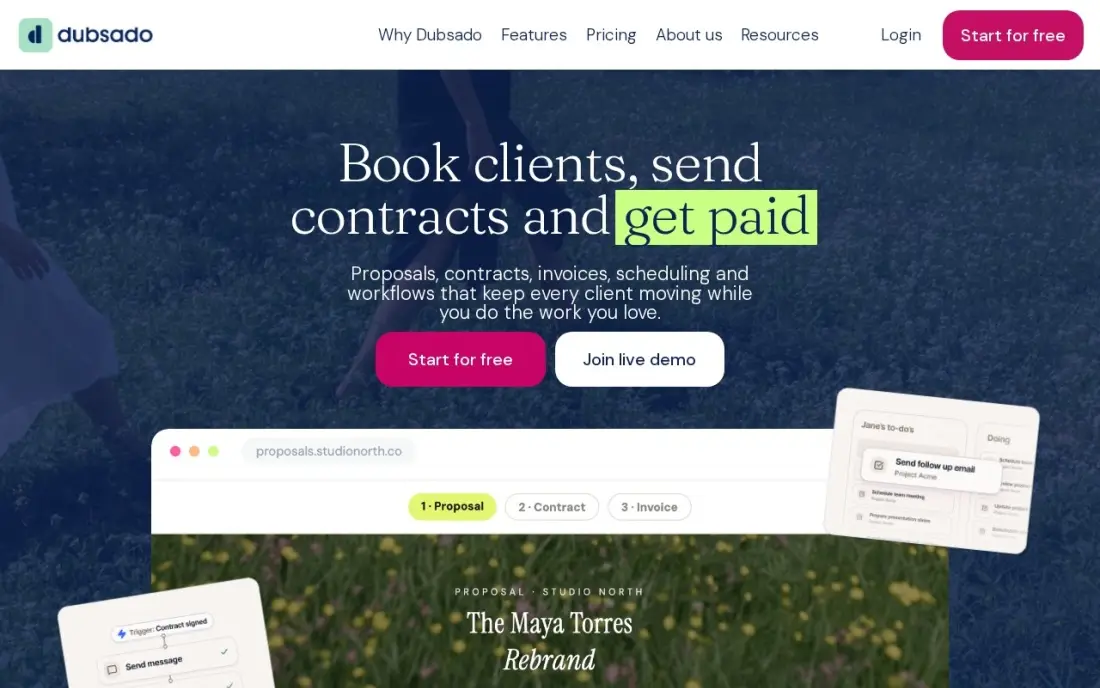
Dubsado is the flat-priced alternative to HoneyBook for event studios that like to build their own workflows. Starter costs $35 a month and covers unlimited clients and projects, invoicing, contracts, forms and a client portal, with three seats included, so a small studio pays one price instead of one price per person. The workflow builder is the draw: a planner can map every step from inquiry to final payment and let the system chase the follow-ups.
The catch is that the automation lives on the higher plan. Starter has no scheduler and no automated workflows, so most event teams need Premier at $55 a month for the scheduling, Flows and Zapier that make the tool worth buying. Prices also rose in December 2025, so the $20 and $40 figures still quoted in older reviews no longer apply to new subscribers.
What we like
- Flat pricing per account with 3 seats included on Starter, so a small studio pays one price
- Premier adds scheduling, automated workflows, public proposals and Zapier for $55 a month
- Forms, contracts, invoices and a client portal cover the whole booking journey in one tool
Watch out for
- Starter has no scheduler and no automated workflows, so most event teams need Premier at $55 a month
- New-subscriber prices rose in December 2025; older reviews still quote $20 and $40, which no longer apply

Zoho CRM
Best for: Budget-conscious event teams that want a full CRM for $14 a user a month on annual billing
Zoho CRM is the cheapest way into a full CRM, and the price gap is real. Standard costs $20 a user a month billed monthly, or $14 on annual billing, and it covers email integration, calling, five pipelines, forecasting and 100,000 records. The free edition covers up to three users, so a tiny event team can run contacts, leads and deals at $0 while deciding whether the paid plan is worth it.
Zoho is the slowest to learn in this list. Setup and customization take longer than on HubSpot or HoneyBook, and the features that make it powerful, including Zia AI and deeper automation, sit on Professional at $23 a user a month or Enterprise at $40. Buy Zoho when the budget is tight and someone enjoys configuring software; buy HubSpot when the team wants to start selling this week.
What we like
- The cheapest full CRM here on annual billing: Standard is $14 a user a month
- Free edition for up to 3 users covers contacts, leads and deals at $0
- Strong automation and a large integration library, including Zoho's own event and finance apps
Watch out for
- Setup and customization take longer than the simpler tools here, and the interface takes time to learn
- Zia AI and advanced automation start on Professional and Enterprise, not on Standard

monday sales CRM
Best for: Visual event teams that manage bookings as boards and want heavy automation
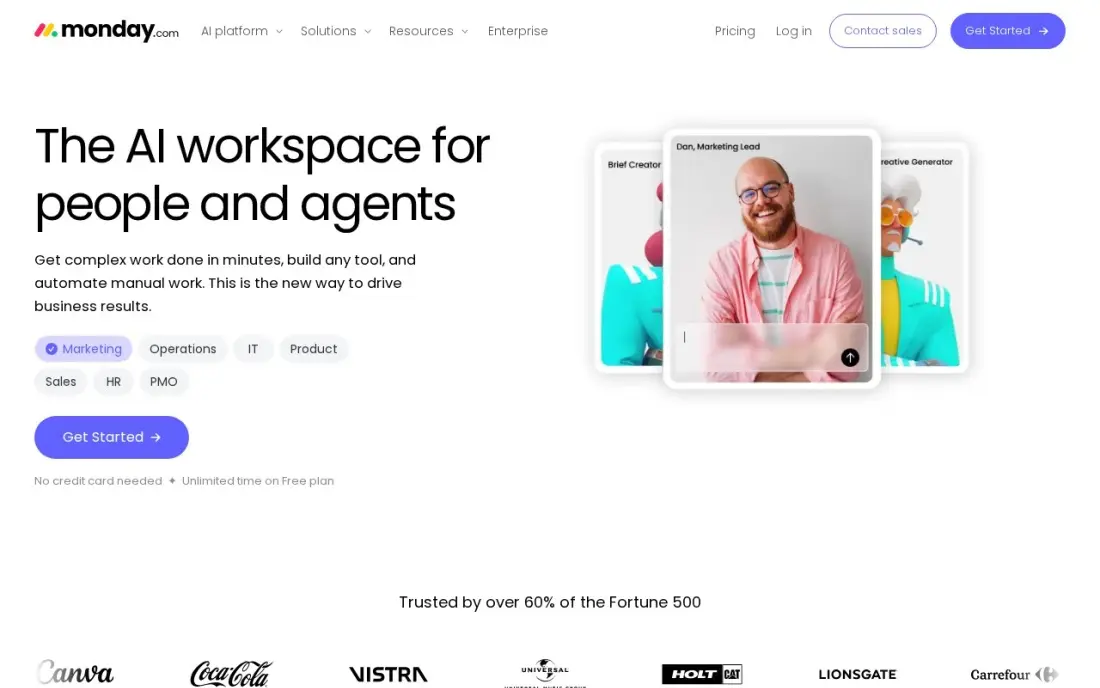
monday sales CRM turns the event pipeline into boards the whole team can read at a glance. Basic costs $18 a seat a month billed monthly, or $12 on annual billing, and covers unlimited boards and pipelines with 1,000 active contacts and deals. Timelines, dashboards and a free plan for up to two seats make it easy to try, and the visual style suits teams who already plan in spreadsheets and whiteboards.
Two limits matter. Plans start from three seats, so a one- or two-person team still pays for three, and Basic has no custom automations, so most event teams need Standard at $17 a seat a month billed annually for the 250 automations and integrations. A team that lives in boards will love it; one that wants contracts and payments built in should look at HoneyBook or Dubsado instead.
What we like
- Visual boards make event pipelines easy to scan, with timelines and dashboards built in
- Standard adds 250 automations a month and integrations for $17 a seat a month billed annually
- A free plan for up to 2 seats lets a tiny team try the boards before paying
Watch out for
- Plans start from 3 seats, so a one- or two-person team still pays for three
- Basic has no custom automations, so most event teams need Standard at $17 a seat a month billed annually
Cvent
Best for: Large event programs that run conferences and trade shows with venue sourcing and registration
Cvent is a different kind of tool from everything else here: an enterprise event platform with CRM connections, not a sales CRM with event features. It covers registration, venue sourcing, an attendee hub for virtual sessions, on-site check-in and a large network of hotels and venues, so a company running conferences and trade shows can run the whole program there. Native Salesforce and marketing-automation integrations keep event data in the CRM.
It is also the only tool here a small event business cannot buy. Cvent publishes no prices and offers no self-serve trial; every plan runs through a sales quote and an annual contract, and third-party procurement data puts typical mid-market contracts near $19,550 a year. Pick Cvent when the program is large enough to need venue sourcing and registration at scale; otherwise pick anything else here.
What we like
- The only enterprise event platform here: registration, venue sourcing, attendee hub and on-site check-in in one suite
- Venue sourcing covers a large network of hotels and venues, with RFP and contract tools built in
- Native Salesforce and marketing-automation integrations keep event data in the CRM
Watch out for
- No published prices and no self-serve trial; every plan runs through a sales quote and an annual contract
- Third-party procurement data puts typical mid-market contracts near $19,550 a year, so it is not a small-team buy
The best CRM software for event management has to do two jobs at once: keep track of clients and keep track of events. The 7 tools below are ranked by fit for the most common buyer, a small event business with one to five people that books weddings, corporate events and conferences, and every price was checked on the vendor's own pricing page on November 12, 2026.
How to choose the best crm software for event management
- Start with the booking, not the pipeline. An event CRM has to turn an inquiry into a signed contract and a deposit; a tool that only tracks deals will leave the booking work to email and spreadsheets.
- Count who pays, and how. HubSpot, Salesforce, Zoho and monday charge per seat, while HoneyBook and Dubsado charge per account. The pricing unit decides what a growing team pays, not the headline price.
- Check the scheduler and automations. On HoneyBook and Dubsado the scheduler and automated workflows sit on a higher plan than the entry price, so budget on the plan that actually has them.
- Check payments and processing fees. HoneyBook takes about 2.9% plus $0.25 per card payment, and its payments work only in the US and Canada. A planner who takes large deposits pays more in processing than in subscription some months.
- Check the free plan's real limits. HubSpot's free CRM covers 2 users, Zoho's covers 3, and monday's covers 2 seats with tight limits. A free plan that runs out mid-season is not a free plan.
- Think about the biggest event, not the average one. A tool that handles a 50-guest wedding may not handle a 5,000-person conference with registration, badges and venue sourcing. That is the line where Cvent starts to make sense.
A CRM fills the diary, but it does not fill it with new clients on its own. If the business is not showing up when people nearby search for event planners, our local SEO service covers that side. And before the business asks clients for reviews after an event, the free Google review link generator makes a one-tap review link for the thank-you email.
Whatever you shortlist, try it with a real event before you pay. The trials in this list run 14 to 30 days, which is long enough to send a real proposal, sign a real contract and take a real deposit. Check two things in the trial: that a client can book and pay without emailing back and forth, and that the calendar never double-books the same date.
CRM software for event management pricing: what you will actually pay
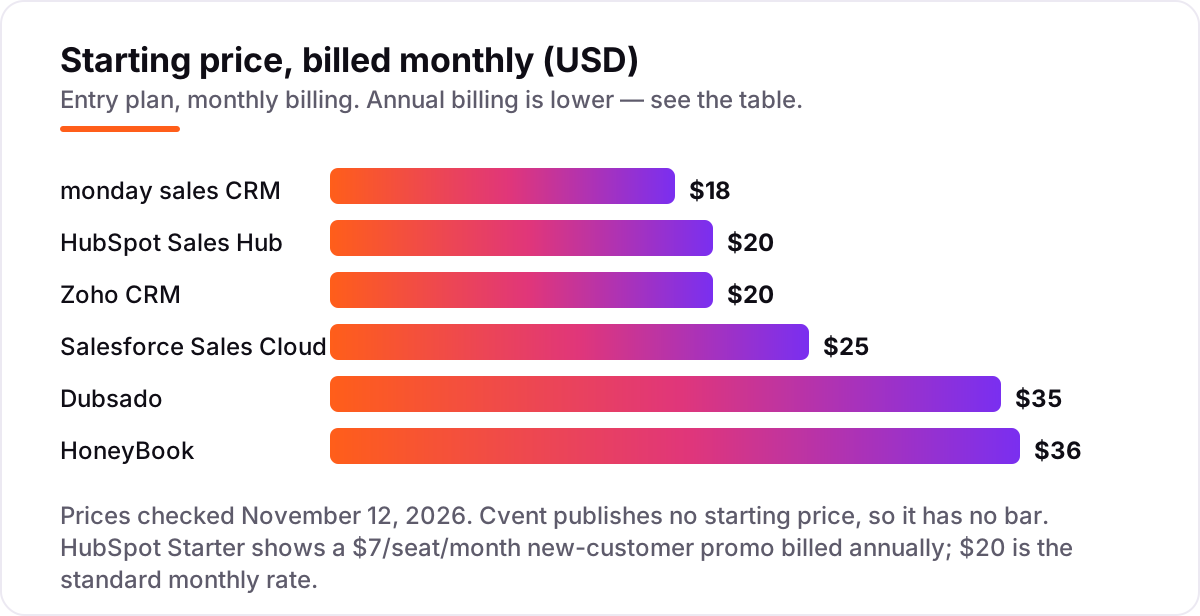
Take a five-person event business at one location. On monthly-billing list prices, the subscription costs $100 a month on HubSpot Starter, $125 on Salesforce Starter Suite, $100 on Zoho Standard, $90 on monday Basic and $35 on Dubsado Starter, which covers 3 seats. HoneyBook Starter at $36 a month covers only 1 user, so a five-person team needs Premium at $129 a month for unlimited seats. On Dubsado Premier, five people cost $80 a month: $55 for the plan plus $25 for the extra-user tier.
Over a year on monthly billing, that is $420 on Dubsado Starter, $960 on Dubsado Premier, $1,080 on monday Basic, $1,200 on HubSpot Starter and Zoho Standard, $1,500 on Salesforce Starter and $1,548 on HoneyBook Premium. Annual billing cuts most of these: Zoho Standard drops to $840 a year for five users, monday Basic to $720, Dubsado Starter to $335 and HoneyBook Starter to $348, though HoneyBook Starter still covers only one user.
Two costs sit outside every number above. First, card processing: a business that takes $5,000 a month in card payments through HoneyBook pays roughly $150 a month in processing fees at about 2.9% plus $0.25 per transaction. Second, the plan that actually has the features: the scheduler and automations that make HoneyBook and Dubsado worth buying sit on Essentials at $49 a month billed annually and Premier at $55 a month, not on the $36 and $35 entry prices.
Know the difference: event CRM vs event management platform
The confusion in this category is between two different products that share the word event. An event CRM, like HoneyBook, Dubsado or HubSpot, manages the client: the inquiry, the proposal, the contract, the invoice and the follow-up after the event. Its unit is the client, and its job ends when the client is happy and paid. An event management platform, like Cvent, manages the event itself: registration, ticketing, venue sourcing, hotel blocks, an attendee app and on-site check-in. Its unit is the attendee, and its job ends when the doors close.
The two overlap in the middle, which is where buyers go wrong. HoneyBook can run a wedding for 100 guests from first email to final payment, but it cannot register 5,000 conference attendees or source a hotel. Cvent can register those 5,000 attendees and book their rooms, but it is not the tool that chases a single client's deposit or sends a thank-you note. A planning studio that books clients one at a time needs the CRM; a company that runs conferences needs the platform; a company that does both usually needs both, with the CRM holding the client record and the platform holding the event.
Quick comparison: tool type by need
| Buyer | Best pick | Why |
|---|---|---|
| Small event business starting out | HubSpot Sales Hub | Free CRM for 2 users, Starter is $20/seat/month |
| Planner who books with proposals and payments | HoneyBook | Proposals, contracts and payments in one place from $36/month |
| Large event company that needs scale | Salesforce Sales Cloud | Deepest customization, from $25/user/month |
| Small studio that wants custom workflows | Dubsado | Flat $35/month with 3 seats included |
| Team on a tight budget | Zoho CRM | Free edition for 3 users, Standard is $14/user/month billed annually |
| Conference or trade show program | Cvent | Registration and venue sourcing, priced by quote |
Mistakes to avoid
- Budgeting on the entry price. The scheduler and automations sit on HoneyBook Essentials and Dubsado Premier, not on the $36 and $35 entry prices. Price the plan that has the features, not the cheapest one.
- Comparing monthly prices without checking billing. The annual price is usually 15–20% lower — Zoho Standard drops from $20 to $14 a user a month — and Cvent has no monthly option at all.
- Ignoring the pricing unit. A per-seat CRM costs $100 a month for five people on HubSpot Starter, while Dubsado Starter covers three seats for $35. Price the team you will have next year, not the team you have today.
- Forgetting card processing. At about 2.9% plus $0.25 per transaction, a business taking $5,000 a month in card payments pays roughly $150 a month in processing — more than most of these subscriptions.
- Buying a conference platform for a planning studio. Cvent is built for registration and venue sourcing at scale. A studio that books one client at a time pays an enterprise price for features it will never open.
How we chose
We checked each vendor's own pricing page on November 12, 2026 and recorded the starting price exactly as shown, including the annual-billing figure where the page lists one, and we ranked the tools by fit for the most common buyer — a small event business with one to five people booking weddings, corporate events and conferences — not by brand size. Three prices needed extra care. HubSpot Starter shows a $7 a seat new-customer promo on annual billing; $20 is the standard monthly rate, and that is the figure we used. Dubsado raised its prices for new subscribers in December 2025, so the $20 and $40 figures still quoted in older reviews no longer apply. Cvent publishes no prices, so its entry is a custom quote, and the near-$19,550 mid-market figure in its card comes from third-party procurement data, not from Cvent. Ratings come from G2 pages with fresh copies checked on November 12, 2026: HubSpot Sales Hub 4.4 from 13,909 reviews, HoneyBook 4.5 from 252 and Salesforce Sales Cloud 4.4 from 27,591. The other four tools show no rating because no fresh G2 page copy was available today. No vendor paid for a place in this list, and none of the links here are affiliate links.
What to do next
Start with the free plan or trial of your top pick and run one real event through it: send the proposal, sign the contract, take the deposit and send the thank-you note. Check that a client can book and pay without emailing back and forth, and that the calendar never double-books the same date. If the business is sorted but new clients are not finding it, our monthly SEO service handles the visibility side. Once your tools are in place, find out what's holding your rankings back.
Frequently asked questions
What is the best CRM software for event management?
HubSpot Sales Hub is the best fit for most event businesses: a free CRM for up to 2 users, with Starter from $20 a seat a month. HoneyBook is the best event-native pick at $36 a month, with proposals, contracts and payments built in. Large programs that need registration and venue sourcing should look at Cvent instead.
How much does CRM software for event management cost?
Most small event businesses pay $0 to $129 a month for the subscription. HubSpot and Zoho both have free plans, and the first paid plans run $18 to $36 a month. A five-person team typically pays $80 to $129 a month on list prices, before card processing, which adds about 2.9% on payments taken through HoneyBook.
Is there a free CRM for event management?
Yes, with limits. HubSpot has a free CRM for up to 2 users, Zoho has a free edition for up to 3 users, and monday has a free plan for up to 2 seats. All three still charge for the features that run an event business, like scheduling and automation, so a free plan is a starting point, not the whole system.
What is the difference between HoneyBook and Dubsado?
Both cover proposals, contracts, invoices and client portals at a flat monthly price, but HoneyBook is easier to set up and charges $36 a month, while Dubsado is more customizable and charges $35 a month. HoneyBook payments work only in the US and Canada; Dubsado works in more countries. Both keep their scheduler and automations on a higher plan.
Do I need Cvent or a regular CRM?
A regular CRM is enough for a planning studio that books clients one at a time. Cvent fits a company running conferences and trade shows, where registration, venue sourcing, hotel blocks and on-site check-in are the work. If the biggest event has hundreds of attendees and a venue contract, look at Cvent; if it has one client and one date, a CRM is enough.
Can I switch CRM software later?
Yes, but move in a quiet week. Export the client list, contracts, prices and future events, then import them into the new tool and test the booking flow before going live. Keep the old system open until the new one is proven, because a mid-season switch is how double-bookings and lost deposits happen.
What should I check before paying for event CRM software?
Check how the price grows with the team, whether the scheduler and automations are included or on a higher plan, and what card processing costs on payments. Then run the trial with a real event: send a real proposal, sign a real contract and take a real deposit, and confirm the calendar never double-books the same date.
Sources we checked (10)
- HubSpot Sales Hub pricing — hubspot.com/pricing/sales (checked November 12, 2026)
- HubSpot Sales Hub on G2 — 4.4/5, 13,909 reviews (checked November 12, 2026)
- HoneyBook pricing — honeybook.com/pricing (checked November 12, 2026)
- HoneyBook on G2 — 4.5/5, 252 reviews (checked November 12, 2026)
- Salesforce Sales Cloud pricing — salesforce.com/crm/pricing (checked November 12, 2026)
- Salesforce Sales Cloud on G2 — 4.4/5, 27,591 reviews (checked November 12, 2026)
- Dubsado pricing — dubsado.com/pricing (checked November 12, 2026)
- Zoho CRM pricing — zoho.com/crm/pricing.html (checked November 12, 2026)
- monday sales CRM pricing — monday.com/pricing (checked November 12, 2026)
- Cvent — cvent.com (no published pricing; custom quote) (checked November 12, 2026)
Make one of these tools?
We re-check this list every quarter. Send a correction, request a review, or ask about a clearly labeled sponsored spot.
Request a listingShamim
Founder of SerpAstra
A full-stack SEO and digital marketer who spends most days on Local SEO for dental practices, AI search visibility and lead generation.
Free SEO and AI visibility audit
Find out what is holding your rankings back
Send us your site. Within 2 business days you get a written audit, an AI visibility check and a short fix list ranked by impact. Free, with no contract attached.
Request my free audit→Related buying guides
 Events & Webinars9 Best Event Marketing Platforms for 2026 (Pros, Cons and Pricing)9 best event marketing platforms compared with real prices, G2 ratings and free plans. Find the right fit for conferences, webinars and ticketed events.Read guide →
 Sales & CRMBest Marketing CRM Software for 2026: 11 Options Compared by Use CaseCompare the 11 best marketing crm software options for 2026 on price, free plans, automation and AI features, with every price checked November 5, 2026.Read guide →
 Sales & CRM12 Best CRM Email Marketing Software in 2026, Compared12 best crm email marketing software tools compared on price, CRM depth and automation, with real starting prices checked on November 4, 2026.Read guide →