Best CRM for Small Business in 2026: 10 Options Ranked and Reviewed
Compare the 10 best crm for small business options on starting price, free plans and AI features, with every price checked on November 12, 2026.
 Shamim Mia, Founder, SerpAstraLast verified November 12, 202615 min read
We compare pricing pages, documentation and public reviews. We never accept payment for rankings.

Key takeaways
- HubSpot is the best fit for most small businesses: a real free CRM for 2 users, then Starter at $20 a seat a month. Freshsales follows at $9 a user a month billed annually, and Zoho CRM at $14.
- Four tools here cost nothing to start: HubSpot, Zoho CRM, Salesforce Free Suite and Capsule all have free plans, though Capsule caps at 250 contacts and 2 users.
- The single most important buying factor is the limit that forces your next upgrade: user caps, contact caps and the tier where automation lives decide what you actually pay, not the headline price.
- Per-seat pricing multiplies fast: the same five-person team costs $420 a year on Close Essentials and $1,740 on Insightly Plus, before calling usage and add-ons.
On this page
Quick comparison
| Tool | Best for | Starting price | Free plan |
|---|---|---|---|
| HubSpot | Small businesses that want a real free CRM now and the easiest upgrade path when they outgrow it | $20/seat/mo | Yes (free CRM) |
| Zoho CRM | Small businesses that want the cheapest full-featured CRM with a free plan for up to three users | $14/user/mo (annual) | Yes (free plan) |
| Freshsales | Small teams that want built-in phone, email and chat from the cheapest paid plan | $9/user/mo (annual) | Yes (free plan) |
| Pipedrive | Sales teams that want the clearest visual pipeline and the fastest setup | $14/user/mo (annual) | No (14-day trial) |
| Monday Sales CRM | Visual teams that run sales on boards and want a CRM that bends to their process | $12/seat/mo (annual) | No (14-day trial) |
| Salesforce | Growing businesses that want the deepest CRM ecosystem and plan to scale | $25/user/mo | Yes (Free Suite) |
| Capsule | Small teams that sell on relationships and want a simple contact-first CRM | $18/user/mo (annual) | Yes (free plan) |
| Less Annoying CRM | Tiny teams that want one flat price, every feature included, and no pricing games | $15/user/mo | No (30-day trial) |
| Close | Outbound sales teams that live on the phone and want calling built into the CRM | $9/user/mo (annual) | No (14-day trial) |
| Insightly | Small businesses where the sale is only half the job and delivery lives in the same system | $29/user/mo (annual) | No (14-day trial) |
Make one of these tools?
We re-check this list every quarter. Send a correction, request a review, or ask about a clearly labeled sponsored spot.
Request a listingThe best CRM for small business

HubSpot
Best for: Small businesses that want a real free CRM now and the easiest upgrade path when they outgrow it
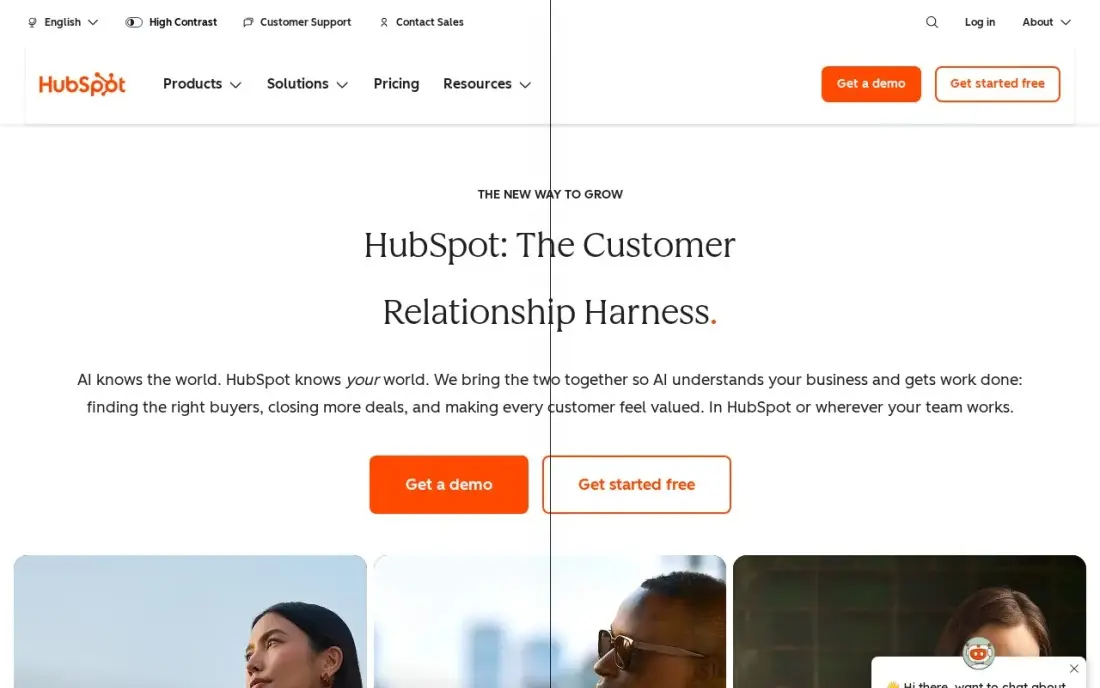
HubSpot is the easiest place for a small business to start because the free CRM is a working tool, not a demo: two users, 1,000 contacts, deal pipelines, email tracking and meeting scheduling at $0, with no time limit. When the team grows past two users, Sales Hub Starter costs $20 a seat a month and adds more pipelines, email templates, snippets and simple automation, plus 500 HubSpot Credits a month for AI features.
The catch is the size of the step up. Professional costs $90 a seat a month billed annually, or $100 billed monthly, plus a required $1,500 onboarding fee, and it holds the forecasting, sequences and deeper automation most growing teams eventually want. Buy HubSpot for the free start and the widest ecosystem; buy Zoho CRM or Freshsales when the per-seat price decides it.
What we like
- A real free CRM: 2 users, 1,000 contacts, deal tracking and email tracking at $0
- The widest integration marketplace here, with marketing, sales and service sharing one database
- Starter includes 500 HubSpot Credits a month for AI features, not held for the top tier
- The easiest setup in this list, with the most help articles and community answers
Watch out for
- Starter at $20 a seat is only the start: Professional jumps to $90 a seat plus a $1,500 onboarding fee
- The $7 a seat annual promo is for new customers only, so budget on the $20 list price
- Forecasting and sequences sit on Professional, not Starter

Zoho CRM
Best for: Small businesses that want the cheapest full-featured CRM with a free plan for up to three users
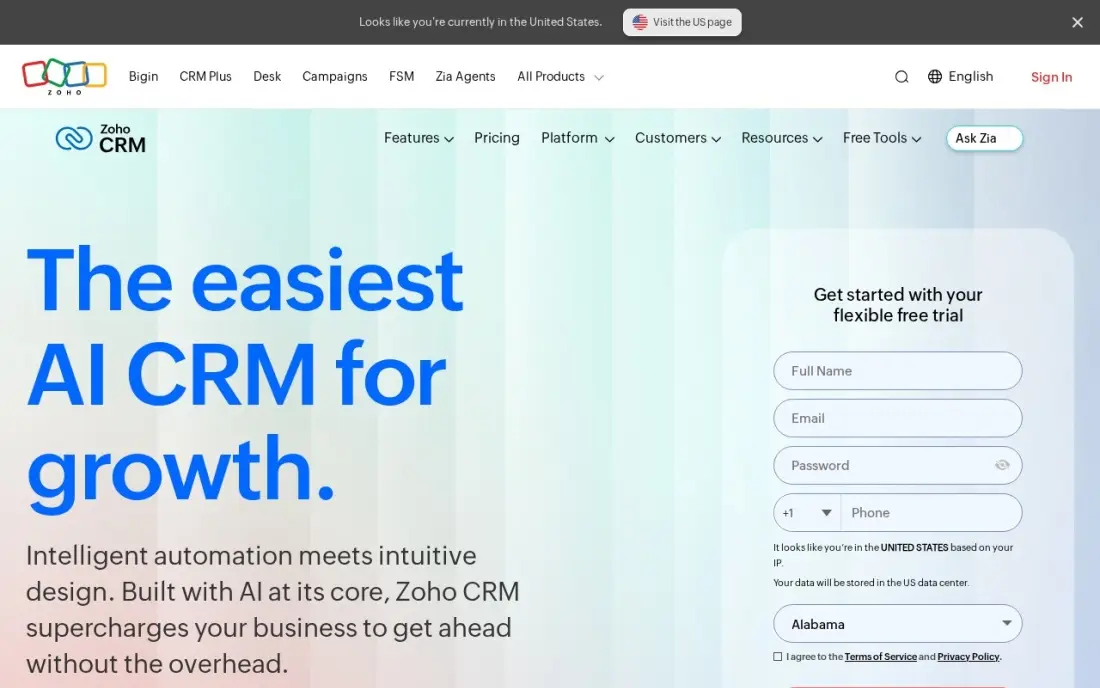
Zoho CRM is the value pick because the free plan covers three users and the first paid plan is the cheapest full-featured CRM here: Standard costs $14 a user a month billed annually, or $20 billed monthly, and includes email integration, mass email, built-in calling, up to five pipelines, sales forecasting and custom modules. A five-person team pays $840 a year on annual billing.
The trade-off is the learning curve. The interface packs in more than Pipedrive or Freshsales, so setup takes longer, and the AI assistant Zia waits for Enterprise at $40 a user a month. Support is the most common complaint in reviews. Choose Zoho CRM when you want the most features per dollar and already use other Zoho apps; choose Pipedrive when a simpler screen matters more than a longer feature list.
What we like
- A genuinely free plan for up to 3 users, with paid plans from $14 a user a month billed annually
- The deepest feature set at the entry price: workflows, custom modules and forecasting on Standard
- Part of the huge Zoho ecosystem, so Desk, Campaigns and Books connect without third-party tools
- Five pipelines, mass email and built-in calling included on Standard
Watch out for
- Zia AI features wait for Enterprise at $40 a user a month, not Standard
- The interface is dense and takes longer to learn than Pipedrive or Freshsales
- Support quality is the most common complaint in reviews, and setup help costs extra

Freshsales
Best for: Small teams that want built-in phone, email and chat from the cheapest paid plan
Freshsales is the cheapest way into a CRM that already includes the phone. Growth costs $9 a user a month billed annually, or $11 billed monthly, and includes a Kanban pipeline, contact lifecycle stages, built-in chat, email and phone, plus basic workflows. A five-person team pays $540 a year on annual billing, the lowest paid total in this list.
The limits sit one tier up. Contact scoring, deal insights and sales sequences need Pro at $39 a user a month, and the Freddy AI Agent is a separate add-on at $49 per 100 sessions. The free plan covers up to three users, though some guides report it as retired, so confirm it at signup. Pick Freshsales when calls and emails are the daily work; pick Zoho CRM when you need deeper automation at the entry price.
What we like
- The cheapest paid plan here: Growth at $9 a user a month billed annually
- Built-in phone, email and chat on Growth, so reps stop switching between tools
- Kanban pipeline, lifecycle stages and basic workflows included from the first paid plan
- No onboarding fee on any plan, and a 21-day trial of the full product
Watch out for
- Contact scoring, deal insights and sales sequences wait for Pro at $39 a user a month
- Freddy AI Agent is a paid add-on at $49 per 100 sessions, not included in the plan price
- The free plan is small, and some guides report it as retired, so check at signup

Pipedrive
Best for: Sales teams that want the clearest visual pipeline and the fastest setup
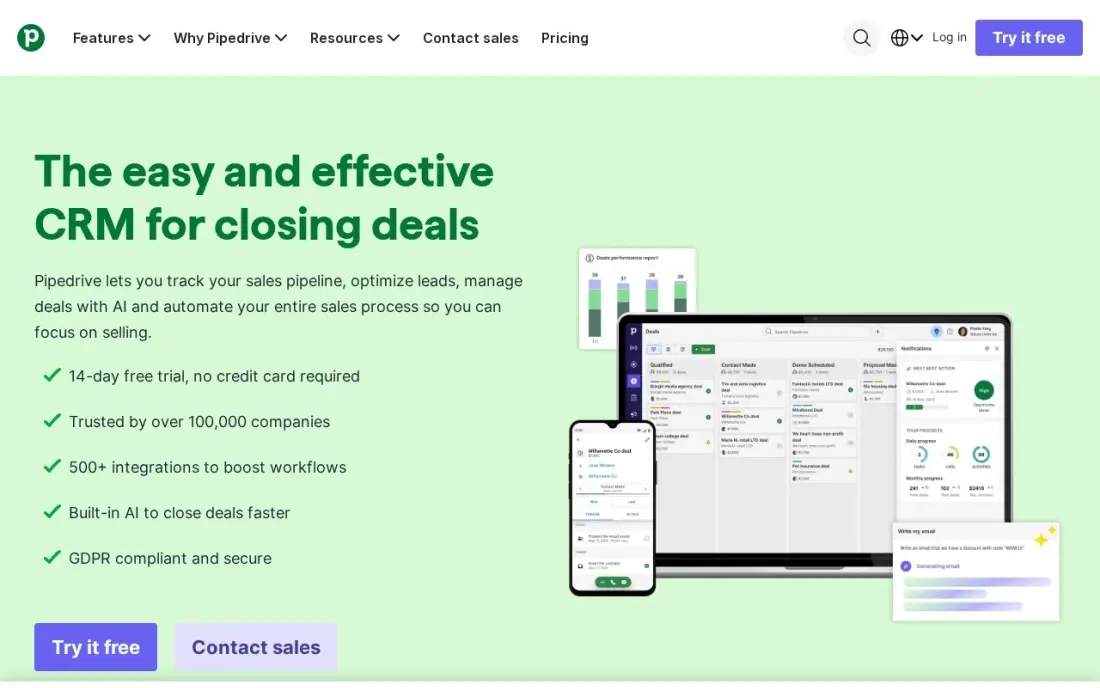
Pipedrive is built around one job: moving deals through a visual pipeline. Lite costs $14 a user a month billed annually, or $24 billed monthly, and covers pipeline views, contact and deal tracking, email integration and mobile access. Reps learn it in a day because the board is the product, and more than 500 integrations connect it to the tools a small team already uses.
The catch is what Lite leaves out. Workflow automation is limited, revenue forecasting waits for Premium at $59 a user a month, and lead capture and enrichment are paid add-ons. There is no free plan, only a 14-day trial. Choose Pipedrive when the pipeline is the whole job; choose HubSpot when you also need marketing and service in the same database.
What we like
- The clearest visual pipeline in this list, with drag-and-drop deals reps learn in a day
- Lite includes email integration, contact and deal tracking and mobile access from $14
- More than 500 integrations on the entry plan, so it plugs into the tools you already use
- No free-plan trap: the price you see is the price, with no user-count surprise
Watch out for
- No free plan, only a 14-day trial, so the meter starts running immediately
- Workflow automation is limited on Lite, and forecasting waits for Premium at $59
- Lead capture and enrichment are paid add-ons, so the real cost grows past the headline price

Monday Sales CRM
Best for: Visual teams that run sales on boards and want a CRM that bends to their process
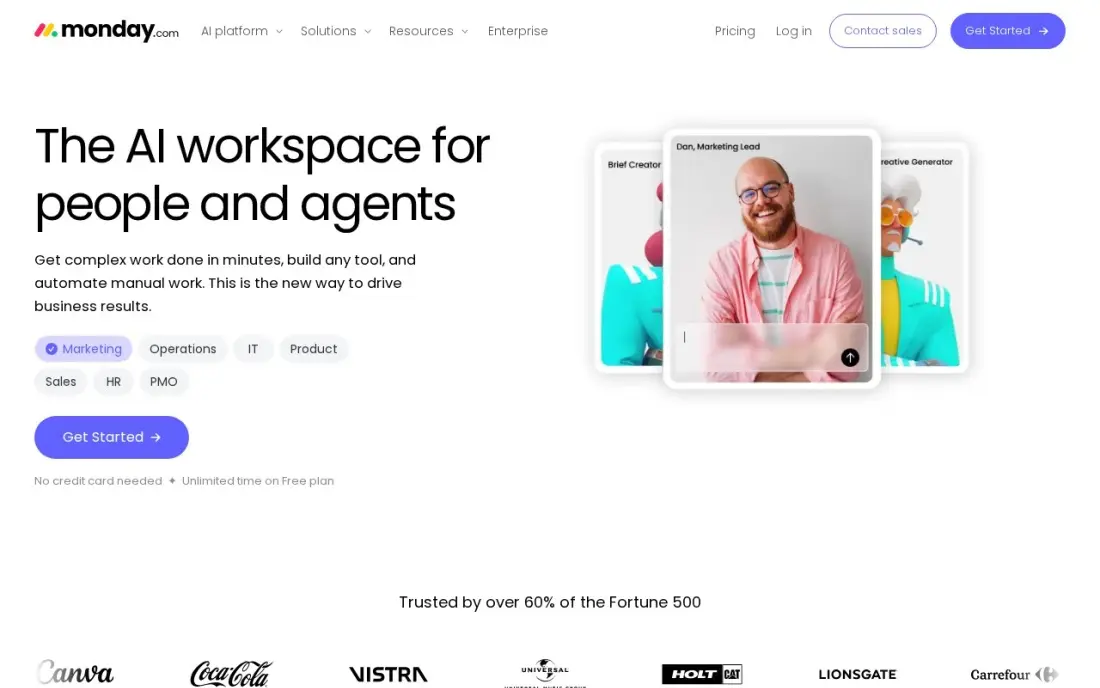
Monday Sales CRM turns the pipeline into boards, where deals move as cards across columns and the whole team can see the state of play. Basic costs $12 a seat a month billed annually, or $18 billed monthly, and includes 1,000 active contacts and deals, one dashboard and 20 quotes or invoices a month. It suits teams with unusual processes because columns and statuses bend without code.
Price the seat rule first. Paid plans start at three seats, so a solo founder pays $432 a year for Basic, and custom automations wait for Standard at $17 a seat a month. There is no free plan, only a 14-day trial, and yearly plans are paid upfront. Pick monday CRM when the team thinks in boards; pick Pipedrive when you want a purpose-built sales pipeline instead of a flexible work platform.
What we like
- Boards, timelines and Kanban views make the pipeline visible at a glance
- Basic includes 1,000 active contacts and deals, quotes and invoices, and a custom dashboard
- Columns, statuses and automations bend to unusual sales processes without code
- The same platform runs projects, so sales and delivery can share one workspace
Watch out for
- Paid plans start at 3 seats, so a solo founder pays for three seats at $432 a year
- Custom automations wait for Standard at $17 a seat a month, not Basic
- No free plan beyond the 14-day trial, and yearly plans are paid in one upfront installment

Salesforce
Best for: Growing businesses that want the deepest CRM ecosystem and plan to scale
Salesforce is the category definer, and the Starter Suite at $25 a user a month is its answer to small businesses that assumed it was out of reach. It covers lead, account, contact and opportunity management, built-in sales flows, lead routing, email syncing and email marketing, with Slack included at no extra cost. A Free Suite covers up to two users at $0.
The price ladder is the steepest here. Pro Suite costs $100 a user a month billed annually, four times Starter, and API access adds another $25 a user a month. Agentforce for Sales starts at $125 a user a month on top. Choose Salesforce when the business plans to scale into the deepest ecosystem; choose HubSpot or Zoho CRM when a gentler ladder matters more than depth.
What we like
- The deepest CRM ecosystem here, with the widest app marketplace and the most integrations
- Starter Suite covers leads, accounts, contacts, opportunities and email marketing in one price
- The only plan in this list payable monthly all the way up the ladder, starting at $25
- Free Suite gives two users a working CRM at $0 before any payment
Watch out for
- The jump to Pro Suite quadruples the price to $100 a user a month, billed annually
- API access costs an extra $25 a user a month, and AI features are paid add-ons
- Setup and customization take longer than any other tool here, and most teams need help

Capsule
Best for: Small teams that sell on relationships and want a simple contact-first CRM
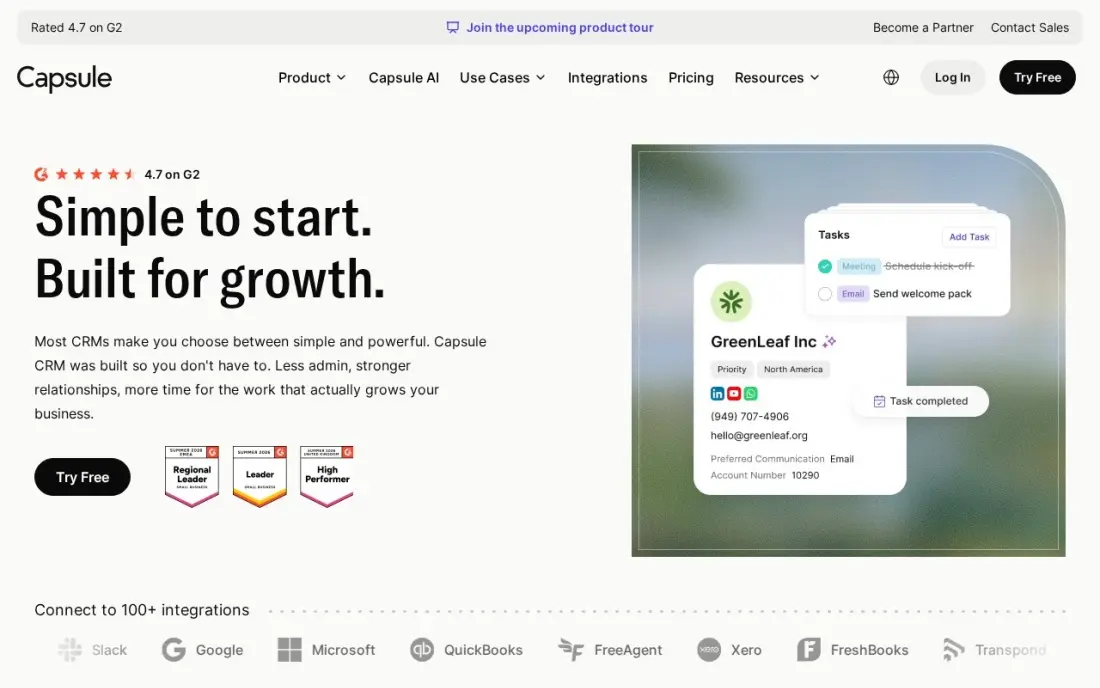
Capsule is built for small businesses that sell on relationships. It is contact-first rather than deal-first, so every client, prospect and referrer carries a rich history of tasks, notes and files. The free plan covers 2 users and 250 contacts at $0, and Starter costs $18 a user a month billed annually, or $22 billed monthly, raising the limit to 30,000 contacts with email templates and a shared mailbox.
The honest catch is that Starter is a tidy shared contact book, not a working sales machine: workflow automations, a second pipeline and two-way email sync all wait for Growth at $36 a user a month. The free plan's 250 contacts run out fast. Pick Capsule when relationships are the business; pick Pipedrive when the pipeline, not the contact record, is the centre of the work.
What we like
- A genuinely free plan for 2 users, with 250 contacts and a sales pipeline at $0
- Contact-first design keeps a rich history of every client, prospect and referrer
- Starter raises the contact limit to 30,000 and adds email templates and a shared mailbox
- Premium integrations such as Xero and Zendesk included from Starter
Watch out for
- Workflow automations and a second pipeline wait for Growth at $36 a user a month
- The free plan's 250-contact cap is small, so most teams pay within months
- AI tools beyond the pipeline generator wait for Growth, not Starter

Less Annoying CRM
Best for: Tiny teams that want one flat price, every feature included, and no pricing games
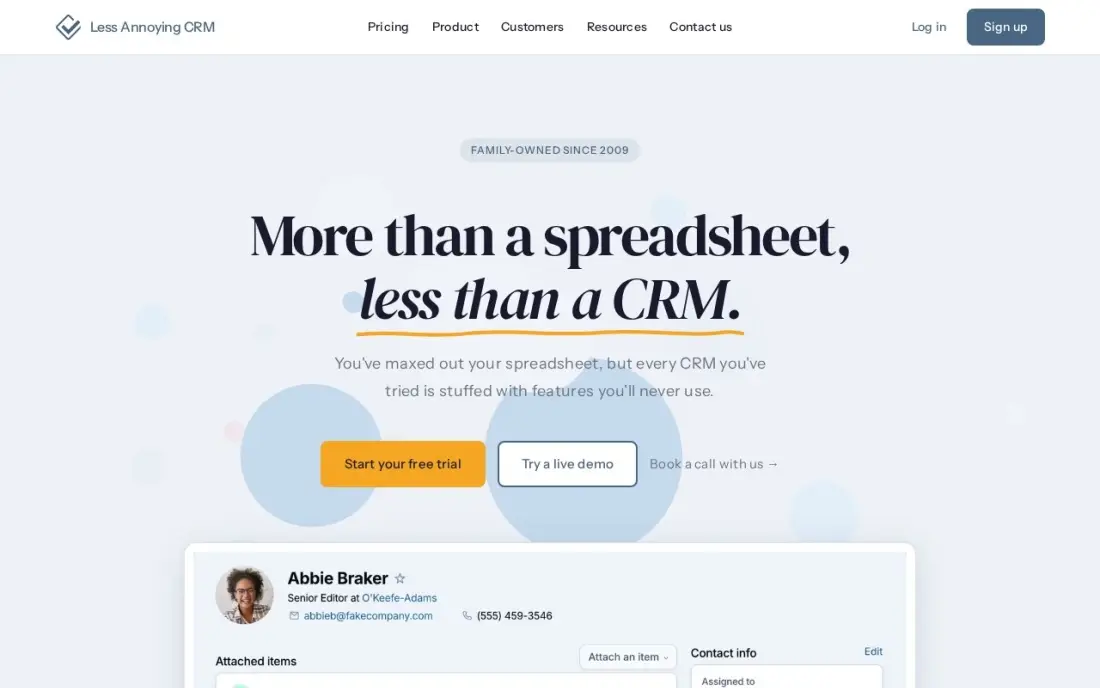
Less Annoying CRM does exactly what the name promises. One plan, $15 a user a month, no tiers, no contracts, no upsells, and every feature the company makes is included from day one: unlimited contacts, companies and pipelines, task management, email logging, mobile access and 25GB of file storage per user. The 30-day trial needs no credit card.
What you do not get is automation of any kind: no drip campaigns, no lead scoring, no workflow builder, no AI, and you cannot send emails or make calls from inside the CRM. The integration list is thin. Pick Less Annoying CRM when you want a plain, cheap place to keep contacts and follow-ups; pick Freshsales when the team needs the CRM to chase leads on its own.
What we like
- One plan at $15 a user a month, with every feature included and nothing locked behind an upgrade
- Unlimited contacts, companies and pipelines, with 25GB of file storage per user
- Free phone support from real humans, included in the price
- No contracts and no annual lock-in: the price is the same every month
Watch out for
- No workflow automation, email sequences or AI features at any price
- No built-in calling and no way to send emails from inside the CRM
- The integration list is thin, with no Gmail integration by name

Close
Best for: Outbound sales teams that live on the phone and want calling built into the CRM
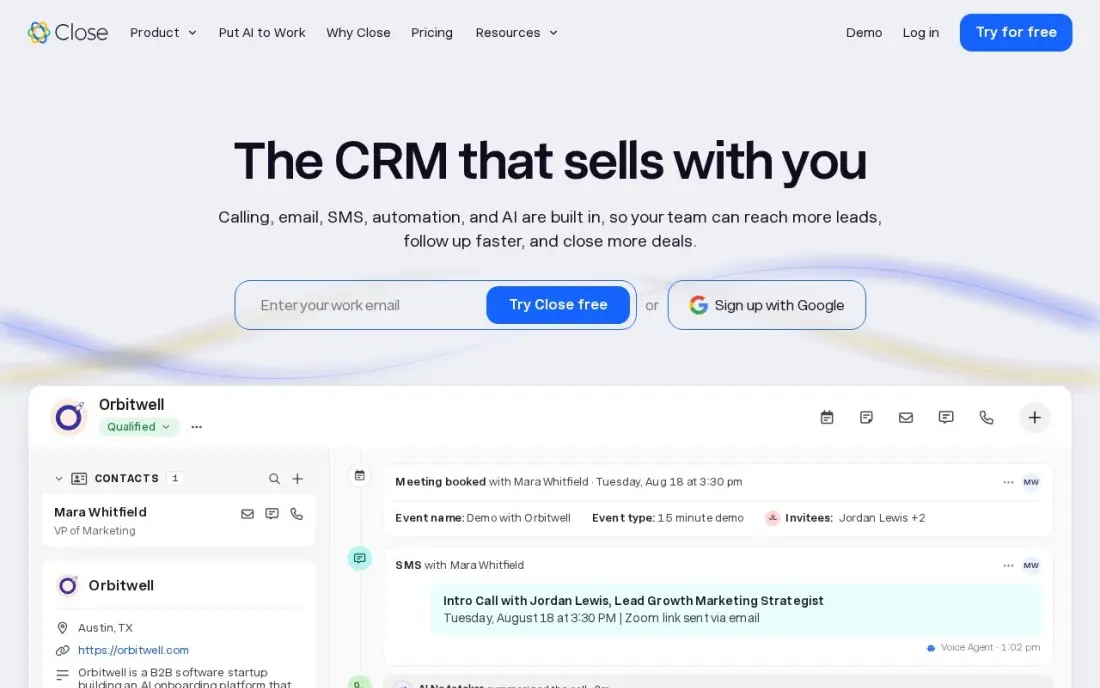
Close is a sales dialer with a CRM attached, built for teams that live on the phone. Solo costs $9 a user a month billed annually, or $19 billed monthly, for one user with calling, email, SMS and a pipeline, plus 500 AI credits a month. A team moves to Essentials at $35 a month flat, which covers unlimited leads with SMS included.
The real cost depends on how much you call. Outbound calling is billed by usage at about $0.02 a minute on top of the plan, and the Power Dialer and workflows that make Close worth buying wait for Growth at $99 a user a month billed annually. Choose Close when the phone is the main sales tool; choose Pipedrive when the team sells by email and meetings instead.
What we like
- Calling, SMS and email built into every plan, so there is no separate dialer to buy
- Solo starts at $9 a user a month billed annually, the joint-cheapest entry here
- Rated 4.7 out of 5 on G2, the joint-highest score in this list
- 14-day trial with no credit card required, and month-to-month billing available
Watch out for
- Solo covers one user only, so a team needs Essentials at $35 a month flat
- Power Dialer and workflows wait for Growth at $99 a user a month billed annually
- Calling is billed by usage on top of the plan, so heavy dialers pay much more than the headline price

Insightly
Best for: Small businesses where the sale is only half the job and delivery lives in the same system
Insightly earns its place by linking projects to sales: when a deal closes, the delivery project, tasks and milestones live in the same system, which suits agencies, consultants and contractors who sell a project and then deliver it. Plus costs $29 a user a month billed annually and includes 100,000 records, 10GB of storage, 2,500 mass emails a day and advanced reports.
The entry plan is honest but thin. Plus has no workflow automation, no lead assignment and no AI Copilot; those wait for Professional at $49 a user a month. There is no free plan, only a 14-day trial, and Insightly publishes no monthly-billing price. Pick Insightly when delivery follows the sale; pick Capsule or Pipedrive when the sale itself is the whole job.
What we like
- Native project management on every plan, so a won deal becomes a delivery project in the same system
- Plus includes 100,000 records, 10GB of storage and 2,500 mass emails a day
- Advanced reports and pre-built dashboards included from the entry plan
- A stable price: the same $29, $49 and $99 ladder has held for more than two years
Watch out for
- No workflow automation on Plus, so the entry plan is a contact database with a pipeline
- No free plan, and Insightly publishes no monthly-billing price, only annual
- AppConnect integrations cost from $249 a month plus a $3,000 setup fee on top
The best crm for small business is the one your team actually opens every day: it keeps every lead, conversation and deal in one place, reminds you to follow up, and shows what is likely to close this month. We ranked the ten tools below by fit for the most common buyer — a US small business with one to ten people selling by phone, email and meetings — starting with the free plans and ending with the calling-first and project-linked options, and every price was checked on the vendor's own pricing page on November 12, 2026.
How to choose the best crm for small business
- Count your users first. Every tool here except Close Essentials and Less Annoying CRM charges per seat, so multiply the sticker price by your headcount: monday CRM starts at 3 seats, Close Solo covers one user only, and HubSpot is free for 2 users.
- Count your contacts next. Capsule's free plan stops at 250 contacts, HubSpot's at 1,000, and Zoho CRM's free plan has no stated contact cap but only 3 users. The cap you hit first is your real starting price.
- Check where automation lives. Insightly Plus has no workflow automation, Close holds the Power Dialer for Growth at $99 a user a month, and monday CRM holds custom automations for Standard at $17 a seat a month.
- Decide whether calling is built in. Freshsales and Close include the phone from the first paid plan; the others need a separate dialer or a paid add-on, and Close bills calls by usage on top.
- Think about what happens after the sale. Insightly turns a won deal into a delivery project in the same system, Salesforce scales into the deepest ecosystem, and HubSpot shares one database across sales, marketing and service.
A CRM is one system in your stack, not the whole stack. If the business also needs to be found online, our guide to marketing platforms for small business SEO covers the visibility side. And before you publish new pages for the services you sell, run your titles through the free SERP snippet preview tool — it shows exactly how the title and description will look in Google.
Whatever you shortlist, try it with real data before you pay. The free plans and trials in this list are long enough to run one genuine month — your contacts, your pipeline, your follow-ups — and that month tells you more than any review can. Check two things in the trial: that importing your contacts keeps owners and stages intact, and that the mobile app is fast enough for the rep who lives on the road. Every tool here offers a free plan or a trial of at least 14 days, so there is no reason to buy before the team has used it.
CRM for small business pricing: what you will actually pay
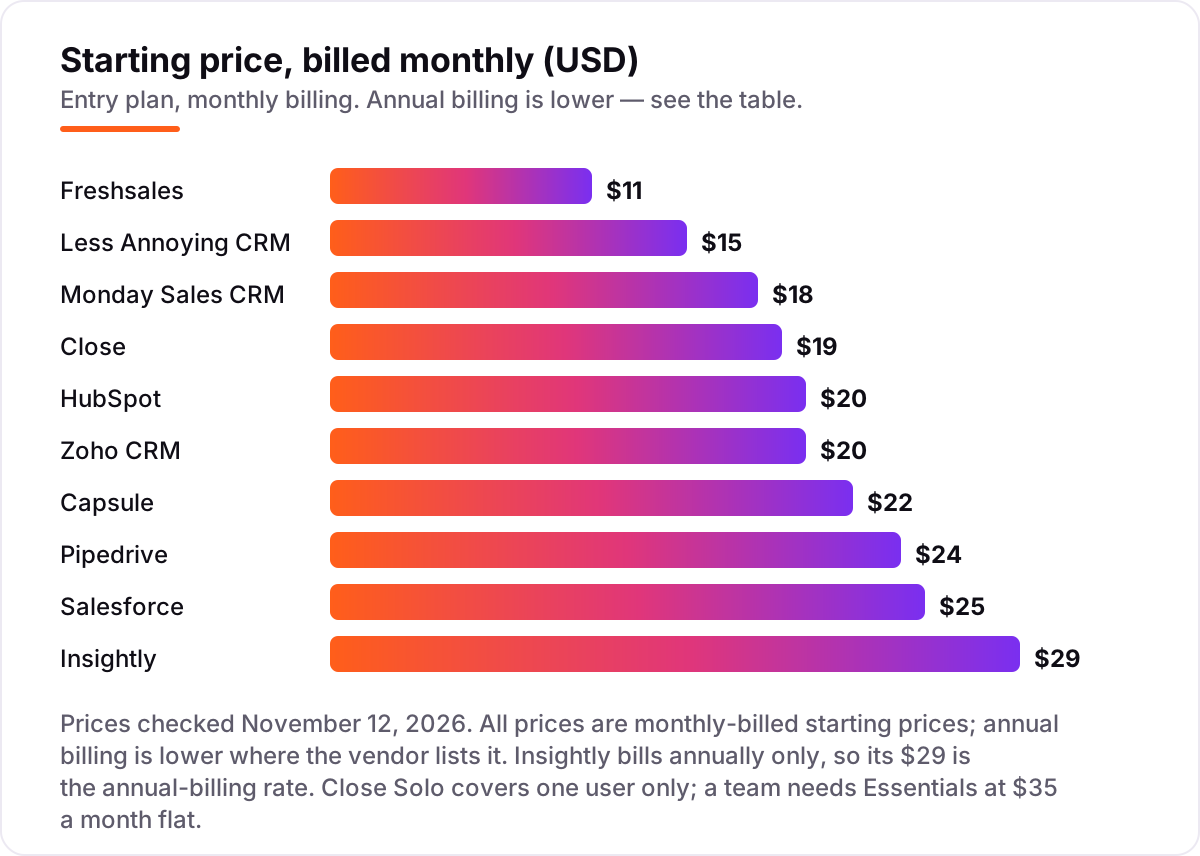
Take a five-person sales team. On annual-billing prices, the subscription costs $420 a year on Close Essentials at $35 a month flat, $540 on Freshsales Growth, $720 on monday CRM Basic, $840 on Zoho CRM Standard or Pipedrive Lite, $900 on Less Annoying CRM, $1,080 on Capsule Starter, $1,200 on HubSpot Starter at the $20 list price, $1,500 on Salesforce Starter Suite and $1,740 on Insightly Plus. The same five people cost $420 a year at the cheap end and $1,740 at the dear end — a $1,320 gap that comes entirely from per-seat pricing and plan limits, not from features.
Two of those numbers need adjusting before they are real. First, HubSpot's free CRM covers two users, so a two-person team pays $0 on HubSpot, Zoho CRM or Capsule, and the five-person HubSpot bill drops to $420 in year one if the new-customer $7 a seat annual promo applies. Second, Close Essentials has no workflows or Power Dialer, so a team that actually dials all day needs Growth at $99 a user a month billed annually, or $5,940 a year for five users, plus usage-based calling at about $0.02 a minute.
Three costs sit outside every number above. First, the introductory discounts — $7 a seat on HubSpot Starter for new customers — end, so budget on the list price. Second, onboarding: HubSpot Professional charges a required $1,500, Insightly's AppConnect integrations start at $249 a month plus a $3,000 setup fee, and Salesforce implementation usually needs paid help. Third, the AI add-ons: Freshsales charges $49 per 100 Freddy AI Agent sessions, and Salesforce's Agentforce for Sales starts at $125 a user a month. If you want the wider comparison before deciding, our guide to CRM software covers the whole category.
Annual billing cuts the bill on most tools here: Zoho CRM Standard drops from $1,200 to $840 a year for five users, Freshsales Growth from $660 to $540, Pipedrive Lite from $1,440 to $840, and Capsule Starter from $1,320 to $1,080. Less Annoying CRM has no annual plan, so $900 is the whole story, and Insightly publishes no monthly price at all. One more cost to check before you commit: a second business is a second subscription on every tool in this list, so an owner with two businesses pays double whatever the chart shows.
Know the difference: a CRM vs a contact list
The confusion in this category is between a place to store names and a system that moves deals forward. A contact list holds names, numbers and notes; a CRM logs every call, email and meeting against the contact, reminds you to follow up, moves deals through a pipeline and shows what is likely to close this month. A spreadsheet can hold 100 contacts, but it will not tell you who to call today, and it will not warn you that a deal has sat untouched for two weeks.
There is a second, quieter confusion: email marketing tools are not CRMs. An email tool sends campaigns to a list; it does not track who replied, who booked a call, or which deal stalled after the demo. HubSpot blurs the line because its marketing and sales tools share one database, but a standalone email tool belongs in a different list. All ten tools here track deals through a pipeline, which is what the phrase "CRM" means here.
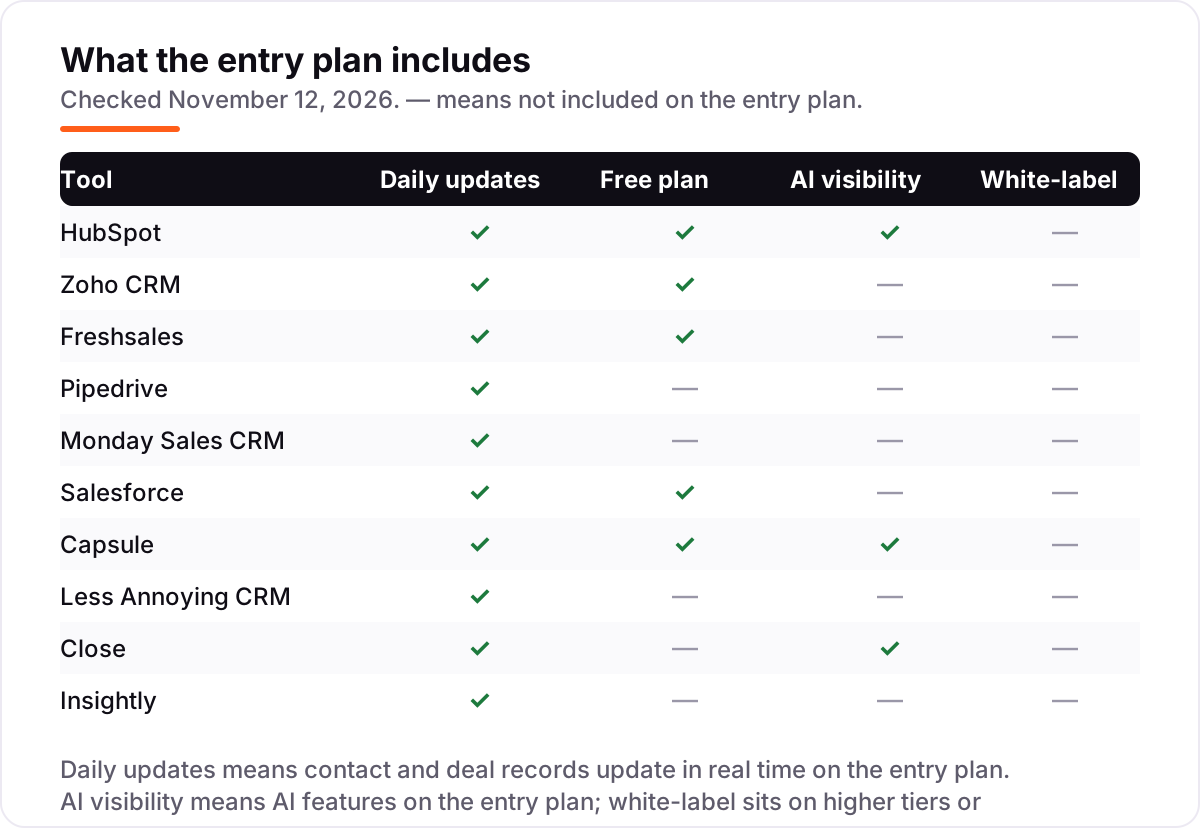
A third distinction worth knowing is a free plan versus a free trial. HubSpot, Zoho CRM, Salesforce and Capsule have free plans you can use forever within their caps; Pipedrive, monday CRM, Less Annoying CRM, Close and Insightly offer trials of 14 to 30 days and then require payment. A trial is a deadline, not a plan, so a team that needs months to decide should start on a free plan and move to a trial only when it is ready to buy.
Quick comparison: tool type by need
| Buyer | Best pick | Why |
|---|---|---|
| Solo founder on a budget | Freshsales | Growth is $9 a user a month billed annually, with phone built in |
| Most small businesses | HubSpot | Free CRM for 2 users, then Starter at $20 a seat a month |
| Best value with a free plan | Zoho CRM | Free for 3 users, Standard is $14 a user a month billed annually |
| Team that thinks in boards | Monday Sales CRM | Visual boards from $12 a seat a month billed annually, 3-seat minimum |
| Calling-first sales team | Close | Dialer built in from $9 a user a month billed annually on Solo |
| Sale-to-project handoff | Insightly | Projects built in, Plus is $29 a user a month billed annually |
| Simplest flat price | Less Annoying CRM | One plan, $15 a user a month, everything included |
Mistakes to avoid
- Budgeting on the promo price. HubSpot's $7 a seat Starter promo is for new customers on annual billing. The list price is $20 a seat, so compare tools on that number.
- Buying on the free plan, then finding the contact cap. Capsule's free plan stops at 250 contacts and HubSpot's at 1,000. If your list is bigger than the cap, count the first paid plan in the price from day one.
- Ignoring the tier where automation lives. A tool can be cheap and still be the wrong buy: Insightly Plus at $29 has no workflow automation, and Close Solo at $9 has no Power Dialer.
- Forgetting the seat minimum. monday CRM starts at 3 seats and Close Solo covers one user only. A solo founder pays $432 a year for monday CRM Basic, not $144.
- Pricing the plan and forgetting the calls. Close bills outbound calls by usage, Freshsales sells its AI agent by the session, and Salesforce charges extra for API access. Price the usage, not just the seat.
How we chose
We verified every price against the vendor's own pricing page as read in fresh search-index copies and independent October–November 2026 reads, with at least two sources agreeing on each figure, because the page-fetch tool was down on November 12, 2026; where a figure differed between reads — Pipedrive's monthly-billing price is $24 in one read and $21 in another — we show the figure from the vendor's own pricing page as read on November 2, 2026. Ratings come from fresh search-index copies of G2 comparison pages: HubSpot Sales Hub 4.4 out of 5 from 13,909 reviews, Zoho CRM 4.1 from 2,947, Freshsales 4.5 from 1,236, Close 4.7 from 2,069 and Insightly 4.2 from 945. Pipedrive, monday CRM, Salesforce, Capsule and Less Annoying CRM carry no rating because no fresh G2 copy with a score and count was available for them, and we would rather show no rating than a stale one. Freshsales' free plan is shown as available for up to 3 users per Freshworks' own comparison table checked November 3, 2026, though some guides report it as retired. We ranked the tools by fit for the most common buyer — a US small business with one to ten people — not by brand size. No vendor paid for a place in this list, and none of the links here are affiliate links.
What to do next
Start with the free plan or trial of your top pick and run one real month of deals through it. Check that importing your contacts keeps owners and stages intact, that the mobile app is fast enough for the road, and that the plan you bought actually includes the automation you need. If the CRM is sorted but new customers are not finding you, our monthly SEO service handles the visibility side — or compare providers in our guide to SEO companies for small business. Once your tools are in place, find out what's holding your rankings back.
Frequently asked questions
What is the best CRM for a small business?
HubSpot is the best fit for most small businesses: the free CRM covers 2 users and 1,000 contacts, and Starter costs $20 a seat a month. Zoho CRM is the better value pick with a free plan for 3 users, and Freshsales is the cheapest paid plan at $9 a user a month billed annually.
How much does a CRM for a small business cost?
Entry prices run from $0 to $29 a user a month. Four tools here have free plans, and the first paid plans cost $9–$25 a user a month. A five-person team typically pays $420–$1,740 a year for the subscription alone, before calling usage, onboarding fees and add-ons.
Is there a really free CRM for a small business?
Yes, with limits. HubSpot is free for 2 users and 1,000 contacts, Zoho CRM is free for 3 users, Salesforce Free Suite covers 2 users, and Capsule is free for 2 users and 250 contacts. All four are real CRMs, not trials, but the contact and user caps push most teams onto a paid plan.
What is the difference between a CRM and a spreadsheet?
A spreadsheet stores rows; a CRM tracks the relationship. A CRM logs every call, email and meeting against the contact, reminds you to follow up, moves deals through a pipeline and shows what is likely to close. A spreadsheet can hold 100 contacts, but it will not tell you who to call today.
Can I switch CRM later?
Yes, but plan the move for a quiet week. Export your contacts, companies, deals and activity history from the old tool, then import them into the new one and check that owners, stages and dates survived the move. Switching mid-quarter means running two systems while deals are live, so finish open deals first where you can.
Do I need a CRM if I only have a few customers?
Yes, once follow-ups start slipping. With under 20 contacts a spreadsheet works, but past that a free CRM such as HubSpot or Zoho CRM keeps every conversation in one place for $0. The cost of a missed follow-up is almost always larger than the cost of the cheapest paid plan.
Sources we checked (14)
- HubSpot Sales Hub pricing — hubspot.com/pricing/sales (checked November 12, 2026)
- Zoho CRM pricing — zoho.com/crm/zohocrm-pricing.html (checked November 12, 2026)
- Freshsales pricing — freshsales.com/pricing (checked November 12, 2026)
- Pipedrive pricing — pipedrive.com/en/pricing (checked November 12, 2026)
- monday Sales CRM pricing — monday.com/crm/pricing (checked November 12, 2026)
- Salesforce Sales Cloud pricing — salesforce.com/editions-pricing/sales-cloud (checked November 12, 2026)
- Capsule pricing — capsulecrm.com/pricing (checked November 12, 2026)
- Less Annoying CRM pricing — lessannoyingcrm.com/pricing (checked November 12, 2026)
- Close pricing — close.com/pricing (checked November 12, 2026)
- Insightly pricing — insightly.com/pricing (checked November 12, 2026)
- G2 HubSpot Sales Hub vs monday CRM comparison — g2.com/compare/hubspot-sales-hub-vs-monday-crm (checked November 12, 2026)
- G2 Pipedrive vs Zoho CRM comparison — g2.com/compare/pipedrive-vs-zoho-crm (checked November 12, 2026)
- G2 Freshsales vs Insightly CRM comparison — g2.com/compare/freshsales-vs-insightly-crm (checked November 12, 2026)
- G2 Close vs HubSpot Sales Hub comparison — g2.com/compare/close-vs-hubspot-sales-hub (checked November 12, 2026)
Make one of these tools?
We re-check this list every quarter. Send a correction, request a review, or ask about a clearly labeled sponsored spot.
Request a listingShamim
Founder of SerpAstra
A full-stack SEO and digital marketer who spends most days on Local SEO for dental practices, AI search visibility and lead generation.
Free SEO and AI visibility audit
Find out what is holding your rankings back
Send us your site. Within 2 business days you get a written audit, an AI visibility check and a short fix list ranked by impact. Free, with no contract attached.
Request my free audit→Related buying guides
 Sales & CRMBest CRM Software for 2026: 11 Options Compared by Use CaseCompare the 11 best CRM software options for 2026 on price, free plans and fit, from free HubSpot to $299 Keap, with every price checked November 12, 2026.Read guide →
 SEO & AI Search Visibility12 Best Marketing Platforms for Small Business SEO in 2026, ComparedThe 12 best marketing platforms for small business SEO, compared on real prices, SEO tools and AI visibility. Every price checked November 1, 2026.Read guide →
 SEO & AI Search Visibility8 Best SEO Companies for Small Business in 20268 best SEO companies for small business compared on price, contracts and AI visibility, with prices checked on each agency's own site on November 1, 2026.Read guide →