8 Best Accounting Software for Ecommerce Business in 2026
Compare the 8 best accounting software for ecommerce business on inventory, sales channels, users and real monthly cost, with prices checked on vendor pages.
 Shamim Mia, Founder, SerpAstraLast verified November 4, 20269 min read
We compare pricing pages, documentation and public reviews. We never accept payment for rankings.

Key takeaways
- QuickBooks Online is the safest choice for most US online stores because most accountants know it, from $38 a month for one user on Simple Start.
- Xero includes unlimited users on every plan from $27 a month, but the Early plan caps you at 20 invoices and 5 bills a month, so most stores land on Growing at $59.
- Zoho Books is free while revenue stays under $50,000 a year, and pairs with Zoho Inventory, which has a free plan for 50 orders a month.
- Once stock across several channels is the hard part, add Cin7 Core from $349 a month; NetSuite is the all-in-one ERP for larger sellers, priced by quote.
On this page
Quick comparison
| Tool | Best for | Starting price | Free plan |
|---|---|---|---|
| QuickBooks Online | US online stores that want the accounting software their accountant already knows | $38/mo | Yes (Free plan) |
| Xero | Online sellers with a bookkeeper or team that want unlimited users at no extra cost | $27/mo | No (30-day trial) |
| Zoho Books | New online stores that want a free ledger now and a cheap upgrade later | $15/mo (annual) | Yes (free plan) |
| Odoo | Growing sellers that want accounting, inventory and the online store in one modular system | $31.10/mo | Yes (One App Free) |
| Wave | Side-hustle sellers with no budget that need real bookkeeping for a small shop | $0 | Yes (free forever) |
| Zoho Inventory | Small multichannel sellers that want order and stock control feeding their books | $29/mo (annual) | Yes (50 orders) |
| Cin7 Core | Growing Shopify and Amazon sellers that need one accurate stock number on every channel | $349/mo | No |
| NetSuite | Larger multi-entity ecommerce brands that want accounting, inventory and orders in one ERP | Custom quote | No |
Make one of these tools?
We re-check this list every quarter. Send a correction, request a review, or ask about a clearly labeled sponsored spot.
Request a listingThe best accounting software for ecommerce businesses

QuickBooks Online
Best for: US online stores that want the accounting software their accountant already knows
QuickBooks Online is the default ledger for American small businesses, and that matters for a store: when sales tax, inventory valuation or year-end questions come up, almost any accountant can open your books. Simple Start costs $38 a month for one user, with invoicing, bills, bank feeds and reporting, and Intuit Intelligence AI features are included rather than held for the top tier.
The caps arrive quickly for a growing store. A second user means Essentials at $85 a month, payroll is a paid add-on, and Intuit raised Essentials, Plus and Advanced again for renewals from August 1, 2026. New customers see 50% off for three months. Choose it when accountant familiarity outweighs a lower price.
What we like
- The software most US accountants already use, so finding help and switching accountants is easy
- Full double-entry accounting with invoicing, bills, bank feeds and reporting on every paid plan
- Customer records, estimates and payment tracking give it the basics of a small CRM
- Intuit Intelligence AI features are included on Simple Start, not held for the top tier
Watch out for
- No real sales pipeline — deals, stages and follow-up automation need a separate CRM
- Hard user caps force upgrades: a second user means Essentials at $85/month, and payroll is a paid add-on
- Price rises most years — Essentials, Plus and Advanced all went up again for renewals from August 1, 2026
Xero
Best for: Online sellers with a bookkeeper or team that want unlimited users at no extra cost

Xero suits an ecommerce business where several people touch the books — an owner, a part-time bookkeeper and an outside accountant — because every plan includes unlimited users at no extra fee. It is full double-entry accounting with bank feeds and sales tax handling, and Early costs $27 a month with a 30-day free trial. There is no annual billing option.
Early is too small for most stores: it caps you at 20 invoices and 5 bills a month, and automatic bank reconciliation costs $5 a month extra on that plan. A store paying suppliers weekly will land on Growing at $59 a month. Xero keeps the books; it does not file tax returns.
What we like
- Unlimited users on every plan with no per-user fee, so an accountant costs nothing extra
- Full double-entry accounting with bank feeds, sales tax and 1099 handling
- Early at $27 a month undercuts QuickBooks Simple Start at $38 for the same job
Watch out for
- Early caps the agent at 20 invoices and 5 bills a month, so most agents land on Growing at $59
- No tax filing — Xero keeps the books and the return is filed elsewhere
- Automatic bank reconciliation costs $5 a month extra on Early

Zoho Books
Best for: New online stores that want a free ledger now and a cheap upgrade later
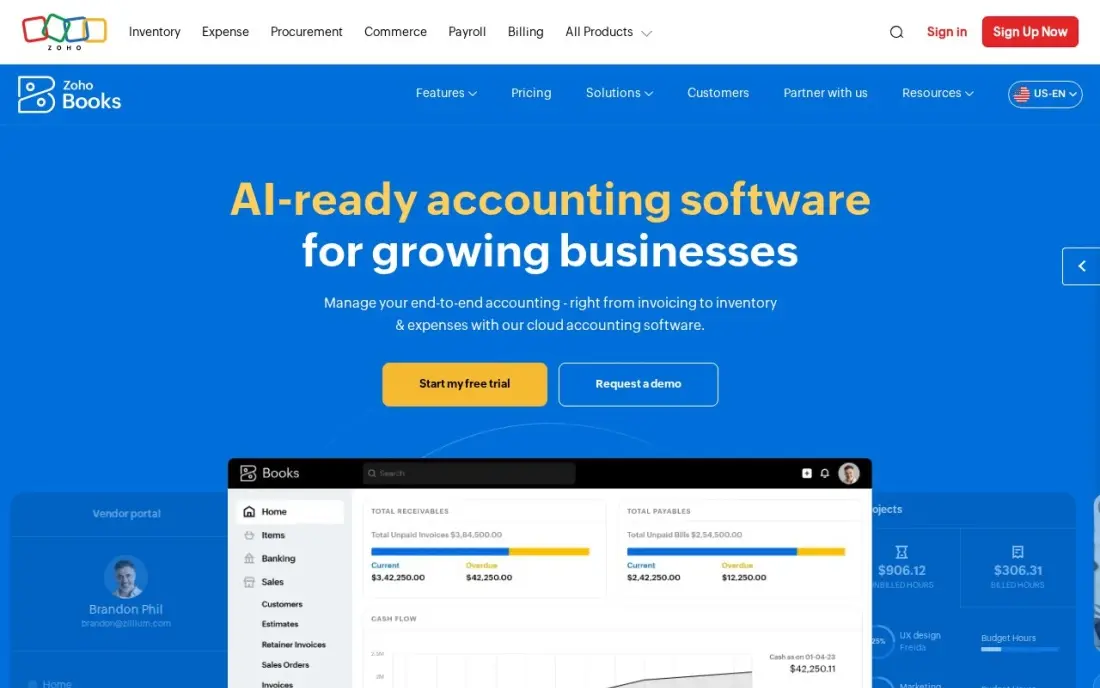
Zoho Books has the most useful free plan for a new store: full double-entry accounting, invoicing and bank reconciliation at $0 while annual revenue stays under $50,000, up to 1,000 invoices a year. Standard costs $15 a month billed annually, or $20 monthly, for three users and 5,000 invoices a year, and it connects to Zoho Inventory without a third-party tool.
The limits matter for ecommerce. Multi-currency and inventory wait for Professional at $50 a month, which a store selling abroad or tracking stock in the ledger will need, and there is no payroll module. Fewer accountants know it than QuickBooks or Xero. It is the best value if you are happy inside the Zoho suite.
What we like
- A real free plan: full double-entry accounting, invoicing and bank reconciliation at $0 while revenue stays under $50,000 a year
- Cheapest paid step up here — Standard is $20/month for 3 users and 5,000 invoices a year
- Deep Zoho ecosystem: CRM, Inventory, Expense and Payroll connect without third-party tools
- Client portal and payment reminders included, so clients can pay from the invoice itself
Watch out for
- Free plan stops at 1,000 invoices a year and only while annual revenue stays under $50,000
- Multi-currency and inventory wait for Professional at $50/month, and there is no payroll module on any plan
- Accountants recommend it less often than QuickBooks Online or Xero, so finding outside help takes more effort

Odoo
Best for: Growing sellers that want accounting, inventory and the online store in one modular system
Odoo is a modular suite where accounting, inventory, sales and an ecommerce storefront are separate apps sharing one database, so an order, its stock movement and its invoice never drift apart. One App Free covers a single app at $0 with unlimited users, and Standard costs $24.90 a user a month billed annually in the first year, with every app, hosting and support included.
Budget year two: the first-year price renews at $31.10 a user a month. Standard runs on Odoo Online only, with no custom modules or external API, and accounting depth varies by country, so check local tax reporting before you move. It suits a store that would rather add modules than connect five tools.
What we like
- CRM and Accounting are two apps inside one system, sharing customers, invoices and payments
- One App Free covers a single app at $0 with unlimited users — the only free accounting entry here
- Standard includes every app, hosting, maintenance and unlimited support in one per-user price
- The modular design means the business adds inventory, projects or e-commerce without re-platforming
Watch out for
- The $24.90 first-year price renews at $31.10 a user a month — budget year two, not year one
- Standard runs on Odoo Online only, with no custom modules and no external API access
- Accounting depth varies by country, so local tax and reporting need checking before buying

Wave
Best for: Side-hustle sellers with no budget that need real bookkeeping for a small shop
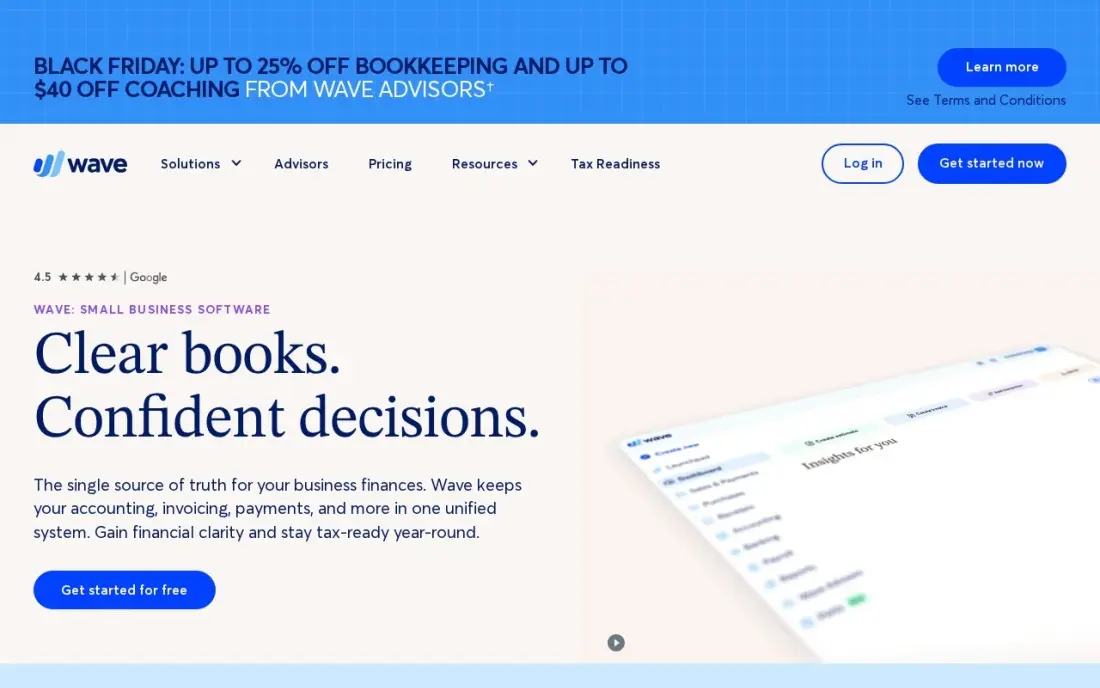
Wave is the zero-cost option for a small online shop: the Starter plan is free forever, with unlimited invoices, estimates, bills and double-entry bookkeeping, and no caps on invoices or bills. Pro at $19 a month adds automatic bank import, unlimited receipt capture and multi-user access. It scores 4.3 on G2.
Wave has no inventory tracking and no built-in payroll on its core plans, so a seller with physical stock records cost of goods by hand or in a separate tool. Card payments on the free plan cost 2.9% plus $0.60 each. It fits a craft or digital seller who needs clean books for tax time, not stock control.
What we like
- Genuinely free core: unlimited invoices, estimates, bills and bookkeeping records at $0
- Pro at $19/month adds bank auto-import, unlimited receipts and multi-user access
- No invoice or bill caps on either plan, unlike the capped entry plans elsewhere
Watch out for
- Automatic bank import, unlimited receipt capture and extra users need Pro at $19/month
- No inventory tracking and no built-in payroll on the core plans
- Card payments cost 2.9% plus $0.60 per transaction on the free Starter plan
Zoho Inventory
Best for: Small multichannel sellers that want order and stock control feeding their books
Zoho Inventory is the stock side that most accounting software lacks: items, orders, purchase orders, composite items and dropshipping, with a free plan for 50 orders a month, one user and one location. Standard costs $29 a month billed annually, or $39 monthly, for 500 orders, three users and two locations, and pricing is per organisation, not per user.
Order caps set the upgrade path — 500 a month on Standard, 3,000 on Premium at $79 — and serial and batch tracking, barcode generation and stock counts sit on Premium or above. Paired with Zoho Books, it gives a small store inventory and accounting from one vendor at a low price.
What we like
- Free plan covers 50 orders a month with item tracking, barcoding and vendor management
- Per-organization pricing, not per-user: adding team members costs nothing extra on any plan
- Standard at $29/month billed annually covers 500 orders, 3 users and 2 locations with composite items and dropshipping
Watch out for
- Order caps force an upgrade at every growth step: 500 orders a month on Standard, 3,000 on Premium
- Serial and batch tracking, barcode generation and stock counting sit on Premium ($79/month) or above
- No free trial of the paid plans beyond the 14-day trial; the free plan is the only way to test long-term

Cin7 Core
Best for: Growing Shopify and Amazon sellers that need one accurate stock number on every channel
Cin7 Core is for the stage when stock, not bookkeeping, is the problem: it keeps one inventory count across Shopify, Amazon and other channels, with unlimited locations on every plan, and posts the results to your accounting software. Standard costs $349 a month, Pro $599 and Advanced $1,199, a rare published price list for a system this deep.
Standard covers five users, two integrations and 6,000 sale orders a year, so a busy store will pay for more volume, and ForesightAI forecasting, the B2B portal and POS are paid add-ons. Pro adds material requirements planning for sellers who assemble what they sell. Pair it with QuickBooks Online or Xero.
What we like
- One published price list for a serious system: Standard $349, Pro $599 and Advanced $1,199 a month
- Unlimited inventory locations on every plan, with native Shopify and Amazon stock sync
- Pro adds material requirements planning for sellers who assemble or make what they sell
Watch out for
- Standard at $349/month covers only 5 users, 2 integrations and 6,000 sale orders a year; volume above that costs more
- ForesightAI forecasting, the B2B portal and POS are paid add-ons, not part of the base plans
- Cin7 Omni, the enterprise product, is quote-only, so larger sellers lose the published-price certainty

NetSuite
Best for: Larger multi-entity ecommerce brands that want accounting, inventory and orders in one ERP
NetSuite puts accounting, CRM, inventory and ecommerce in one database, with multi-entity, multi-currency and multi-subsidiary books for brands selling in several countries. SuiteAnalytics gives real-time reporting across every entity, and Advanced Revenue Management handles complex revenue schedules. It is the system many brands move to after outgrowing QuickBooks plus add-ons.
Everything about it is bigger. Oracle publishes no price list and quotes by users, modules and transaction volume, implementation commonly takes six to twelve months with a partner, and G2 reviewers mention a real learning curve. It holds 4.1 on G2. Consider it once a finance team, not the founder, owns the books.
What we like
- One database for accounting, CRM, inventory and ecommerce, so the subscription, the invoice and the ledger never drift apart
- Advanced Revenue Management handles multi-element arrangements and ASC 606 schedules
- Multi-entity, multi-currency and multi-subsidiary books for SaaS companies selling globally
- SuiteAnalytics and saved searches give real-time reporting across every subsidiary
Watch out for
- No published price list — Oracle quotes every deployment, so two similar companies can pay very different amounts
- Implementation commonly takes 6–12 months, per G2, and usually needs an implementation partner
- Per-user and per-module pricing climbs steeply, and the interface has a real learning curve
The best accounting software for ecommerce business keeps three things in step: the money from every sales channel, the stock you hold and the fees platforms take before payouts reach the bank. We compared eight tools — five ledgers, two inventory systems that feed them and one ERP — on users, inventory, channel handling and the real monthly bill for an online store. This guide also answers the wider question of the best accounting software for e-commerce, and every price below comes from the vendor's own pricing page as checked in November 2026.
How to choose the best accounting software for ecommerce business
- Ask your accountant first. The tool your accountant already uses saves hours at year end; for most US firms that is QuickBooks Online or Xero.
- Decide where inventory lives. Simple stores can track stock in the ledger; multichannel sellers need a dedicated inventory system that posts to the books.
- Count invoices, bills and users. Entry plans cap invoices, bills or seats, and a store paying suppliers weekly outgrows them quickly.
- Plan for payouts, not just sales. Platforms deduct fees, refunds and reserves before paying out, so the books must record gross sales and fees, not just the deposit.
- Check multi-currency. Selling abroad needs multi-currency, which several tools hold back for a higher tier.
- Price year two. Introductory discounts and first-year rates expire, so budget the renewal price.
Clean books show which products and channels make money; growing the profitable ones is a marketing job. Our guide to SEO for ecommerce covers how online stores win organic traffic, and our monthly SEO service does that work for you.
Accounting software for ecommerce businesses pricing: what you will actually pay
Take a small online store with two people in the books and physical stock on one channel. On Zoho Books Standard plus Zoho Inventory Standard, billed annually, that is $15 plus $29 — $44 a month, or $528 a year. On Xero Growing with unlimited users, it is $59 a month, or $708 a year, before any inventory tool. On QuickBooks Online, the second user means Essentials at $85 a month, or $1,020 a year at list price.
At the multichannel stage, the stack changes. Cin7 Core Standard costs $349 a month, or $4,188 a year, on top of the ledger, so QuickBooks Online Essentials plus Cin7 Core runs about $5,208 a year. Odoo can cover accounting and inventory in one system at $24.90 a user a month billed annually in the first year — $597.60 for two users — rising to $31.10 a user at renewal. NetSuite publishes no price; get a written quote that includes implementation.
Know the difference: accounting software vs inventory management software
Accounting software records the money: sales, fees, refunds, supplier bills, payroll and tax, and turns them into a profit and loss, a balance sheet and a tax return. It can hold the value of your stock, but it is not built to know how many units are on which shelf or listing at this minute.
Inventory management software records the goods: quantities by location, purchase orders, bundles, reorder points and stock sync across Shopify, Amazon and other channels. It then posts the cost of goods sold and stock value to the ledger. Small stores can manage with the ledger alone; once you sell the same product in two places, a dedicated inventory tool usually pays for itself in avoided oversells.
Quick comparison: tool type by need
| Buyer | Best pick | Why |
|---|---|---|
| Most US online stores | QuickBooks Online | The ledger accountants know, Simple Start $38/month |
| Teams with a bookkeeper | Xero | Unlimited users on every plan from $27/month |
| New stores on a budget | Zoho Books | Free under $50,000 revenue, Standard $15/month annual |
| All-in-one modular system | Odoo | Accounting, inventory and store apps from $24.90/user/month |
| Side-hustle sellers | Wave | Free forever bookkeeping, Pro $19/month |
| Small multichannel stock | Zoho Inventory | Free for 50 orders/month, Standard $29/month annual |
| Shopify and Amazon at scale | Cin7 Core | One stock count everywhere from $349/month |
| Multi-entity brands | NetSuite | Accounting, inventory and orders in one ERP, by quote |
Mistakes to avoid
- Recording payouts as sales. A deposit net of fees understates revenue and hides what platforms cost you; record gross sales and fees separately.
- Ignoring cost of goods sold. Without COGS, the profit and loss shows revenue, not margin, and you cannot tell which products pay.
- Mixing personal and business accounts. Separate bank and card accounts make reconciliation possible and audits less painful.
- Choosing on the introductory price. First-year and three-month discounts end; compare renewal prices.
- Adding channels before fixing stock sync. A second channel without inventory sync leads to oversells and refunds that the books then have to unpick.
How we chose
We checked each vendor's pricing page in November 2026 and recorded starting prices exactly as shown, with annual and monthly figures where both are listed. We ranked the tools for the most common buyer — an online store with one to ten people selling physical or digital products — and weighed accountant familiarity, users, inventory handling, channel fit and year-two cost. NetSuite publishes no price, so we list it as custom quote. Ratings come from G2 pages checked on the dates shown in the sources. This guide is general information, not accounting or tax advice. No vendor paid for a place in this list, and none of the links here are affiliate links.
What to do next
Ask your accountant which ledger they prefer, open that tool's free plan or trial, and reconcile one month of real store payouts — gross sales, fees and refunds — before you commit. If the books show healthy margins but too few orders, book a free review of your store's search visibility.
Frequently asked questions
What is the best accounting software for an ecommerce business?
QuickBooks Online is the best fit for most US online stores because most accountants know it, from $38 a month. Xero is better when several people need access, with unlimited users from $27 a month, and Zoho Books is the best free option while revenue is under $50,000 a year.
Is there free accounting software for ecommerce?
Yes. Zoho Books is free while annual revenue stays under $50,000, Wave's Starter plan is free forever with unlimited invoices and bills, and Odoo's One App Free covers one app with unlimited users. Wave has no inventory tracking.
Do I need separate inventory software for my online store?
Usually once you sell physical products on more than one channel. Accounting software records the value of stock, but inventory tools such as Zoho Inventory or Cin7 Core keep counts in sync across Shopify, Amazon and other channels and stop overselling.
How much does ecommerce accounting software cost?
On published prices, Wave is free, Zoho Books starts at $15 a month billed annually, Odoo at $24.90 a user in year one, Xero at $27 a month and QuickBooks Online at $38. Adding inventory software costs $29 a month on Zoho Inventory or $349 on Cin7 Core.
What is the best accounting software for e-commerce sellers on Amazon and Shopify?
For multichannel sellers, pair a ledger such as QuickBooks Online or Xero with an inventory system such as Cin7 Core, which syncs stock with Shopify and Amazon natively. Smaller sellers can start with Zoho Books plus Zoho Inventory.
Should an online store use cash or accrual accounting?
Stores that hold inventory usually need accrual accounting so cost of goods sold matches the sales it relates to. Most tools here support both methods; ask your accountant which one your tax situation requires before you set up the books.
Sources we checked (13)
- QuickBooks Online — quickbooks.intuit.com/pricing (checked November 12, 2026)
- Xero — www.xero.com/us/pricing-plans (checked November 10, 2026)
- Xero reviews on G2 (checked November 10, 2026)
- Zoho Books — www.zoho.com/us/books/pricing (checked November 8, 2026)
- Odoo — www.odoo.com/pricing (checked November 12, 2026)
- Wave — www.waveapps.com/pricing (checked November 10, 2026)
- Wave reviews on G2 (checked November 10, 2026)
- Zoho Inventory — www.zoho.com/us/inventory/pricing (checked November 10, 2026)
- Zoho Inventory reviews on G2 (checked November 10, 2026)
- Cin7 Core — www.cin7.com/pricing (checked November 10, 2026)
- Cin7 Core reviews on G2 (checked November 10, 2026)
- NetSuite — www.netsuite.com/portal/products/pricing.shtml (checked November 4, 2026)
- NetSuite reviews on G2 (checked November 4, 2026)
Make one of these tools?
We re-check this list every quarter. Send a correction, request a review, or ask about a clearly labeled sponsored spot.
Request a listingShamim
Founder of SerpAstra
A full-stack SEO and digital marketer who spends most days on Local SEO for dental practices, AI search visibility and lead generation.
Free SEO and AI visibility audit
Find out what is holding your rankings back
Send us your site. Within 2 business days you get a written audit, an AI visibility check and a short fix list ranked by impact. Free, with no contract attached.
Request my free audit→Related buying guides
 Accounting & Finance10 Best Accounting Software for Small Business with Inventory in 2026, Compared10 best accounting software for small business with inventory, compared on price, stock depth and free plans. Prices checked November 2, 2026.Read guide →
 Logistics, Supply Chain & Procurement10 Best Inventory Management Software Small Business in 2026, Compared10 best inventory management software small business picks compared with real 2026 prices, free plans and order limits, so you can choose by volume.Read guide →
 Accounting & Finance11 Best Small Business Accounting Software in 2026, ComparedCompare the 11 best small business accounting software tools on price, free plans, bank feeds and payroll, with every price checked November 4, 2026.Read guide →